
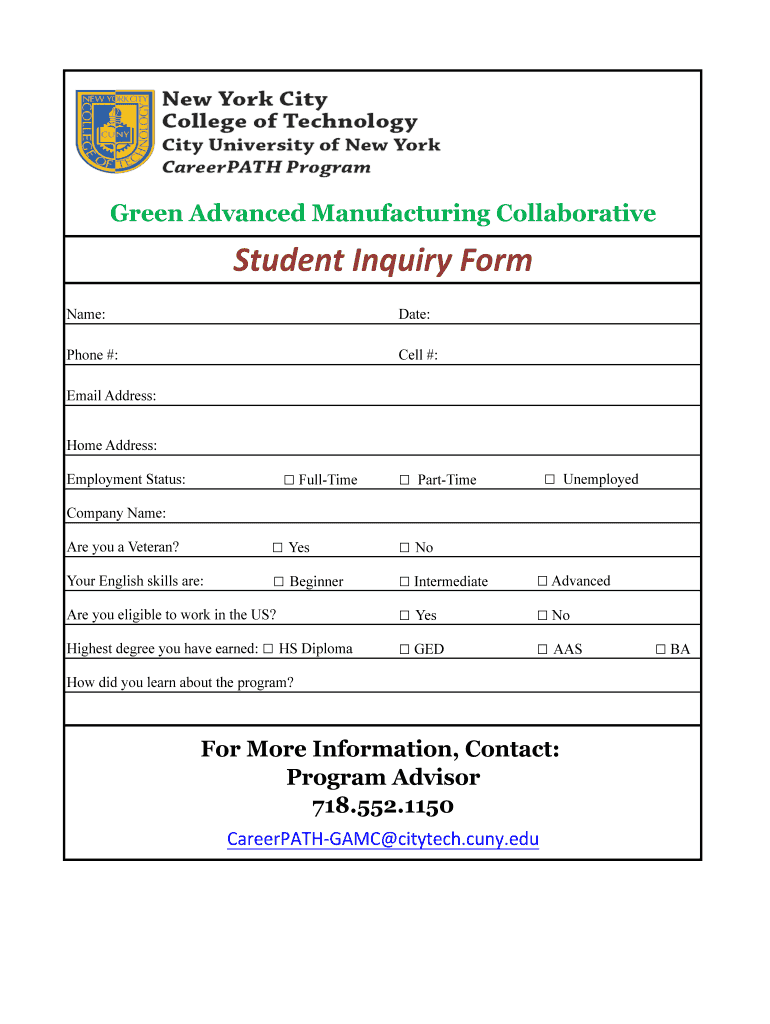







Definition and Purpose of the Student Enquiry Form
The student enquiry form is a crucial document used by educational institutions to gather information from potential students who express interest in enrolling. This form serves several primary purposes:
- Information Collection: It collects essential details such as personal information, educational background, and specific interests related to courses or programs.
- Initial Assessment: The data gathered allows institutions to assess the prospective student's needs and determine their fit for various programs.
- Follow-Up Communication: By providing contact details on the form, prospective students enable schools to reach out with additional information, open days, application processes, and other relevant details.
This form typically includes sections for the student's name, contact details, the program of interest, and basic information about their current educational status.
Steps to Complete the Student Enquiry Form
Filling out the student enquiry form is generally straightforward but requires attention to detail to ensure accurate information is provided. Here are the recommended steps to complete the form effectively:
-
Gather Necessary Information: Collect personal details, such as full name, address, phone number, and email address. Have your current academic details ready, such as last school attended and any relevant qualifications.
-
Select the Courses of Interest: Identify the programs or courses you’re most interested in. This could include multiple selections if the form allows for it.
-
Complete Additional Sections: Fill out any additional sections such as questions on English proficiency, veteran status, or related interests. Be honest and precise in your responses as this information may be used to tailor the communication you receive.
-
Review for Accuracy: Once completed, review the form for any errors or missing information. Ensuring accuracy will facilitate faster responses from the institution.
-
Submit the Form: Follow the provided instructions for submitting the form, whether online or via mail. Make a note of any confirmation messages or emails you receive.
Key Elements of the Student Enquiry Form
Understanding the essential components of the student enquiry form can enhance its effectiveness. Some key elements typically included are:
-
Personal Information Section: This usually involves fields for the applicant's name, address, contact number, and email.
-
Program Selection: A designated area for students to specify their intended program or area of interest helps schools tailor their follow-up.
-
Background Information: Sections asking about the student's previous educational experiences or qualifications can provide context for their application.
-
English Proficiency and Eligibility: Many forms include questions regarding language skills and eligibility requirements, which are critical in assessing prospective students, especially in diverse learning environments.
-
Signature Block: A section where students can date and sign the form may be required to affirm the accuracy of the information provided.
These elements contribute to the form’s functionality, making it easier for educational institutions to process enquiries efficiently.
Digital vs. Paper Versions of the Student Enquiry Form
The student enquiry form can be available in both digital and paper formats, each with its own set of advantages:
-
Digital Version:
- Accessibility: Online forms can be accessed from anywhere, facilitating ease of use for prospective students.
- Quick Submission: Digital forms usually allow for immediate submission, which often results in faster processing by the educational institution.
- Integration with Systems: Many institutions have digital systems in place that automatically process submissions and generate automatic responses.
-
Paper Version:
- Familiarity: Some applicants may prefer traditional paper forms due to comfort or lack of access to technology.
- Physical Record Keeping: A paper copy can be kept for personal records, which some applicants find reassuring.
Educational institutions often provide both options to accommodate a wider range of applicants and their preferences.
Examples of Using the Student Enquiry Form
The student enquiry form finds application in various educational contexts, providing vital insight and information to institutions and prospective students alike. Here are a few typical scenarios:
-
High School Graduates: Students finishing high school often use the enquiry form to express interest in college programs, allowing the institution to provide relevant information on admissions criteria and available courses.
-
Adult Learners: Individuals looking to return to education may use the form to enquire about adult learning programs or professional certifications, enabling schools to tailor information to their unique circumstances.
-
International Students: Prospective students from abroad may utilize the form to inquire about specific admissions processes, visa requirements, and English language support services available to non-native speakers.
By capturing this diverse range of enquiries, educational institutions can enhance their outreach and provide tailored information that meets the needs of prospective students.
Important Terms Related to the Student Enquiry Form
Understanding specific terminology associated with the student enquiry form can aid in completing it effectively and engaging with the admission process. Key terms include:
-
Prospective Student: An individual who is considering enrolling in an educational program but has not yet applied.
-
Curriculum: The subjects comprising a course of study offered by the educational institution; the enquiry form might have sections related to curricular choices.
-
Admission Requirements: Criteria that students must fulfill to be eligible for enrollment in a program, often outlined in the follow-up communications resulting from submission of the enquiry form.
-
Enrollment Process: The series of steps a prospective student must take to officially join a program after expressing interest through the enquiry form.
By familiarizing oneself with these terms, potential applicants can navigate the admission process with greater ease and confidence.


