




Here's how it works

01. Edit your form online
Type text, add images, blackout confidential details, add comments, highlights and more.

02. Sign it in a few clicks
Draw your signature, type it, upload its image, or use your mobile device as a signature pad.

03. Share your form with others
Send it via email, link, or fax. You can also download it, export it or print it out.
How to use or fill out I Office of Clinical Pharmacology and Biopharmaceutics New Drug with our platform

- Click ‘Get Form’ to open the I Office of Clinical Pharmacology and Biopharmaceutics New Drug form in the editor.
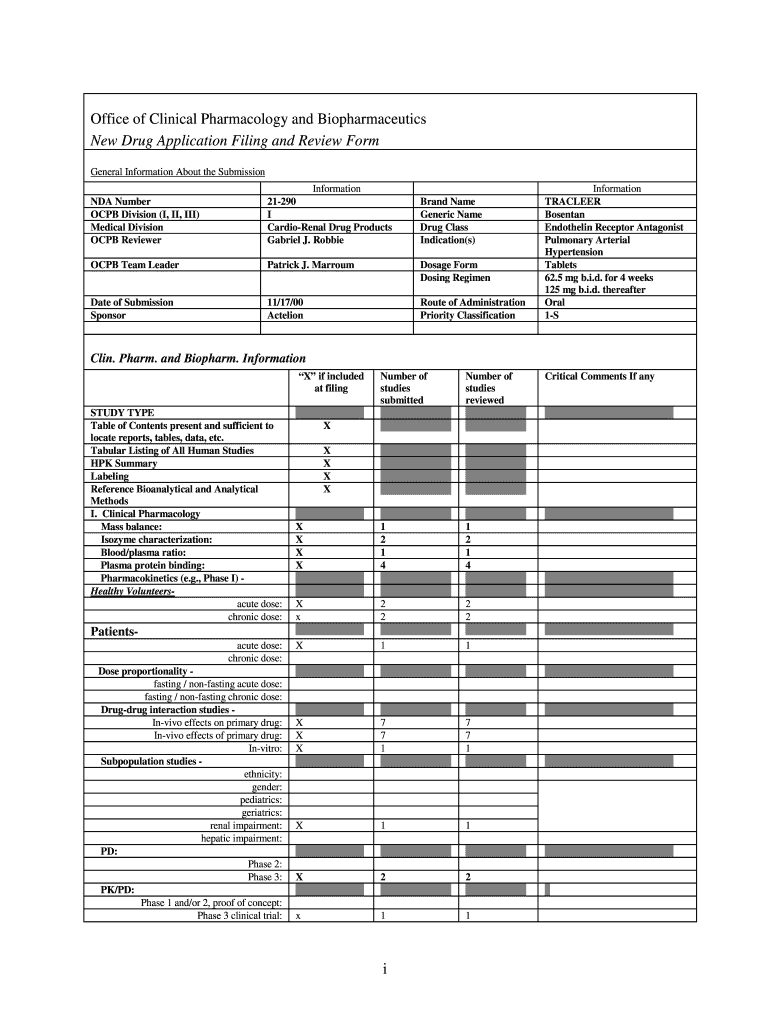
- Begin by filling out the 'General Information About the Submission' section, including NDA Number, OCPB Division, Medical Division, and OCPB Reviewer.
- In the 'Information' section, provide details about the drug such as Brand Name, Generic Name, Drug Class, Indication(s), Dosage Form, Dosing Regimen, Route of Administration, and Priority Classification.
- Complete the 'Clin. Pharm. and Biopharm. Information' section by marking 'X' for included studies at filing and providing details on study types and summaries.
- Fill in any critical comments or questions regarding pharmacokinetics or other relevant information in the designated sections.
- Review all entered information for accuracy before submitting your completed form through our platform.
Start using our platform today to streamline your document editing and submission process for free!
Fill out I Office of Clinical Pharmacology and Biopharmaceutics New Drug online
It's free
It's free
Got questions?
We have answers to the most popular questions from our customers. If you can't find an answer to your question, please contact us.
Contact us
What is drug discovery in clinical research?
In the discovery stage the first step in bringing a new drug to market researchers evaluate compounds to determine which could be candidates for development as medical treatments. The process begins with the identification of a new target molecule, a protein or other molecule involved in the disease process.
What is the FDA new drug submission?
The NDA submission is the culmination of years of drug development, preclinical studies, and clinical trials. It serves as the formal request for FDA approval, providing the data and documentation necessary to demonstrate that a drug product is safe, effective, and can be consistently manufactured to high standards.
What are the 4 stages of drug discovery?
The Drug Discovery Process involves many different stages and series of actions. Typically, it can be divided into four main stages: Early Drug Discovery, Pre-Clinical Phase, Clinical Phases, and Regulatory Approval. Lets explore the major steps that are taken in each of these stages to develop a new drug.
What is the procedure for new drug approval?
The drug approval process requires four phases, which include preclinical investigation, clinical investigation, review of the new drug application, and postmarketing surveillance.
What is the clinical evaluation of a drug?
The objective of clinical investigations is to assess whether a drug is of value in the treatment or prophylaxis of a disease or condition, its risks or undesirable effects, and the relative relationship of these assessments.
Security and compliance
At DocHub, your data security is our priority. We follow HIPAA, SOC2, GDPR, and other standards, so you can work on your documents with confidence.
Learn more


People also ask
What is the FDA supplemental new drug application?
Compilation of information on the safety and efficacy of a marketed drug that is submitted to the FDA in order to request approval to market the drug for another indication.
What is drug discovery and clinical evaluation of drugs?
Drug Discovery and Evaluation has become a more and more difficult, expensive and time-consuming process. The effect of a new compound has to be detected by in vitro and in vivo methods of pharmacology. The activity spectrum and the potency compared to existing drugs have to be determined.
What is drug discovery and clinical evaluation of new drugs?
It involves a series of steps that begins with identifying potential drug targets and end with the approval of a new drug by the Food and Drug Administration (FDA). This can be done through a variety of methods, including studying natural substances, synthesizing new compounds, or modifying existing drugs.