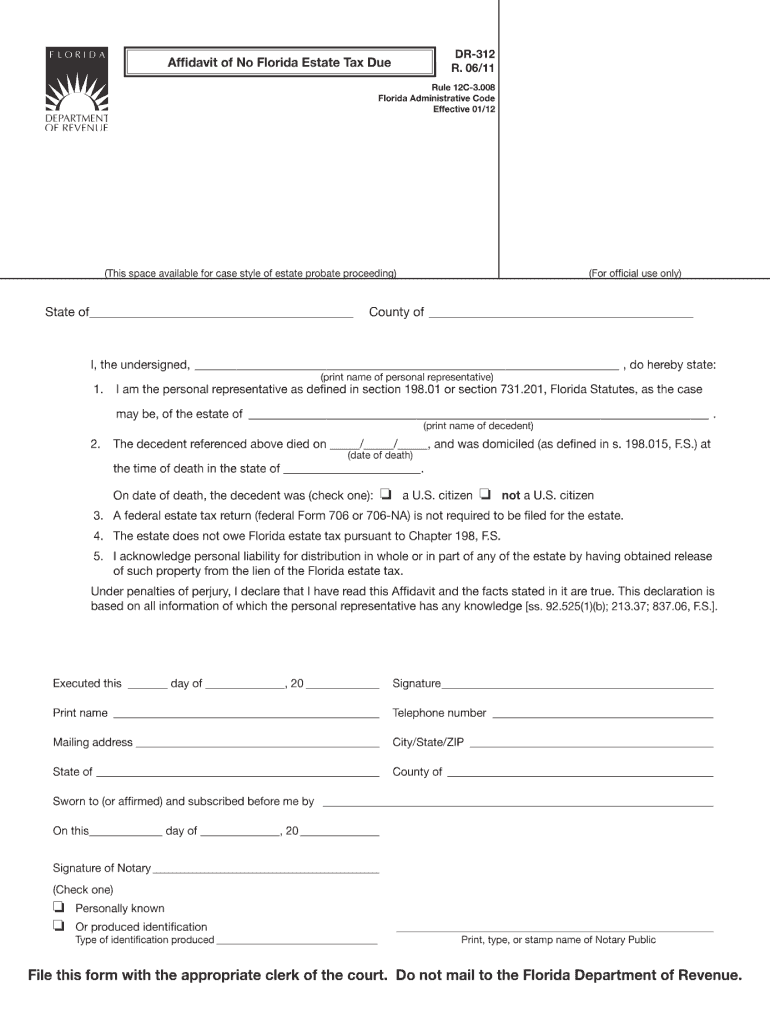
Dr 312 2011 form-2026

Get Form
affidavit of no florida estate tax due fillable form Preview on Page 1

Here's how it works

01. Edit your affidavit of no florida estate tax due fillable form online
Type text, add images, blackout confidential details, add comments, highlights and more.
02. Sign it in a few clicks
Draw your signature, type it, upload its image, or use your mobile device as a signature pad.
03. Share your form with others
Send dr 312 via email, link, or fax. You can also download it, export it or print it out.

How to use or fill out dr 312 2011 form with our platform

Form edit decoration
9.5
Ease of Setup
DocHub User Ratings on G2
9.0
Ease of Use
DocHub User Ratings on G2
  1. Click ‘Get Form’ to open the dr 312 2011 form in the editor.
  2. Begin by entering your personal information in the designated fields, including your name, address, and contact details. Ensure accuracy for effective processing.
  3. Next, navigate to the section that requires specific details about your request. Carefully read each prompt and provide the necessary information as requested.
  4. If there are any checkboxes or options, select those that apply to your situation. This will help clarify your intentions on the form.
  5. Review all entered information for completeness and correctness before finalizing. Use our platform’s editing tools to make any adjustments easily.
  6. Once satisfied with your entries, proceed to sign the document electronically using our signature feature, ensuring a smooth submission process.

Start filling out your dr 312 2011 form online for free today!

See more dr 312 2011 form versions

We've got more versions of the dr 312 2011 form form. Select the right dr 312 2011 form version from the list and start editing it straight away!
Versions Form popularity Fillable & printable
2024 4.8 Satisfied (27 Votes)
2021 4.8 Satisfied (50 Votes)
2013 4.4 Satisfied (546 Votes)
2011 4.3 Satisfied (175 Votes)
be ready to get more

Complete this form in 5 minutes or less

Get form

Got questions?

We have answers to the most popular questions from our customers. If you can't find an answer to your question, please contact us.
Contact us
Most relatively simple estates do not require the filing of an estate tax return. A filing is required for estates with combined gross assets and prior taxable gifts exceeding $11.4 million. Contact us online or by calling (954) 764-7273 today!
You do not have to file Form 1041 if the estate generates no taxable income unless one of the beneficiaries is a nonresident alien. When is the due date for Form 1041? The deadline to file Form 1041 depends on the tax year being used.
Yes, the IRS does require an estate tax return, specifically Form 706, for estates with combined gross assets and prior taxable gifts exceeding $12.92 million in 2023. This form should be filed even when no tax is due if the estate is valued at more than the exempt amount (set by law each year).
An estate tax return (Form 706) must be filed if the gross estate of the decedent (who is a U.S. citizen or resident), increased by the decedents adjusted taxable gifts and specific gift tax exemption, is valued at more than the filing threshold for the year of the decedents death, as shown in the table below.
This affidavit serves as a formal declaration stating that no Florida estate taxes are owed. Its a vital document required to finalize the probate process and provide the court with official confirmation of tax compliance.

Security and compliance

At DocHub, your data security is our priority. We follow HIPAA, SOC2, GDPR, and other standards, so you can work on your documents with confidence.

Learn more
ccpa2
pci-dss
gdpr-compliance
hipaa
soc-compliance

People also ask

Florida does not have estate or inheritance tax. However, a Florida resident may still owe taxes on inherited property if the value of the estate exceeds the federal estate tax limit or is located in a state that has an estate tax.
Its also possible for beneficiaries to owe tax if the estate generates more than $600 in gross income during administration, triggering an IRS filing requirement. In such instances, estates may pass that income to beneficiaries via Schedule K-1, which reports the amount each person must include on their tax return.

dr 312 form