




01. Edit your omnicare resident pharmacy enrollment form online
Type text, add images, blackout confidential details, add comments, highlights and more.

Type text, add images, blackout confidential details, add comments, highlights and more.

Draw your signature, type it, upload its image, or use your mobile device as a signature pad.

Send omnicare forms via email, link, or fax. You can also download it, export it or print it out.
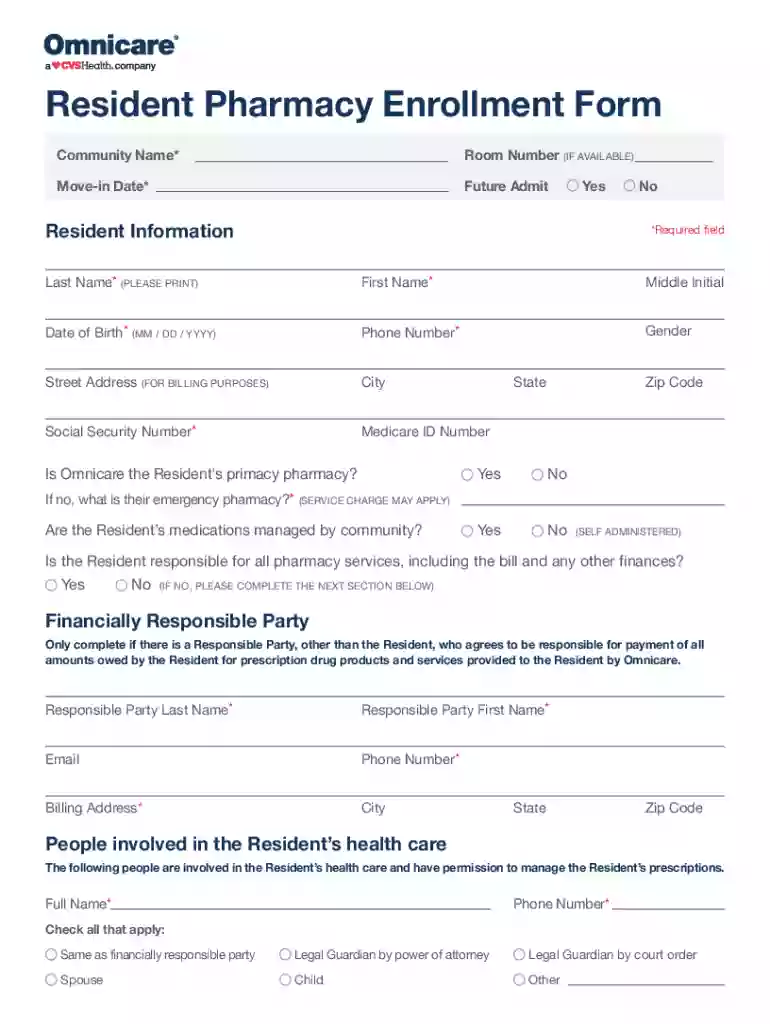
The Resident Pharmacy Enrollment Form serves as a crucial document designed for individuals residing in managed care environments, such as nursing homes or assisted living facilities, to enroll in pharmacy services, particularly through Omnicare. This form collects vital information to ensure that residents receive appropriate pharmaceutical care tailored to their specific healthcare needs. Typically, the form includes sections for resident personal details, healthcare provider information, financial responsibility, and consent for the partnership with the pharmacy in managing medication.
Understanding its purpose is essential for both residents and healthcare professionals, as it streamlines the process of managing prescriptions and facilitates communication regarding the residents’ pharmaceutical care. By detailing necessary health information and consent, the form promotes a seamless pharmacy service experience while ensuring compliance with healthcare regulations.
Using the Resident Pharmacy Enrollment Form involves several straightforward steps to ensure effective completion and submission. The primary objective is to accurately capture the necessary information that enables the pharmacy to deliver appropriate services. Here's how to effectively utilize the form:
Completing the Resident Pharmacy Enrollment Form requires careful attention to detail and adherence to specified sections. Follow these organized steps for a successful completion:
Personal Information Section:
Healthcare Provider Information:
Financial Responsibility:
Medication History:
Consent and Permissions:
When completing the Resident Pharmacy Enrollment Form, familiarity with specific terminology is beneficial for accurate submission and understanding of the process. Here are a few key terms frequently encountered:
Understanding these terms supports effective communication and ensures that residents or their advocates can engage with healthcare providers and pharmacies knowledgeably.
The Resident Pharmacy Enrollment Form encompasses several critical components that facilitate its primary function of enrolling residents in pharmacy services. Each element serves to gather essential information while ensuring compliance with healthcare protocols.
We've got more versions of the omnicare resident pharmacy enrollment form form. Select the right omnicare resident pharmacy enrollment form version from the list and start editing it straight away!
| Versions | Form popularity | Fillable & printable |
|---|---|---|
| 2017 | 4.9 Satisfied (48 Votes) |
You need to use only trusted software solutions with strong data protection compliance to approve your documents electronically. DocHub is just the type of editor you need! It stores data on Amazon Web Servers and complies with all required security criteria and eSignature laws, so it’s a trusted way to eSign your omnicare resident pharmacy enrollment or other paperwork using this tool.
If you choose analog ways of completing your Resident Pharmacy Enrollment Form, you can easily download your file for printing. Search DocHub’s Forms & Templates catalog to find the exact document template you need and open it for editing or download it on your device in the format of your choice. It is possible to complete your form electronically and place your handwritten signature on it right after printing or eSign your document with DocHub.
At DocHub, your data security is our priority. We follow HIPAA, SOC2, GDPR, and other standards, so you can work on your documents with confidence.
We offer four PGY-1 positions per year. You must apply through the Pharmacy Online Residency Centralized Application Service (PhORCAS). The resident matching
In order to receive your vaccination, voucher information must be provided to CVS Pharmacy prior to administration of the vaccine. A hardcopy of the voucher


