
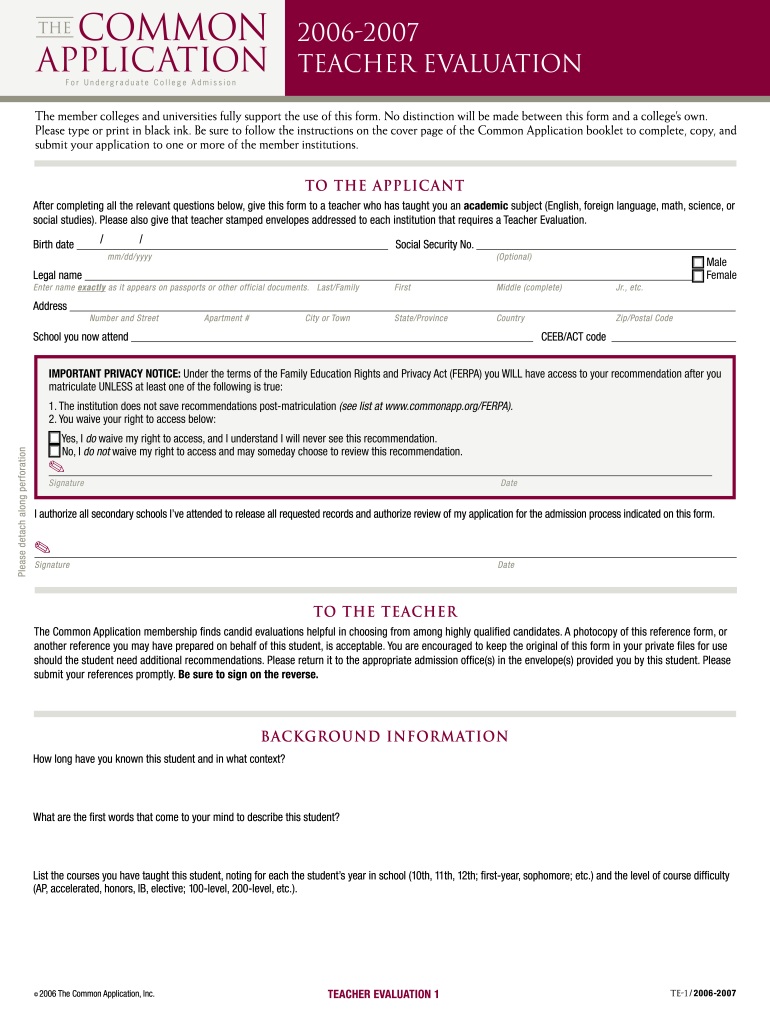







Overview of the Common App Teacher Evaluation Form
The Common App Teacher Evaluation Form is a crucial document in the college application process, allowing teachers to provide insights on a student's academic abilities and character. This evaluation plays a significant role in admissions decisions, influencing how prospective colleges view applicants.
-
Purpose: The form aims to gather qualitative insights from teachers about a student's performance, work ethic, and personal qualities. This information can set applicants apart by highlighting their strengths in ways that grades and test scores cannot.
-
Components: The evaluation typically includes sections for personal information, specific academic metrics, and qualitative assessments. Teachers may evaluate attributes such as motivation, intellectual curiosity, maturity, and engagement in classroom discussions.
Teacher Evaluation vs. Teacher Recommendation
Understanding the distinction between teacher evaluations and recommendations is essential for students navigating the Common App process.
-
Evaluation Form: This form focuses on rating specific qualities and providing standardized feedback. It often includes numerical scales and predefined categories, making it less subjective.
-
Recommendation Letter: In contrast, a recommendation letter offers personal anecdotes and detailed narratives that paint a fuller picture of a student's abilities and character. These letters allow for a more personalized approach, incorporating stories and examples.
Steps to Complete the Common App Teacher Evaluation Form
Completing the Common App Teacher Evaluation Form requires careful attention to detail and thoughtful reflection on the student's performance.
-
Accessing the Form: Teachers can find the evaluation form through the Common App portal. Students typically need to provide access when selecting their recommenders.
-
Filling in Personal Information: The teacher should complete sections requesting the student’s name, school name, and specific classes taught to the student.
-
Assessing the Student’s Qualifications: Teachers will use rating scales to evaluate various dimensions of a student's performance and character.
-
Writing Narrative Responses: Most forms include open-ended questions requiring qualitative feedback about the student, allowing teachers to share specific examples of the student’s strengths.
-
Submitting the Form: After thorough review and completion, teachers must submit the form electronically via the Common App to ensure timely delivery.
Key Elements of the Evaluation Form
Several critical components make up the Common App Teacher Evaluation Form, each contributing to how an applicant is viewed by colleges.
-
Rating Section: Teachers rate students on a scale (often one to five or one to seven) across various attributes, such as academic performance, classroom participation, and leadership skills.
-
Commentary Section: This part allows teachers to elaborate on the ratings given. They can discuss specific instances where the student demonstrated outstanding qualities or overcame challenges.
-
Teacher Qualifications: Teachers may be required to provide their credentials, which lend credibility to their evaluations. This includes their position, years of teaching experience, and relationship to the student.
Examples of Completing the Teacher Evaluation
Practical examples can clarify how to effectively complete a teacher evaluation.
-
Positive Assessment Example: A teacher might note, "In my advanced mathematics class, John consistently demonstrates exceptional problem-solving skills, often assisting peers in understanding complex concepts."
-
Constructive Feedback Example: A teacher could write, "While Sarah excels in group projects, she sometimes hesitates to share her ideas in larger class discussions. Encouraging her to take the lead in discussions could enhance her confidence further."
Common Questions Regarding Teacher Evaluations
Many teachers and students have queries about the teacher evaluation process.
-
What is the timeline for submission?: Teachers are typically expected to submit evaluations by application deadlines, often aligning with college admissions schedules.
-
Can a teacher refuse to complete the evaluation?: Yes, teachers can decline if they do not feel they can provide a meaningful assessment. It is best practice for students to choose teachers who know them well and can provide accurate evaluations.
-
How are evaluations seen by admissions committees?: Admissions committees often look for consistency in evaluations alongside transcripts and test scores. Strong evaluations can provide essential context to a student's academic record.
Common Mistakes to Avoid
Awareness of common pitfalls can lead to better evaluations.
-
Generic Responses: Teachers should avoid making evaluations too generic. Personal anecdotes and specific examples make an evaluation more impactful.
-
Late Submissions: Teachers must be mindful of deadlines to ensure that evaluations reach the admissions committee on time.
By understanding the Common App Teacher Evaluation Form's format, purpose, and process, both teachers and students can navigate the college application journey effectively.




