






Explanation and Purpose of Form 11652
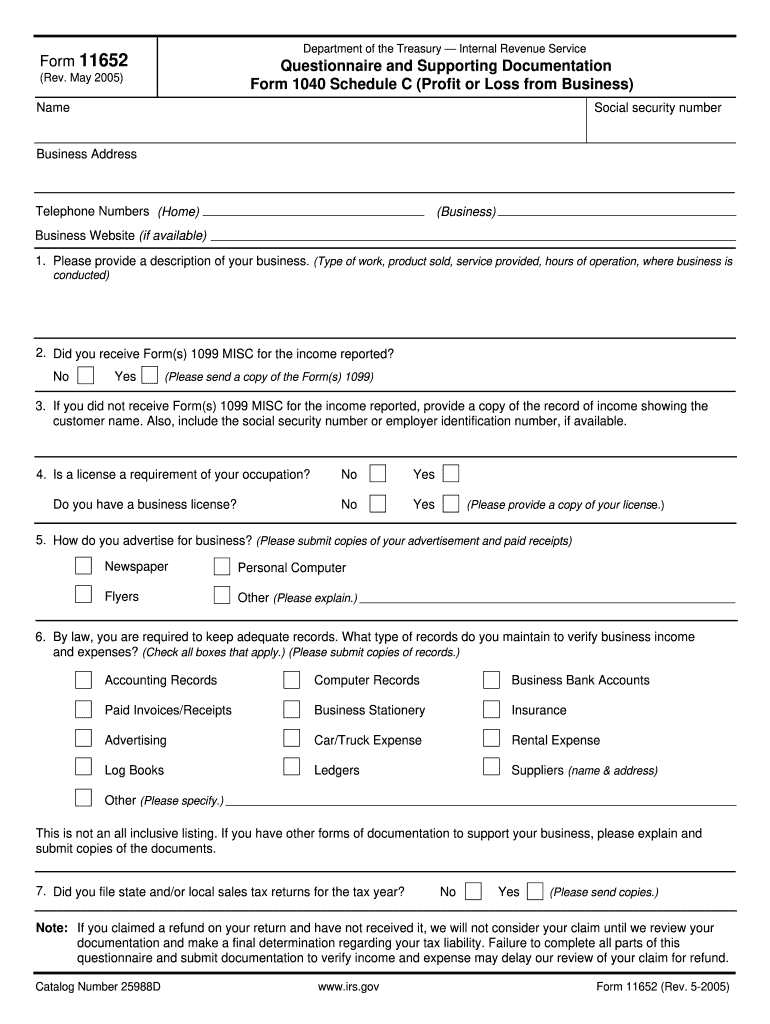
Form 11652, also known as a questionnaire form from the Department of the Treasury — Internal Revenue Service (IRS), is vital for individuals filing Form 1040 Schedule C. Its purpose is to collect supporting documentation concerning business income and expenses. The form serves to verify information provided in tax filings, ensuring that all claims are substantiated by adequate documentation. This includes questions about business description, income verification through Form 1099-MISC, and other essential aspects of running a business.
Key Elements of Form 11652
- Business Description: A clear overview of the taxpayer's business nature and operations.
- Income Verification: Details regarding gross receipts and how they correspond with Form 1099-MISC.
- Licensing Requirements: Information on any licenses necessary for legally operating the business.
- Advertising and Marketing Methods: A section to outline strategies used by the business to attract clients.
- Record-Keeping Practices: Examination of the taxpayer's methods for maintaining records and documentation for tax purposes.
- Sales Tax Returns: Disclosure of state and local sales tax returns, underscoring compliance with regional tax obligations.
How to Obtain Form 11652
Form 11652 can be acquired through several methods, ensuring that taxpayers have access to this important documentation tool. Primarily, the IRS website offers an extensive repository of forms available for download, including Form 11652. Additionally, taxpayers may reach out directly to the IRS through mail or by visiting an IRS office in person to collect the form. This versatility in obtaining the form accommodates diverse taxpayer preferences and needs.
Online Download Steps
- Navigate to the official IRS website.
- Use the search function to locate Form 11652.
- Choose the form from the search results and download it in PDF format.
Requesting by Mail
- Contact the IRS directly to request a mailed copy of Form 11652.
- Ensure your mailing address is correct to receive the form promptly.
Steps to Complete Form 11652
Filling out Form 11652 requires attention to detail and accuracy to ensure compliance and avoid potential issues. Here's a breakdown of the completion process:
-
Gather Necessary Documentation: Before beginning, ensure that all relevant business documents, including income statements and receipts, are accessible.
-
Business Description: Provide an accurate and detailed description of your business activities.
-
Income and Expense Verification: Enter all income data, including those verified by Form 1099-MISC. List all business-related expenses, ensuring correlation with your records.
-
Licenses and Permits: Include any licensing documentation or permits required for your business operations.
-
Review and Submission: Verify all entered information for accuracy, then submit the completed form through your chosen method (mail, in-person).
Who Typically Uses Form 11652
Form 11652 primarily serves self-employed individuals or small business owners who file Form 1040 Schedule C. This includes freelancers, independent contractors, sole proprietors, and other taxpayers operating small businesses. It ensures that business income and expense claims are accurately supported, fostering transparency and correctness in tax filings.
Additional Users and Scenarios
- New Business Owners: Those launching new businesses may need to use Form 11652 to establish compliance with initial tax filings.
- Audited Taxpayers: Individuals undergoing an IRS audit might be required to provide this form to substantiate their financial claims.
IRS Guidelines and Compliance
The IRS has established guidelines to ensure taxpayers accurately complete Form 11652. These guidelines emphasize transparency, requiring substantiation of all claims with proper documentation.
Important Considerations
- Properly documenting all business transactions enhances compliance.
- Adhering to IRS guidelines minimizes the risk of audits or penalties.
Penalties for Non-Compliance
Failure to accurately complete Form 11652 or to provide requisite documentation can result in various penalties. These penalties may include fines, additional audits, or adjustments to the taxpayer's liability. Ensuring completion in line with IRS rules is crucial to avoiding such repercussions.
Possible Consequences
- Financial penalties may arise from inaccuracies or failure to submit the form.
- Additional scrutiny or audits could be prompted by incomplete documentation.
Digital vs. Paper Version: Choosing the Right Format
Taxpayers have the option of completing Form 11652 either digitally or via a paper version. Each format provides distinct benefits, catering to different user preferences.
Benefits of Digital Completion
- Enhanced accuracy through automated systems.
- Faster submission and processing times.
Paper Form Use Cases
- Individuals with limited internet access.
- Those preferring manual entry for thorough review.
Software Compatibility with Form 11652
Various software solutions, including TurboTax and QuickBooks, facilitate the completion of Form 11652. By integrating with these platforms, users can streamline data entry, ensuring accuracy and efficiency in the filing process.
Key Software Functions
- Automatic data import from financial records.
- Form filling automation to prevent errors.
State-Specific Rules for Form 11652
While Form 11652 is standardized by the federal IRS, state-specific rules may influence some sections, such as sales tax returns and business licensing. Taxpayers should consult local regulations to ensure full compliance with any additional requirements.
Considerations and Variations
- Some states might have unique sales tax requirements.
- Licensing documentation may vary based on jurisdiction.
Understanding Form 11652 and its nuances is essential for taxpayers categorized within its usage scope. By following these guidelines, business accuracy and compliance with IRS rules can be confidently achieved.