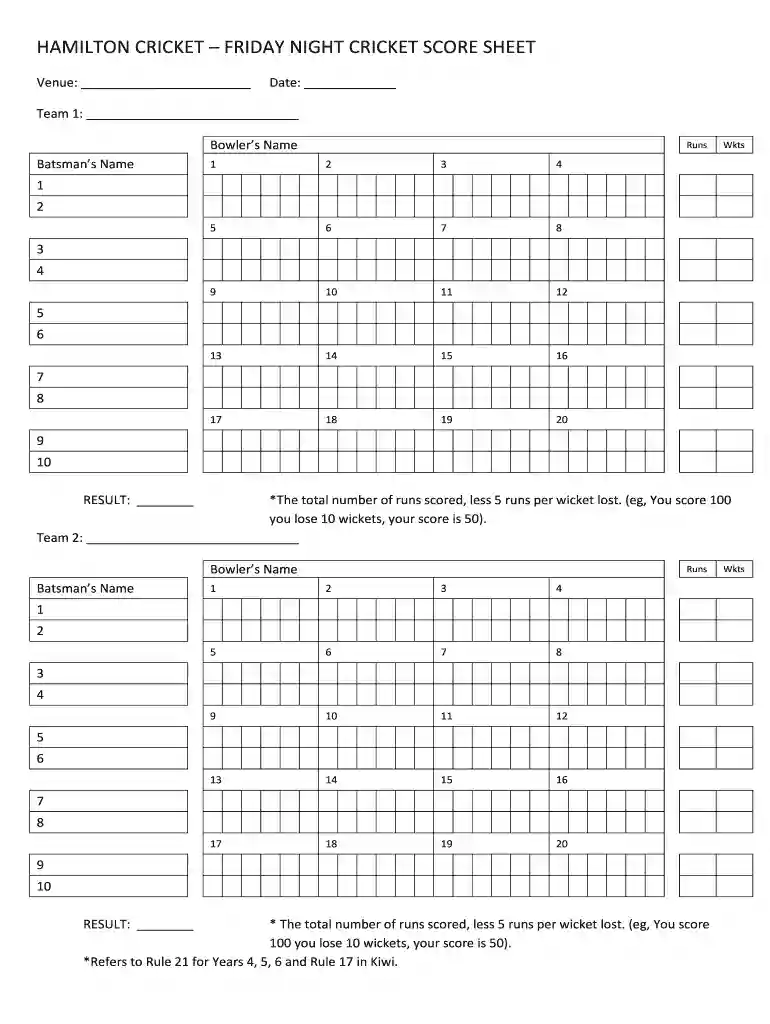
Cricket score sheet 2026

Get Form
cricket scorecard template Preview on Page 1

Here's how it works

01. Edit your cricket scorecard template online
Type text, add images, blackout confidential details, add comments, highlights and more.

02. Sign it in a few clicks
Draw your signature, type it, upload its image, or use your mobile device as a signature pad.

03. Share your form with others
Send cricket score card template via email, link, or fax. You can also download it, export it or print it out.

Definition & Meaning of the Cricket Score Sheet

The cricket score sheet is a comprehensive document that records essential statistics during a cricket match. It serves as a vital tool for players, coaches, and fans alike to track the performance of teams and individual players over the course of a game. The score sheet typically includes details such as team names, player names, runs scored, wickets taken, overs bowled, and other key match events.

The score sheet enables teams to assess their performance and make tactical adjustments in real time. It also provides a historical record for future reference, which can be invaluable for player development and strategy optimization.

Key Components of the Cricket Score Sheet

The score sheet can vary in design, but it generally features:

  • Team Information: Names of the competing teams and dates of the match.
  • Player Details: Names of players, their batting order, and bowling changes.
  • Running Total: Continuous tally of runs scored and wickets lost throughout the game.
  • Bowling Statistics: Number of overs bowled, wickets taken, and runs conceded by each bowler.
  • Extras: Details regarding extras such as no-balls, wides, and byes.

How to Use the Cricket Score Sheet

Effectively utilizing the cricket score sheet enhances the experience of following or participating in a match. Here are the steps to follow when using a cricket score sheet:

  1. Prepare the Score Sheet: Before the match starts, fill in details like team names and the names of the players.
  2. Record Each Ball: As the match progresses, document each ball's outcome, including runs scored, boundaries hit, and any wickets taken.
  3. Update Statistics: Continuously update the totals for runs scored and wickets lost. Ensure that bowler statistics are accurate as each over is bowled.
  4. Document Special Events: Note any special achievements, such as centuries or hat-tricks, on the sheet.
  5. Final Tally: After the match concludes, tally the final scores, including totals for each team and individual performances.

Best Practices for Accurate Scoring

  • Use clear handwriting or a digital score sheet for legibility.
  • Keep a record of players' positions (batting or bowling) to maintain clarity.
  • Regularly communicate with other scorers or team members to ensure accuracy.

Steps to Complete the Cricket Score Sheet

Completing a cricket score sheet requires close attention to detail and a systematic approach. Follow these steps for an organized completion:

  1. Set Up: Lay out your score sheet based on the format of the match (e.g., T20, One Day, Test).
  2. Designate Scorers: Assign scoring responsibilities among team members if needed. Collaboration can help manage data entry effectively.
  3. Score Every Delivery: For every ball bowled, indicate the result: runs scored (if any), wickets falling, and extras.
  4. Track Overs: Note down the number of overs bowled by each bowler and identify any changes in the batting order.
  5. Finalize Scores: Once the match ends, confirm totals against any digital scoreboard or match report to ensure accuracy.

Example of Completing a Section

  • If Player A scores four runs on a delivery and is caught out on the next ball, note down the four in the runs column, tally up the total, and reflect Player A’s dismissal in the wickets column.

Who Typically Uses the Cricket Score Sheet

The cricket score sheet is utilized by various individuals and organizations involved in cricket:


  • Scorers: Individuals responsible for recording match statistics during live matches.
  • Coaches: Used as a tool to analyze player performance and develop strategies for future matches.
  • Players: Members of the team may use the sheet for personal performance analytics and improvement.
  • Fans and Enthusiasts: Cricket lovers track matches for entertainment, leading to discussions and analyses of player performance.
  • Researchers and Statisticians: Data from score sheets serve as crucial inputs for sports analytics and insights.
decoration image ratings of Dochub

Importance for Coaches and Analysts

  • Player Development: Coaches depend on score sheets for assessing player skills and identifying areas for improvement.
  • Game Strategy: The data helps in planning for future matches, determining strengths and weaknesses observed during the game.

Important Terms Related to the Cricket Score Sheet

Understanding the terminology associated with the cricket score sheet is crucial for effective usage:

  • Runs: The total score achieved by batting players.
  • Wickets: The number of outs in a match. Each dismissed batsman counts as a lost wicket.
  • Extras: Additional runs awarded not credited to any batsman, such as byes and no-balls.
  • Overs: A set of six legitimate deliveries bowled by a bowler.
  • Strike Rate: A measure of how quickly a batsman scores runs, calculated as runs per hundred balls faced.

Utilizing Terminology for Better Clarity

Being familiar with these terms aids in clear communication among scorers and makes it easier to interpret match dynamics effectively.

Examples of Using the Cricket Score Sheet

Examples offer practical insights into how the score sheet operates in various match contexts. Here are a few intuitive scenarios where score sheets play a role:

  1. Friendly Matches: During informal games, players may use a simplified score sheet to keep track of runs and wickets casually.
  2. Tournaments: In organized tournaments, a comprehensive score sheet is essential to maintain official statistics for rankings and analysis.
  3. School and College Events: Educational institutions utilizing score sheets can foster interest in cricket and teach valuable data-tracking skills.

Customizing Score Sheets for Specific Formats

  • T20 Format: Require a fast-paced scoring layout to accommodate the rhythm of the game.
  • Test Matches: A more detailed design may be beneficial because of the longer duration and complexity of play.

These examples highlight the versatility and importance of the cricket score sheet in capturing gameplay accurately while providing meaningful insights to various users.

be ready to get more

Complete this form in 5 minutes or less

Get form

Security and compliance

At DocHub, your data security is our priority. We follow HIPAA, SOC2, GDPR, and other standards, so you can work on your documents with confidence.

Learn more
ccpa2
pci-dss
gdpr-compliance
hipaa
soc-compliance