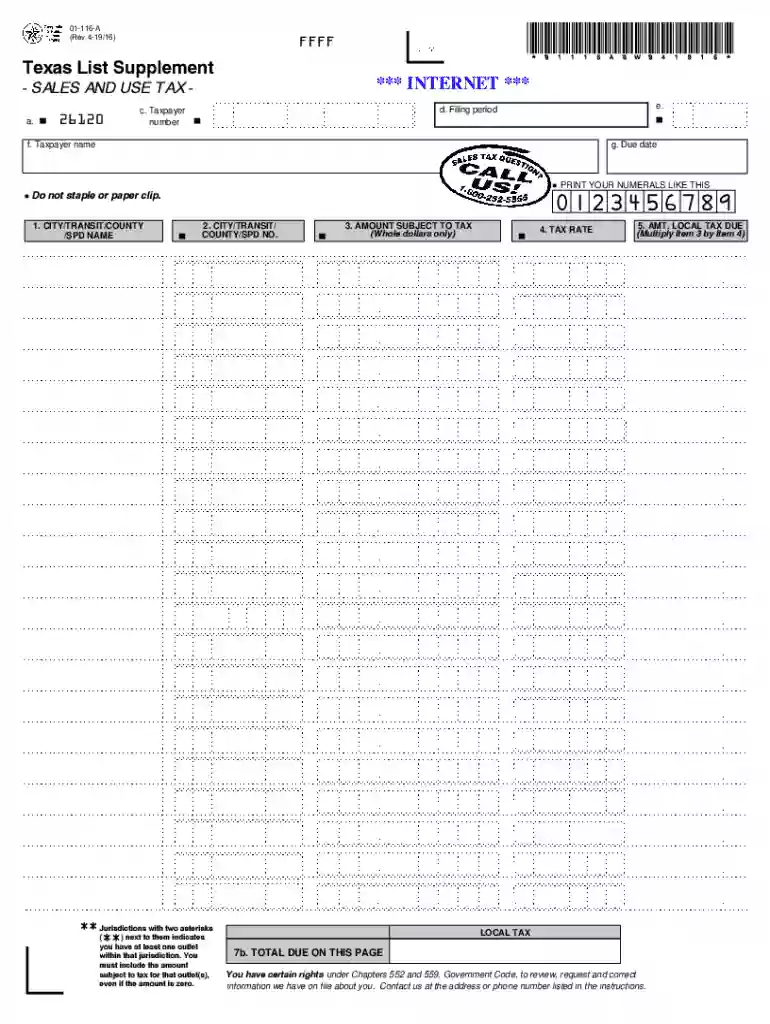
List supplement tax 2026

Get Form
01 116a Preview on Page 1

Here's how it works

01. Edit your 01 116a online
Type text, add images, blackout confidential details, add comments, highlights and more.

02. Sign it in a few clicks
Draw your signature, type it, upload its image, or use your mobile device as a signature pad.

03. Share your form with others
Send list supplement form via email, link, or fax. You can also download it, export it or print it out.

How to use or fill out list supplement tax with our platform

Form edit decoration
9.5
Ease of Setup
DocHub User Ratings on G2
9.0
Ease of Use
DocHub User Ratings on G2
  1. Click ‘Get Form’ to open the Texas List Supplement in the editor.
  2. Begin by entering your Taxpayer number in the designated field. This is crucial for identifying your account.
  3. Fill in your Taxpayer name accurately to ensure proper processing of your submission.
  4. Specify the Filing period by selecting the appropriate dates from the dropdown menu provided.
  5. For each jurisdiction listed, indicate the Amount Subject to Tax. Remember, even if the amount is zero, it must be reported for outlets within that jurisdiction.
  6. Next, input the applicable Tax Rate for each jurisdiction. Ensure this is accurate as it directly affects your calculations.
  7. Calculate the Amount Local Tax Due by multiplying Item 3 (Amount Subject to Tax) by Item 4 (Tax Rate).
  8. Finally, sum up all local taxes due and enter this total in the Total Due on This Page field before submitting your form.

Start using our platform today to easily complete and submit your list supplement tax form online for free!

See more list supplement tax versions

We've got more versions of the list supplement tax form. Select the right list supplement tax version from the list and start editing it straight away!
Versions Form popularity Fillable & printable
2019 4.8 Satisfied (63 Votes)
2015 4.3 Satisfied (29 Votes)
2008 4.3 Satisfied (35 Votes)
be ready to get more

Complete this form in 5 minutes or less

Get form

Got questions?

We have answers to the most popular questions from our customers. If you can't find an answer to your question, please contact us.
Contact us
Since bonuses are paid in addition to your normal paycheck, taxes are withheld at a higher rate than your regular wages. This is because they are considered supplemental income.
Supplementary Rate means, in respect of the initial Calculation Period, the percentage rate per annum specified as such in the relevant Final Terms and, for each subsequent Calculation Period, the greater of zero (0%) and the rate per annum, if any, advised to Noteholders by the Issuer or an affiliate of the Issuer via
Tax-exempt goods Examples include most non-prepared food items, food stamps, and medical supplies. We recommend businesses review the laws and rules put forth by the Texas Comptroller of Public Accounts to understand which goods require sales tax to be collected, and under what conditions.
The supplemental tax rate may apply to extra money paid by your employer outside of your regular salary, like commissions, bonuses, and more.
Unlike your regular salary, which is usually paid on a fixed schedule, supplemental wages are typically irregular or occasional. As a result, they are subject to different tax withholding rates for federal income tax purposes.

Security and compliance

At DocHub, your data security is our priority. We follow HIPAA, SOC2, GDPR, and other standards, so you can work on your documents with confidence.

Learn more
ccpa2
pci-dss
gdpr-compliance
hipaa
soc-compliance
be ready to get more

Complete this form in 5 minutes or less

Get form

People also ask

Supplemental income is extra money or gifts employees earn on top of their regular wages. It can come in the form of bonuses, stock options, or flexible benefits. The key characteristic is that employers arent required to give supplemental income.
What tax rate do I use? The Texas state sales and use tax rate is 6.25 percent, but local taxing jurisdictions (cities, counties, special-purpose districts and transit authorities) also may impose sales and use tax up to 2 percent for a total maximum combined rate of 8.25 percent.
The Amount Subject to Local Tax is the taxable sales, plus taxable purchases, that are subject to local tax for each taxing jurisdiction for this period. Note: An entry is required for each City, Transit, County, SPD and Combined District names marked with the word REQUIRED, even if the amount subject to tax is zero.

01116a