




Here's how it works

01. Edit your printable beehive inspection checklist online
Type text, add images, blackout confidential details, add comments, highlights and more.

02. Sign it in a few clicks
Draw your signature, type it, upload its image, or use your mobile device as a signature pad.

03. Share your form with others
Send beehive inspection sheet pdf via email, link, or fax. You can also download it, export it or print it out.
How to use or fill out bee hive inspection sheet with our platform

- Click ‘Get Form’ to open the bee hive inspection sheet in the editor.
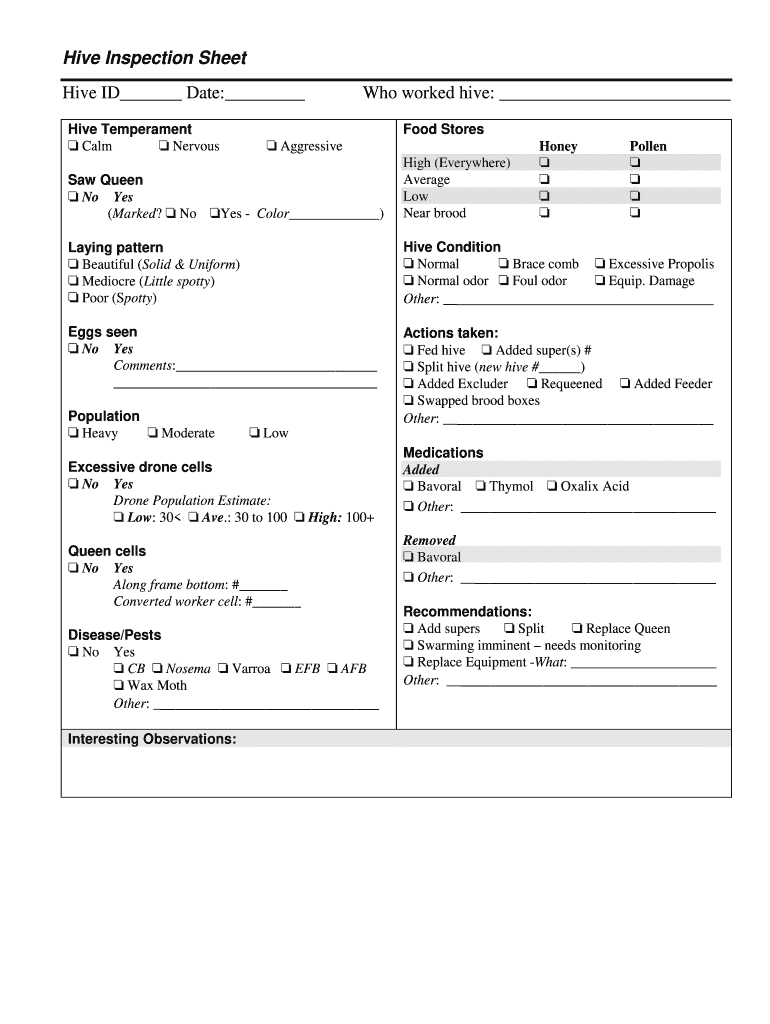
- Begin by entering the Hive ID and Date at the top of the form. This information is crucial for tracking your inspections.
- In the Hive Temperament section, select one of the options: Calm, Nervous, or Aggressive. This helps assess how manageable the hive is during inspections.
- Fill in 'Who worked hive' to document who performed the inspection. This ensures accountability and traceability.
- For Food Stores, indicate whether honey and pollen are present by checking the appropriate boxes. This provides insight into food availability for your bees.
- In the Saw Queen section, note if you saw the queen and her color if marked. This is vital for understanding colony health.
- Assess Laying pattern and Hive Condition by selecting from provided options. These details are essential for evaluating hive performance.
- Document any Eggs seen and provide comments as necessary to capture specific observations during your inspection.
- List Actions taken during your visit, such as feeding or adding supers, to keep a record of management practices.
- Finally, complete sections on Population, Disease/Pests, Medications Added/Removed, and Recommendations based on your findings.
Start using our platform today to streamline your bee hive inspections for free!
Fill out bee hive inspection sheet online
It's free
It's free
Got questions?
We have answers to the most popular questions from our customers. If you can't find an answer to your question, please contact us.
Contact us
What is the 7/10 rule in beekeeping?
You should not open your hive more often than once every two weeks. Inspections are stressful for bees and they disturb the carefully controlled atmospheric conditions within the hive. However, you should do regular inspections every 2-4 weeks to monitor your colonies health and progress.
How do you inspect a bee hive?
Inspecting the hive Hold the frame by the top and inspect the brood thoroughly. Look for symptoms associated with established pests and diseases of honey bee colonies. Look for any queen bee cells on the comb surface and bottom side of the comb, and if present, remove to reduce swarming potential.
Security and compliance
At DocHub, your data security is our priority. We follow HIPAA, SOC2, GDPR, and other standards, so you can work on your documents with confidence.
Learn more




