Vehicle Accident Reporting ProceduresRisk Management 2026

Get Form
doa form Preview on Page 1

Here's how it works

01. Edit your doa form online
Type text, add images, blackout confidential details, add comments, highlights and more.

02. Sign it in a few clicks
Draw your signature, type it, upload its image, or use your mobile device as a signature pad.

03. Share your form with others
Send doa paperwork via email, link, or fax. You can also download it, export it or print it out.

How to use or fill out Vehicle Accident Reporting Procedures Risk Management with our platform

Form edit decoration
9.5
Ease of Setup
DocHub User Ratings on G2
9.0
Ease of Use
DocHub User Ratings on G2
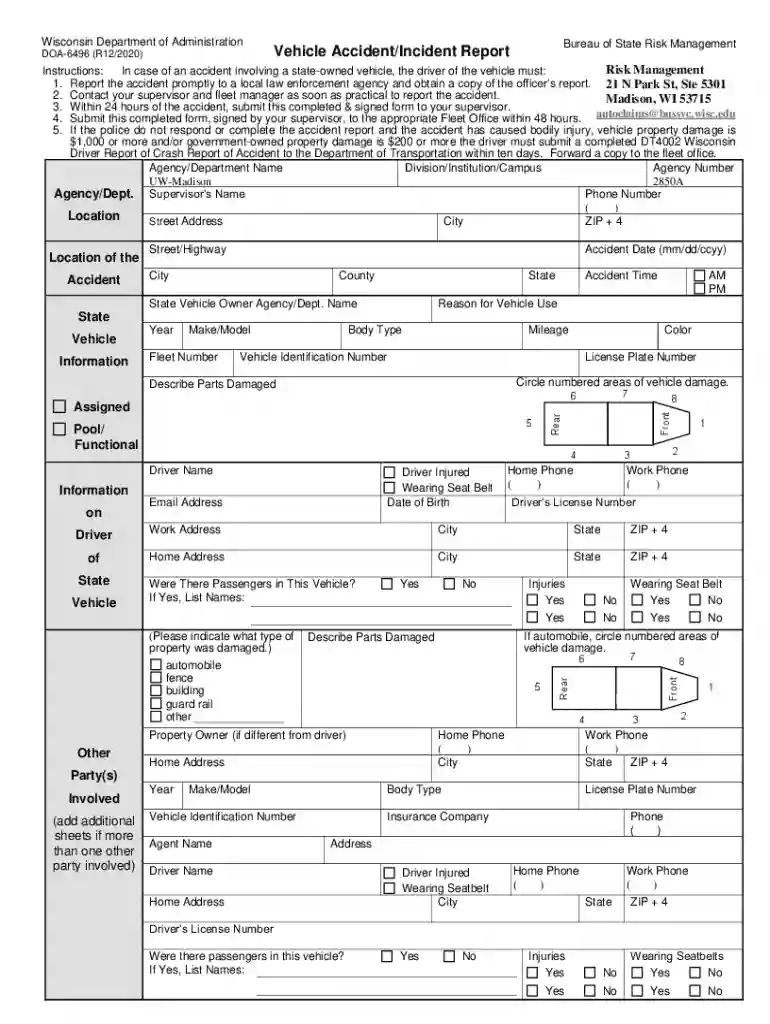
  1. Click ‘Get Form’ to open the Vehicle Accident Reporting Procedures Risk Management form in the editor.
  2. Begin by entering your Agency/Department Name, Division/Institution/Campus, and Agency Number at the top of the form. This information is crucial for proper identification.
  3. Fill in the details regarding the accident location, including Street/Highway, City, County, and State. Ensure that you accurately note the Accident Date and Time.
  4. Provide vehicle details such as Year, Make/Model, Fleet Number, and Vehicle Identification Number. Circle any numbered areas of damage on the vehicle diagram provided.
  5. Complete driver information including Name, Contact Numbers, and Address. Indicate if you were wearing a seatbelt and if there were any injuries.
  6. If applicable, list other parties involved in the accident along with their vehicle details. Include witness information if available.
  7. Finally, review all entered information for accuracy before signing the form. Submit it to your supervisor within 24 hours of the accident.

Start using our platform today to streamline your Vehicle Accident Reporting process for free!

See more Vehicle Accident Reporting ProceduresRisk Management versions

We've got more versions of the Vehicle Accident Reporting ProceduresRisk Management form. Select the right Vehicle Accident Reporting ProceduresRisk Management version from the list and start editing it straight away!
Versions Form popularity Fillable & printable
2020 4.7 Satisfied (45 Votes)
2000 4.6 Satisfied (62 Votes)
be ready to get more

Complete this form in 5 minutes or less

Get form

Got questions?

We have answers to the most popular questions from our customers. If you can't find an answer to your question, please contact us.
Contact us
Accident reporting investigation procedure 6 steps Check for immediate danger. Seek medical assistance. Record details in the accident book. Conduct a formal investigation. Determine if the accident is reportable. Review and update safety measures.
How to Manage Incident Accident Investigations in 4 Easy Steps Preserve and document the scene. Collect Data. Determine root causes. Implement corrective actions.
How to Write an Incident Report: A Step-by-Step Guide (with Examples) Step 1: Provide Fundamental Information. Step 2: Take Note of Any Damages and Injuries. Step 3: Identify Affected Individual(s) Step 4: Identify Witnesses and Take Their Statements. Step 5: Take Action. Step 6: Close Your Report.
8 Steps to Take After a Car Accident: Check Yourself and Other People for Injuries. Call the Police. Take Photos of the Accident Scene. Move Your Vehicle to a Safe Location. Gather Insurance and Contact Details from All Drivers Involved. Record the Contact Details of Eyewitnesses. Visit a Doctor.
Incident reporting is the process of recording worksite events, including near misses, injuries, and accidents. It entails documenting all the facts related to incidents in the workplace. Incidents are generally accidents or events that cause injuries to workers or damages to property or equipment.

Security and compliance

At DocHub, your data security is our priority. We follow HIPAA, SOC2, GDPR, and other standards, so you can work on your documents with confidence.

Learn more
ccpa2
pci-dss
gdpr-compliance
hipaa
soc-compliance

People also ask

What are the five rules of incident report writing? Timeliness: Always report the incident as soon as possible. Accuracy: Make sure all information provided is accurate and detailed. Completeness: Be thorough and provide all important details. Confidentiality: Handle sensitive and personal information carefully.
Report a risk event from an incident Create an audit report template in classic formats. Manage test templates and test plans. Manage engagements. Manage your documents and work papers with Audit Management as cloud files. Manage GRC key risk and control indicators. Confidentiality flag for audit and compliance records.

Related links