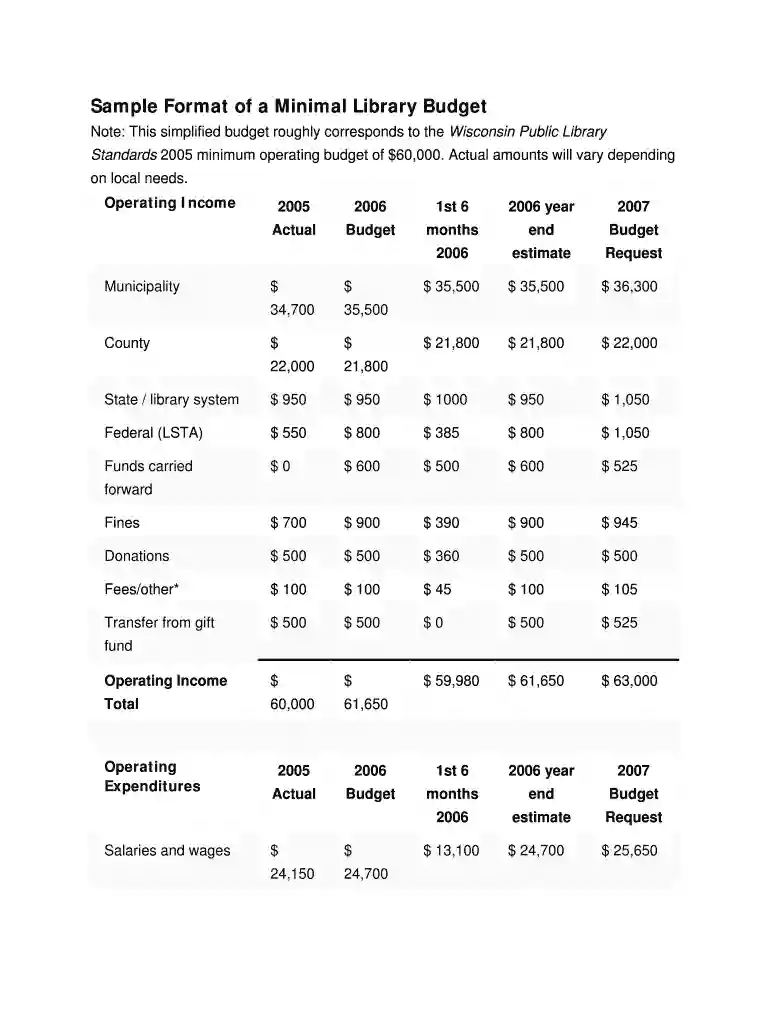
Sample Format of a Minimal Library Budget 2026

Get Form
Sample Format of a Minimal Library Budget Preview on Page 1

Here's how it works

01. Edit your form online
Type text, add images, blackout confidential details, add comments, highlights and more.

02. Sign it in a few clicks
Draw your signature, type it, upload its image, or use your mobile device as a signature pad.

03. Share your form with others
Send it via email, link, or fax. You can also download it, export it or print it out.

How to use or fill out Sample Format of a Minimal Library Budget with DocHub

Form edit decoration
9.5
Ease of Setup
DocHub User Ratings on G2
9.0
Ease of Use
DocHub User Ratings on G2
  1. Click ‘Get Form’ to open the Sample Format of a Minimal Library Budget in our editor.
  2. Begin by entering your municipality's operating income for each year in the designated fields. This includes actual amounts and budget estimates for 2005, 2006, and beyond.
  3. Next, move to the operating expenditures section. Fill in the salaries and wages, employee benefits, and other categories such as books and periodicals. Ensure that you input accurate figures based on your library's financial data.
  4. For capital income and expenditures, enter the relevant amounts for equipment replacement and new shelving. This section is crucial for tracking long-term investments.
  5. Review all entries for accuracy before saving or exporting your completed budget document. Utilize our platform’s features to sign or share the document as needed.

Start using our editor today to streamline your library budget process for free!

See more Sample Format of a Minimal Library Budget versions

We've got more versions of the Sample Format of a Minimal Library Budget form. Select the right Sample Format of a Minimal Library Budget version from the list and start editing it straight away!
Versions Form popularity Fillable & printable
2022 4.1 Satisfied (60 Votes)
2015 4.5 Satisfied (34 Votes)
be ready to get more

Complete this form in 5 minutes or less

Get form

Got questions?

We have answers to the most popular questions from our customers. If you can't find an answer to your question, please contact us.
Contact us
How to Develop Your Budget Determine what your library wants to accomplish this year. Identify the total amount of financial resources needed to achieve your goals. Draft budget documents. Get input on your budget from the board of trustees. Approve the finished budget. Secure funding if necessary.
The following steps will help you set up your budget and manage your finances by helping you track your income and expenses. Determine a Time Span for Your Budget. Choose a Tool to Help You Manage Your Budget. Review Your Monthly Income. Identify and Categorize Your Expenses. Save for Emergencies. Balance Your Budget.
Five simple steps to create and use a budget Step 1: Estimate your monthly income. Step 2: Identify and estimate your monthly expenses. Step 3: Compare your total estimated income and expenses, and consider your priorities and goals. Step 4: Track your spending, and at the end of month, see if you spent what you planned.
Line item and program budgets These are two of the most popular styles of budgets. The line item budget is organized around categories or lines of expenditures and shows how much is spent on the various products and services that the library acquires.
Here are some steps that may help when building your own budget: Choose a spreadsheet program or template. Create categories for income and expense items. Set your budget period (weekly, monthly, etc.). Enter your numbers and use simple formulas to streamline calculations. Consider visual aids and other features.

Security and compliance

At DocHub, your data security is our priority. We follow HIPAA, SOC2, GDPR, and other standards, so you can work on your documents with confidence.

Learn more
ccpa2
pci-dss
gdpr-compliance
hipaa
soc-compliance
be ready to get more

Complete this form in 5 minutes or less

Get form

People also ask

The Real World The format should be consistent from year to year to allow for easy comparisons. This should provide indicators of what happened in the past and what is projected for the future. Finally, the budget should be as comprehensive as possible to provide a complete picture of the fiscal activities.

Related links