Binge eating questionnaire printable 2026

Get Form
binge eating questionnaire pdf Preview on Page 1

Here's how it works

01. Edit your binge eating questionnaire pdf online
Type text, add images, blackout confidential details, add comments, highlights and more.

02. Sign it in a few clicks
Draw your signature, type it, upload its image, or use your mobile device as a signature pad.

03. Share your form with others
Send binge eating scale pdf via email, link, or fax. You can also download it, export it or print it out.

How to use or fill out binge eating questionnaire printable with our platform

Form edit decoration
9.5
Ease of Setup
DocHub User Ratings on G2
9.0
Ease of Use
DocHub User Ratings on G2
  1. Click ‘Get Form’ to open the binge eating questionnaire in the editor.
  2. Begin by entering the date of your interview or examination at the top of the form. This helps track your responses over time.
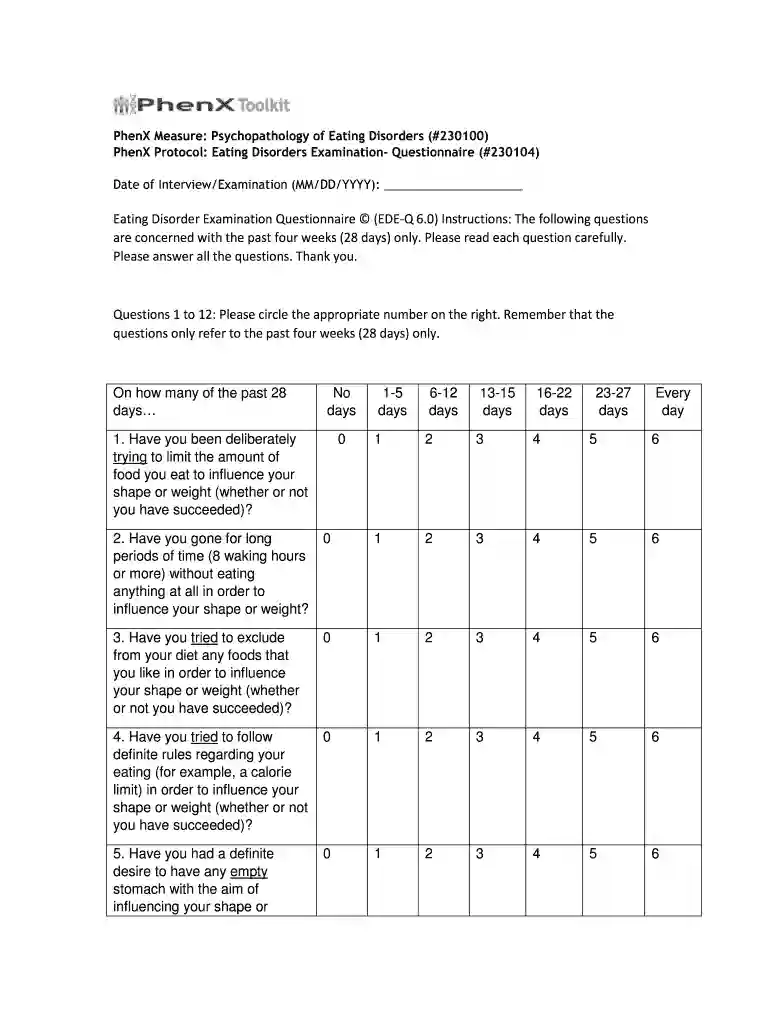
  3. Carefully read each question, focusing on your experiences over the past four weeks. For questions 1 to 12, circle the number that best represents your experience.
  4. For questions 13 to 18, fill in the appropriate numbers in the boxes provided. These questions require you to quantify specific behaviors related to eating.
  5. Continue with questions 19 to 28, circling the number that reflects your feelings and experiences regarding weight and body image.
  6. Finally, provide your current weight and height at the end of the form. If applicable, answer any additional questions regarding menstrual periods.

Start using our platform today for free to complete your binge eating questionnaire effortlessly!

be ready to get more

Complete this form in 5 minutes or less

Get form

Got questions?

We have answers to the most popular questions from our customers. If you can't find an answer to your question, please contact us.
Contact us
Symptoms of binge-eating disorder vary but can include: Feeling that you dont have control over your eating behavior, for example, you cant stop once you start. Often eating much larger than usual amounts of food in a specific amount of time, such as over a two-hour period. Eating even when youre full or not hungry.
2) Binge-Eating Disorder 307.51 (F50. 8)
The Eating Disorder Examination Questionnaire (EDE-Q) [24]. Based on the Eating Disorder Examination interview (EDE; Fairburn, Wilson [25]), the EDE-Q is a self-report questionnaire that assesses of the severity and frequency of eating disorder symptoms (including binge eating) experienced over the 28 days prior.
Eating until feeling uncomfortably full. Eating large amounts of food when not feeling physically hungry. Eating alone because of feeling embarrassed by how much one is eating. Feeling disgusted with oneself, depressed, or very guilty afterwards.
Acceptable indications for a patients admission include the following: weight is less than 75% of ideal body weight, temperature is lower than 35.5C (95.9F), heart rate is less than 45 beats/min, systolic blood pressure level is lower than 80 mm Hg, orthostatic change in pulse is higher than 20 beats/min, or

Security and compliance

At DocHub, your data security is our priority. We follow HIPAA, SOC2, GDPR, and other standards, so you can work on your documents with confidence.

Learn more
ccpa2
pci-dss
gdpr-compliance
hipaa
soc-compliance
be ready to get more

Complete this form in 5 minutes or less

Get form

People also ask

The EAT-26 is a 26-item questionnaire that assesses three major areas of disordered eating attitudes and behaviors: dieting behavior (e.g., I am preoccupied with a desire to be thinner), bulimia and food preoccupation (e.g., I give too much time and thought to food), and oral control (e.g., I find myself eating
The DSM-5 outlines three specified eating disorders; anorexia nervosa (AN), bulimia nervosa (BN) and binge-eating disorder (BED)1(American Psychiatric Association [APA], 2013). These diagnoses are defined by specific, universally recognised criteria.
To diagnose binge-eating disorder, your healthcare professional may recommend a mental health evaluation. This includes talking about your feelings and eating habits with a mental health professional. Look for a mental health professional with expertise in treating eating disorders.

binge eating scale questionnaire pdf