




01. Edit your patient information sheet medical online
Type text, add images, blackout confidential details, add comments, highlights and more.

Type text, add images, blackout confidential details, add comments, highlights and more.

Draw your signature, type it, upload its image, or use your mobile device as a signature pad.

Send it via email, link, or fax. You can also download it, export it or print it out.
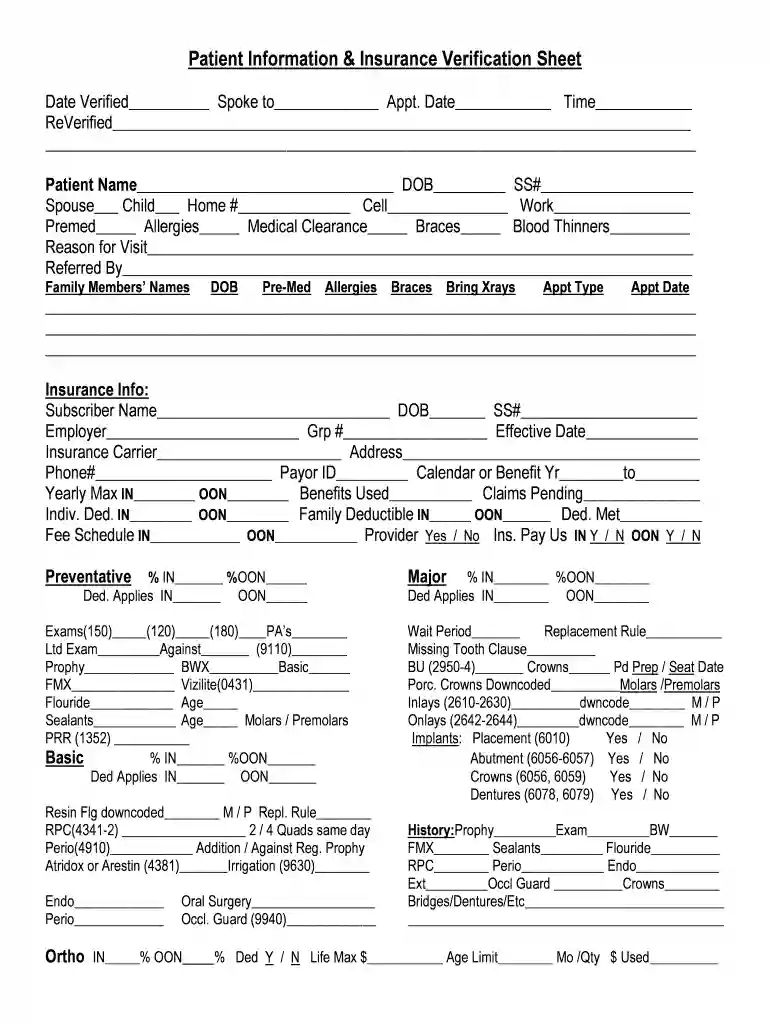
The Patient Information & Insurance Verification Sheet is a crucial document in the healthcare industry designed to collect and confirm a patient's essential personal and insurance details. This sheet is often utilized during the registration process at medical facilities to ensure accurate record-keeping and effective billing.
Patient Identity Verification: This section includes fields for the patient's name, date of birth, social security number, and contact information. Accurately filling in this information helps medical staff confirm the patient's identity and streamline the appointment process.
Medical History: Patients are typically asked to provide information about their medical history, including any pre-existing conditions, allergies, and current medications. This section is vital for healthcare providers to ensure proper treatment.
Appointment Specifics: The document usually includes questions about the reason for the visit, which assists medical professionals in understanding the patient's needs beforehand.
Insurance Coverage Details: Patients must disclose their insurance provider, policy number, and subscriber information. This data is critical for verifying the patient's insurance eligibility and determining coverage for services rendered.
Consent and Authorization: Most versions of the form will have a section where patients must provide consent for their information to be shared as required by their healthcare provider. This ensures compliance with privacy regulations.
To effectively utilize the Patient Information & Insurance Verification Sheet, follow these steps:
Collect Necessary Information:
Complete All Sections:
Review for Accuracy:
Submit the Form:
Keep a Copy:
Completing the Patient Information & Insurance Verification Sheet requires attention to detail to ensure all necessary information is gathered. Here are step-by-step instructions:
Identify Personal Information:
Provide Medical History:
Insurance Information Section:
Complete the Appointment Details:
Consent Verification:
The Patient Information & Insurance Verification Sheet is essential for numerous reasons:
Accuracy in Medical Record-Keeping: Having accurate patient information helps eliminate errors in medical records, which can lead to inappropriate treatments or medication errors.
Efficient Insurance Claims Processing: Providing complete insurance information allows healthcare providers to bill insurers effectively, reducing delays in processing claims.
Enhances Patient Care: By collecting detailed medical histories, healthcare providers can tailor treatments to individual patient needs, improving overall care and outcomes.
Legal Compliance: The form ensures that patient information is collected respectfully and legally, adhering to privacy laws that protect individuals' health information.
The Patient Information & Insurance Verification Sheet is utilized by various stakeholders in the healthcare ecosystem:
Healthcare Providers: Hospitals, clinics, and private practices use this form to gather necessary data for patient registration and care.
Medical Billing Departments: Billing departments refer to this information to verify insurance coverage and initiate claims for reimbursement.
Insurance Companies: Insurers may require such documentation for processing claims related to medical services provided to patients.
Patients: Individuals seeking medical care must complete this form to facilitate their treatment and insurance processes, emphasizing its role in patient-provider interactions.
Each of these users relies on accurate and complete information to ensure smooth operations and adequate patient care processes.


We've got more versions of the patient information sheet medical form. Select the right patient information sheet medical version from the list and start editing it straight away!
| Versions | Form popularity | Fillable & printable |
|---|---|---|
| 2012 | 4.6 Satisfied (54 Votes) |
At DocHub, your data security is our priority. We follow HIPAA, SOC2, GDPR, and other standards, so you can work on your documents with confidence.
Our mobile-friendly template lets your practice gather patient insurance details, collect signatures, and securely store and share patient data.Read more
by J Heintzman 2015 Cited by 30 Objective To validate electronic health record (EHR) insurance information for low-income pediatric patients at Oregon community health centersRead more
(1) pharmacy prescription number;. (2) pharmacys national identification number;. (3) patient name;. (4) patient address, including street, city, state, ZIPRead more


