




01. Edit your 30 day review template online
Type text, add images, blackout confidential details, add comments, highlights and more.

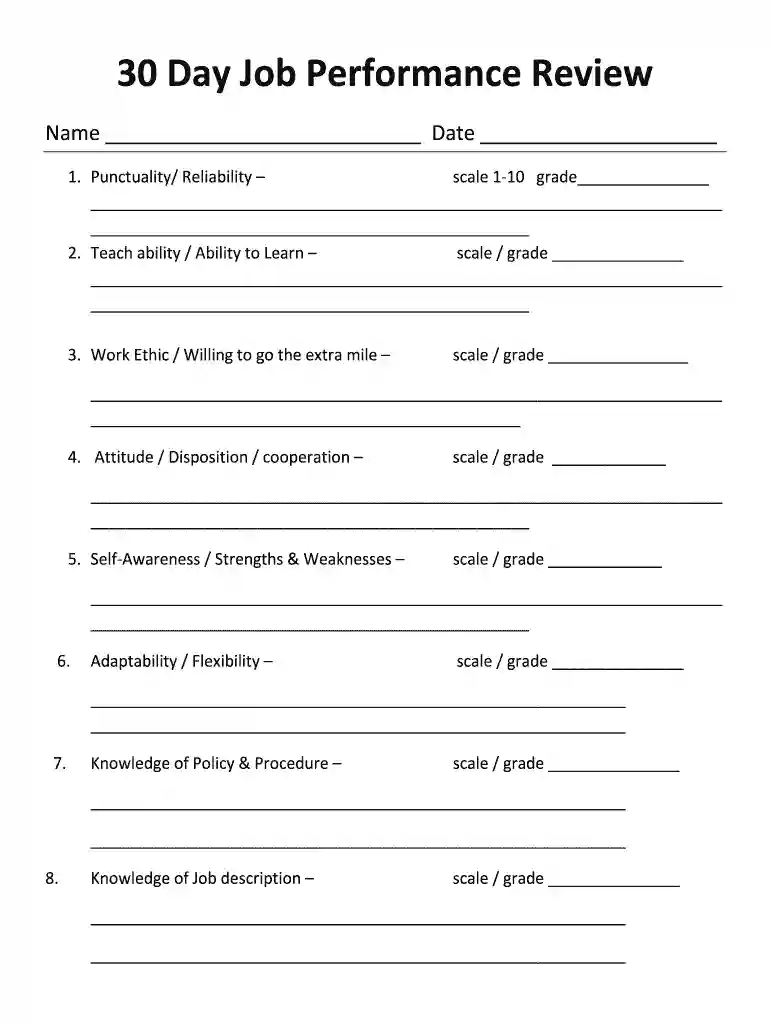
Type text, add images, blackout confidential details, add comments, highlights and more.

Draw your signature, type it, upload its image, or use your mobile device as a signature pad.

Send 60 day review answers via email, link, or fax. You can also download it, export it or print it out.
The 30 day review template serves as a structured tool specifically designed to assess an employee's performance within the first month of their employment. This template allows supervisors to evaluate various criteria such as punctuality, teamwork, adaptability, and adherence to company policies. By offering a consistent framework for reviews, organizations can ensure that employees receive constructive feedback early in their tenure, which helps guide their development and align expectations.
Key elements typically included in a 30 day review template are:
Integrating a 30 day review template in the onboarding process can also promote accountability and engagement within the employee, ultimately contributing to higher retention rates and enhanced employee satisfaction.
Filling out a 30 day review template necessitates a systematic approach to ensure that the evaluation is thorough and constructive. The process can be broken down into several steps:
Preparation: Prior to conducting the review, gather relevant information. This may include previous evaluations, notes from team meetings, or feedback from colleagues that provide context to the employee's performance.
Use the Template: Begin by transferring the performance criteria from the template to your evaluation. Provide ratings based on observed behaviors and accomplishments.
Document Observations: For each criterion, write specific examples that support ratings. Highlight achievements as well as areas needing improvement. This ensures that feedback is not only objective but also actionable.
Engage in Dialogue: Schedule a meeting with the employee to discuss the review. Encourage them to share their thoughts and feedback, creating a two-way conversation about their experiences and expectations.
Set Goals Together: Collaboratively outline performance goals and expectations for the next review period. This reinforces a sense of direction and purpose for the employee.
Follow Up: Post-review, it is crucial to monitor progress toward the set goals. Follow up at regular intervals to ensure that the employee feels supported and can make any necessary adjustments.
This structured approach fosters an inclusive environment where employees feel valued and invested in their own development.
The effectiveness of a 30 day review template lies in its carefully crafted components. Key factors that contribute to the utility of the template include:
Rating Scale: A clear and easy-to-understand rating scale (for example, one to ten) that defines what each score means. This quantification is helpful in delivering structured feedback.
Performance Indicators: Specific performance indicators provide clarity on what is being assessed. Identifying elements such as punctuality, teamwork, and productivity will guide supervisors in their evaluation.
Feedback Sections: These areas for written comments allow evaluators to provide nuanced insights along with quantifiable ratings. This is essential for giving employees not just scores, but actionable feedback.
Follow-Up Objectives: Templates that include a section to outline follow-up actions and future objectives help in aligning the employee’s development with organizational goals.
Space for Employee Input: Including sections for employee self-assessment encourages ownership of personal performance and facilitates open communication.
Together, these components make the 30 day review template a comprehensive tool for evaluating and enhancing employee performance.
Understanding the legal implications surrounding the use of a 30 day review template is crucial for organizations during employee evaluations. Key considerations include:
Compliance with Employment Laws: Ensure that reviews are conducted fairly and consistently, adhering to all federal and state employment regulations. This includes non-discriminatory practices in assessment.
Data Retention Policies: Maintain records of evaluations according to applicable data retention laws. This protects the organization in the case of disputes or grievances from employees concerning their evaluations.
Confidentiality: All documentation related to individual employee performance should be treated with confidentiality. Sharing information outside of authorized personnel can lead to legal repercussions.
Objective Criteria: Establishing clear and objective performance criteria can help defend against claims of biased evaluations. It minimizes the risk of perceived discrimination or unfair treatment.
For organizations, understanding and navigating these legal aspects is crucial to safeguarding both the employer's and employees' rights in the performance review process.
The application of a 30 day review template can greatly differ depending on the context. Here are scenarios that illustrate its effective use:
Onboarding a New Hire: A company implements a 30 day review for all new employees to provide them with timely feedback. Within this period, the employee's integration into the team, understanding of job responsibilities, and engagement levels are assessed. Concrete examples from their first month help in shaping constructive feedback.
Performance Improvement: In cases where an employee is on a performance improvement plan, the 30 day review template can serve as a benchmark tool to gauge progress. Regular reviews assure that employees receive consistent feedback and support while addressing performance issues.
Team Collaboration Assessment: When evaluating teams rather than individuals, the template can highlight collaboration efforts. Recognizing how a new employee contributes to team dynamics within the first month helps establish clear expectations for future performance.
Utilizing these diverse examples showcases the flexibility and relevance of the 30 day review template in various scenarios within the workplace.
At DocHub, your data security is our priority. We follow HIPAA, SOC2, GDPR, and other standards, so you can work on your documents with confidence.
Oct 5, 2018 Can be full date (day, month, and year) or partial date (month and year, season and year, or year). Use same format as other publication datesRead more
University by completing in detail the following review. Please evaluate the employee on the following qualities. Be specific. When evaluating, orRead more
30 Day, 60 Day, or final evaluation of the employee). Use the following scale: 1 = Unacceptable; 2 = Needs Improvement; 3 = Satisfactory. See the second pageRead more


