




01. Edit your letter naming fluency practice pdf online
Type text, add images, blackout confidential details, add comments, highlights and more.

Type text, add images, blackout confidential details, add comments, highlights and more.

Draw your signature, type it, upload its image, or use your mobile device as a signature pad.

Send letter fluency test via email, link, or fax. You can also download it, export it or print it out.
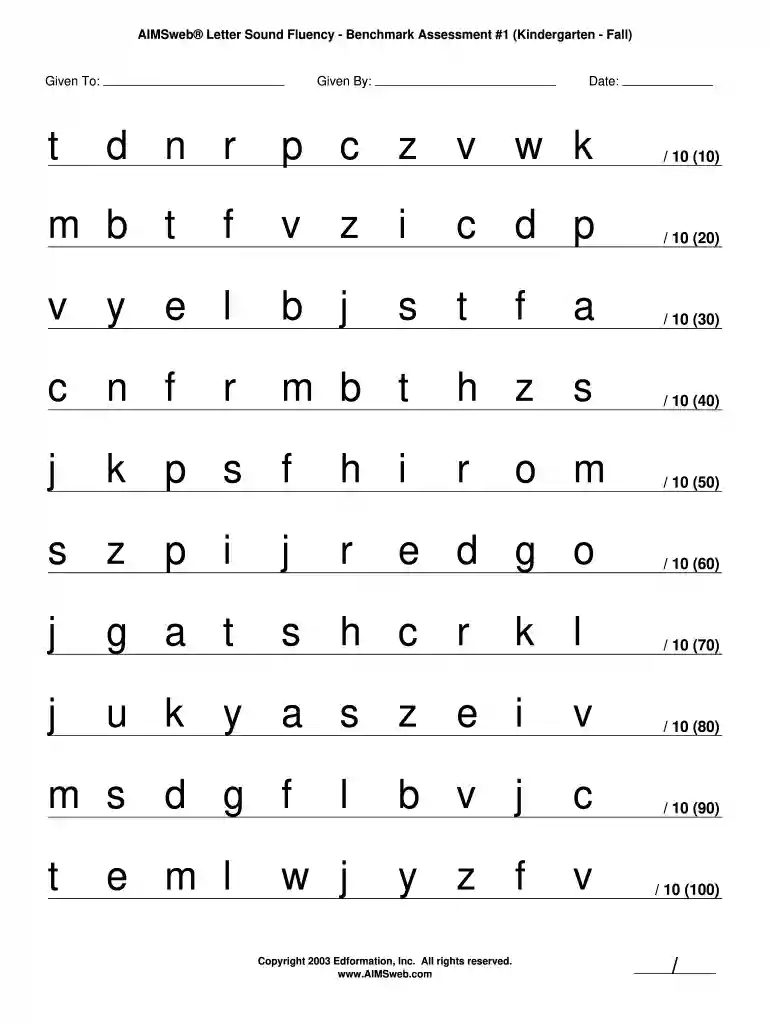
Letter sound fluency assessments are critical tools for evaluating students' phonemic awareness and reading readiness, especially in early childhood education. These assessments focus on how quickly and accurately students can identify or produce the sounds associated with letters, which is foundational for reading development.
The letter sound fluency assessment is often administered in various educational environments, including:
To effectively administer a letter sound fluency assessment, educators should consider the following strategies:
Various tools and activities can be integrated into letter sound fluency assessments, such as:
While conducting letter sound fluency assessments, teachers may face challenges such as:
Letter sound fluency assessments are invaluable in shaping early literacy development among students. By understanding their purpose, implementation, best practices, and common challenges, educators can leverage these assessments effectively to foster a love for reading and learning in young children.
At DocHub, your data security is our priority. We follow HIPAA, SOC2, GDPR, and other standards, so you can work on your documents with confidence.
Feb 6, 2025 This video provides additional practice for those who are just starting to administer DIBELS, as well as those who are looking for a refresher in how toRead more
To warm up, students can pull 1 card from each box and link them in a mini story. Let them practice in their groups for a few minutes and then its story time!!Read more
by KD Ritchey 2008 Cited by 73 This article compares 2 fluency-based assessments of letter sound knowledge: letter sound fluency and nonsense word fluency (NWF). Ninety-one children were


