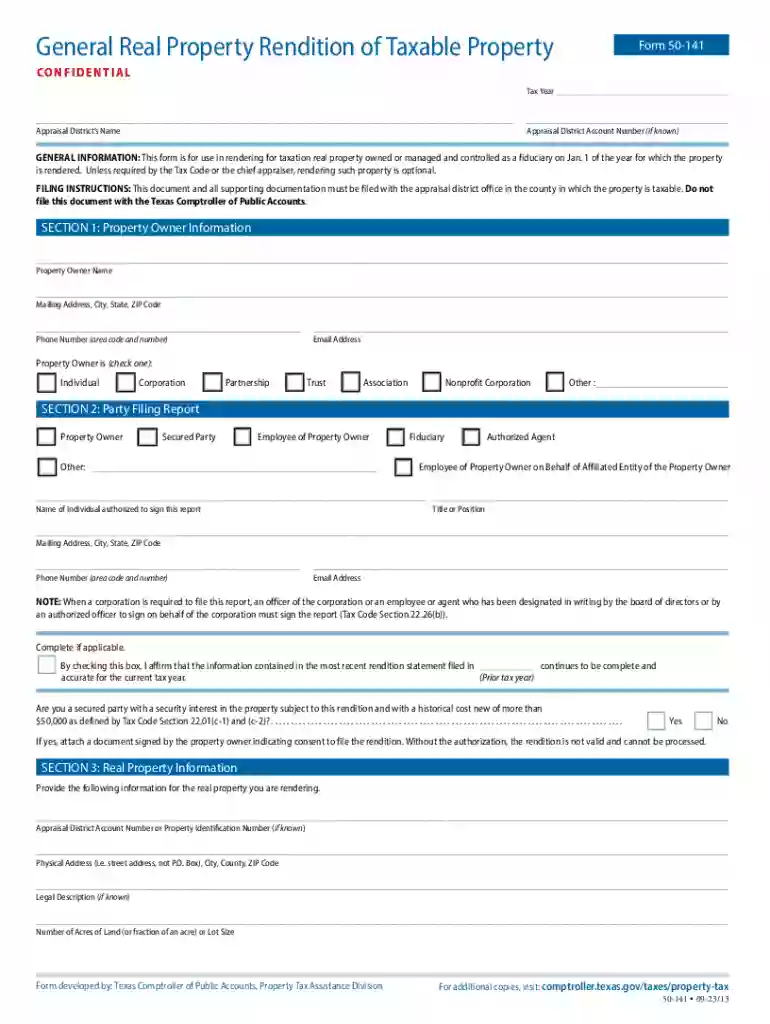
General Real Property Rendition of Taxable 2026

Get Form
General Real Property Rendition of Taxable Preview on Page 1

Here's how it works

01. Edit your form online
Type text, add images, blackout confidential details, add comments, highlights and more.

02. Sign it in a few clicks
Draw your signature, type it, upload its image, or use your mobile device as a signature pad.

03. Share your form with others
Send it via email, link, or fax. You can also download it, export it or print it out.

How to use or fill out General Real Property Rendition of Taxable

Form edit decoration
9.5
Ease of Setup
DocHub User Ratings on G2
9.0
Ease of Use
DocHub User Ratings on G2
  1. Click ‘Get Form’ to open it in the editor.
  2. Begin with Section 1: Property Owner Information. Fill in your name, mailing address, phone number, and email. Indicate your status by checking the appropriate box (Individual, Corporation, etc.).
  3. Proceed to Section 2: Party Filing Report. Select who is filing the report and provide the name and title of the authorized individual signing this report.
  4. In Section 3: Real Property Information, enter the appraisal district account number or property identification number, physical address, legal description, and size of the property.
  5. Continue in Section 3 by listing all buildings and improvements on the land. Optionally, provide an estimate of total market value for all properties described.
  6. Finally, complete Section 4: Affirmation and Signature. Ensure that you sign and date the form; notarization may be required unless exempt.

Start using our platform today to easily fill out your General Real Property Rendition of Taxable for free!

See more General Real Property Rendition of Taxable versions

We've got more versions of the General Real Property Rendition of Taxable form. Select the right General Real Property Rendition of Taxable version from the list and start editing it straight away!
Versions Form popularity Fillable & printable
2023 4.3 Satisfied (56 Votes)
2019 4.8 Satisfied (60 Votes)
2018 4.4 Satisfied (117 Votes)
2017 4.3 Satisfied (39 Votes)
2013 4.3 Satisfied (57 Votes)
be ready to get more

Complete this form in 5 minutes or less

Get form

Got questions?

We have answers to the most popular questions from our customers. If you can't find an answer to your question, please contact us.
Contact us
Personal property renditions (aka, personal property returns) require you to take a detailed inventory of your assets everything from laptops and lamps to heavy machinery across every location. As a result, one location can easily have tens of thousands of assets.
A rendition is a form that provides the appraisal district with taxable business property information. This form includes the business name and location, a description of assets, cost and acquisition dates, and an opinion of value for business personal property.
The four broad types of property taxes are land, improvements to land (immovable man-made objects, such as buildings), personal property (movable man-made objects) and intangible property. Real property (also called real estate or realty) is the combination of land and improvements.
In this informative video, we delve into the concept of property tax rendition, a crucial process for property owners to declare the value of their property to taxing authorities. By understanding property tax rendition, individuals can ensure accurate taxation assessments and compliance with tax laws.
Tax Savings: Winning a protest can lower your tax billnot just once, but year after year. That extra breathing room can make a big difference, especially for seniors, veterans, or anyone on a fixed income. Understanding Exemptions: The protest process also allows you to learn which exemptions apply to your situation.

People also ask

A rendition is a copy of a document in a format other than the original. Typically, the rendition is in a non-editable format and is distributed only for reference or hard copy printing while the original, editable source document is not distributed outside of the organization.
In California, paying someone elses taxes, even if done in good faith, is considered a gesture of goodwill or a means of avoiding a tax lien, but no matter the motive, payment does not transfer legal ownership.

Related links