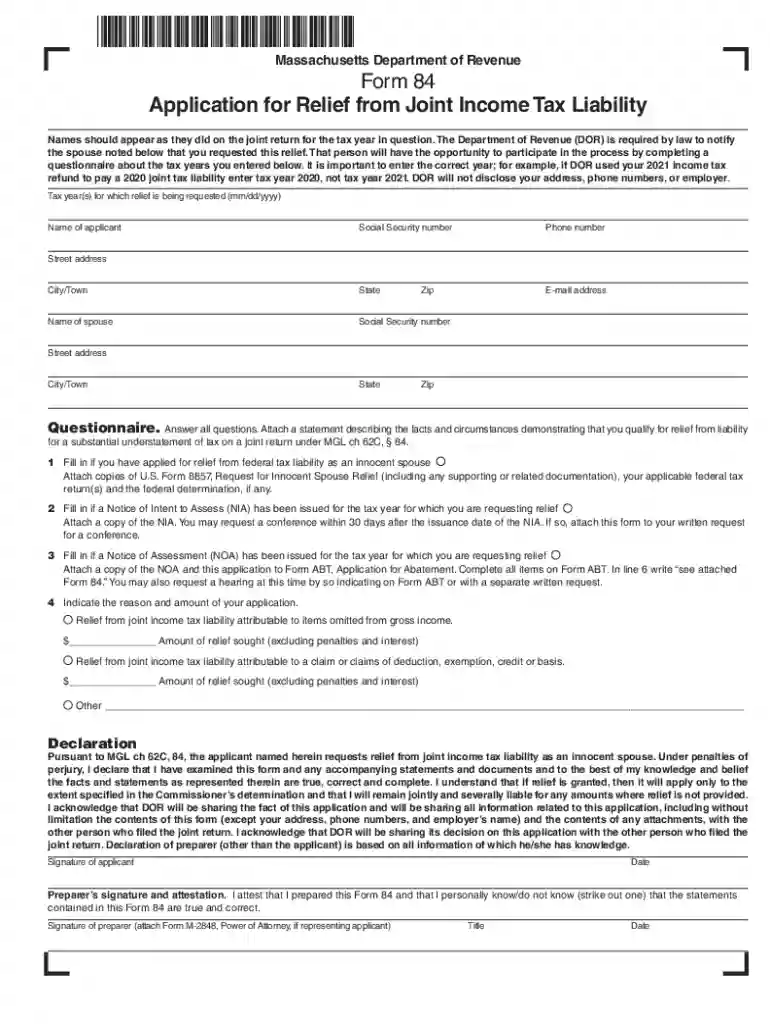
The Department of Revenue (DOR) is required by law to notify 2026

Get Form
The Department of Revenue (DOR) is required by law to notify Preview on Page 1

Here's how it works

01. Edit your form online
Type text, add images, blackout confidential details, add comments, highlights and more.

02. Sign it in a few clicks
Draw your signature, type it, upload its image, or use your mobile device as a signature pad.

03. Share your form with others
Send it via email, link, or fax. You can also download it, export it or print it out.

How to use or fill out The Department of Revenue (DOR) is required by law to notify

Form edit decoration
9.5
Ease of Setup
DocHub User Ratings on G2
9.0
Ease of Use
DocHub User Ratings on G2
  1. Click ‘Get Form’ to open it in the editor.
  2. Begin by entering your name as it appears on the joint return for the tax year in question. Ensure accuracy, as this information is crucial for processing your application.
  3. Fill in your Social Security number, phone number, city/town, state, and email address. This information will help DOR contact you regarding your application.
  4. Next, provide your spouse's name and Social Security number along with their street address and zip code. This ensures that both parties are notified about the relief request.
  5. Complete the questionnaire section by answering all questions thoroughly. Attach a statement detailing the facts that support your claim for relief from liability.
  6. If applicable, attach copies of any federal forms related to your claim for relief and any notices received from DOR regarding assessments.
  7. Finally, review all entries for accuracy before signing and dating the declaration at the bottom of the form.

Start using our platform today to complete your application quickly and efficiently!

See more The Department of Revenue (DOR) is required by law to notify versions

We've got more versions of the The Department of Revenue (DOR) is required by law to notify form. Select the right The Department of Revenue (DOR) is required by law to notify version from the list and start editing it straight away!
Versions Form popularity Fillable & printable
2023 4.4 Satisfied (49 Votes)
2022 4.6 Satisfied (56 Votes)
2019 4.2 Satisfied (53 Votes)
2012 4 Satisfied (39 Votes)
be ready to get more

Complete this form in 5 minutes or less

Get form

Got questions?

We have answers to the most popular questions from our customers. If you can't find an answer to your question, please contact us.
Contact us
For faster service on your current year tax, use our Wheres My Refund application: (608) 266-8100 in Madison, (414) 227-4907 in Milwaukee, or. toll free (866) WIS-RFND (947-7363) in other areas.
The Massachusetts DOR has various types of notices and bills that are issued to individuals and businesses if it is determined that additional taxes might be or are owed. Notices and bills ask for and provide information and request payment when necessary.
You must be 70 or older. For Clauses 41C and 41C, the eligible age may be reduced to 65 or older, by vote of the legislative body of your city or town. You must own and occupy the property as your domicile.
About the Massachusetts Department of Revenue (DOR) DORs mission is to gain full compliance with the tax, child support, and municipal finance laws of the Commonwealth. DOR is committed to enforcing these laws in a fair-minded and respectful manner.
Massachusetts Department of Revenue (DOR) Our mission is to gain full compliance with the tax, child support, and municipal finance laws of the Commonwealth.

Security and compliance

At DocHub, your data security is our priority. We follow HIPAA, SOC2, GDPR, and other standards, so you can work on your documents with confidence.

Learn more
ccpa2
pci-dss
gdpr-compliance
hipaa
soc-compliance

People also ask

The IRS sends notices and letters for the following reasons: You have a balance due. The IRS changed your return - You are due a larger or smaller refund The IRS has a question about your tax return. The IRS needs to verify your identity. The IRS needs additional information.
The Internal Revenue Service (IRS) administers and enforces U.S. federal tax laws.

Related links