



Form 507 Statement of Person Claiming an Income Tax Refund Due a Deceased Taxpayer 2026

Get Form
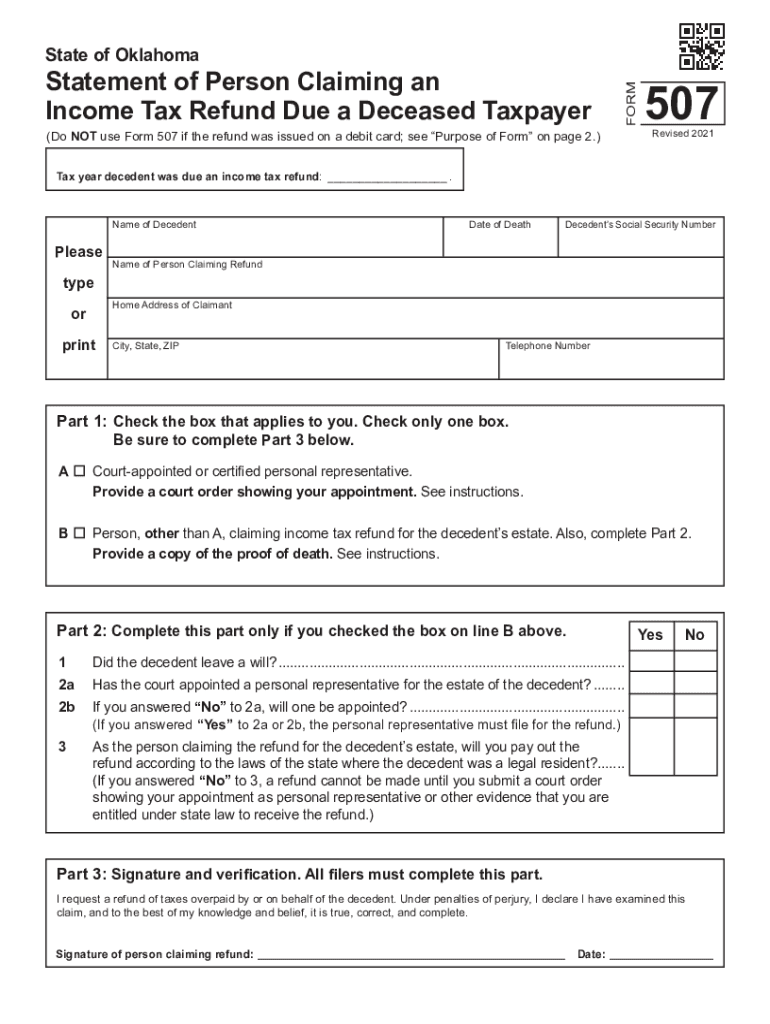
Form 507 Statement of Person Claiming an Income Tax Refund Due a Deceased Taxpayer Preview on Page 1

Here's how it works

01. Edit your form online
Type text, add images, blackout confidential details, add comments, highlights and more.

02. Sign it in a few clicks
Draw your signature, type it, upload its image, or use your mobile device as a signature pad.

03. Share your form with others
Send it via email, link, or fax. You can also download it, export it or print it out.

How to use or fill out Form 507 Statement of Person Claiming an Income Tax Refund Due a Deceased Taxpayer with DocHub

Form edit decoration
9.5
Ease of Setup
DocHub User Ratings on G2
9.0
Ease of Use
DocHub User Ratings on G2
  1. Click ‘Get Form’ to open it in the editor.
  2. Begin by entering the tax year for which the decedent was due a refund. Fill in the name, date of death, and Social Security number of the decedent.
  3. In Part 1, check the appropriate box indicating whether you are a court-appointed personal representative or another person claiming on behalf of the estate. Ensure to complete Part 3 if you select option B.
  4. If you checked box B in Part 1, proceed to Part 2. Answer questions regarding whether the decedent left a will and if a personal representative has been appointed.
  5. Complete Part 3 by signing and dating the form, confirming that all information provided is accurate. Attach any required documentation such as proof of death or court orders as necessary.

Start using our platform today to easily fill out Form 507 for free!

See more Form 507 Statement of Person Claiming an Income Tax Refund Due a Deceased Taxpayer versions

We've got more versions of the Form 507 Statement of Person Claiming an Income Tax Refund Due a Deceased Taxpayer form. Select the right Form 507 Statement of Person Claiming an Income Tax Refund Due a Deceased Taxpayer version from the list and start editing it straight away!
Versions Form popularity Fillable & printable
2021 4.8 Satisfied (46 Votes)
2016 4.2 Satisfied (67 Votes)
be ready to get more

Complete this form in 5 minutes or less

Get form

Got questions?

We have answers to the most popular questions from our customers. If you can't find an answer to your question, please contact us.
Contact us
Court-Appointed or Certified Personal Representative The representative must attach a copy of the court certificate showing their appointment to the return. In most cases, Form 1310 is not required if a copy of the court appointment is included. The IRS will issue the refund to the estate.
To get the refund, you must complete and attach Form 1310 to your fathers final return. You should check the box on Form 1310, line C; answer all the questions in Part II; and sign your name in Part III. You must also keep a copy of the death certificate or other proof of death for your records.
If you dont file taxes for a deceased person, the IRS can take legal action by placing a federal lien against the Estate. This essentially means you must pay the federal taxes before closing any other debts or accounts. If not, the IRS can demand the taxes be paid by the legal representative of the deceased.
If the deceased was due to receive a tax refund, determining who is entitled to the money is a key issue for the surviving spouse, family members and estate representatives. In most cases, the IRS allows those legally responsible for the estate to claim the refund.
Title the account clearly: Estate of [Decedent Name], Deceased[Your Name], Personal Representative. Endorse refund checks with the estate name and your representative title before depositing.

Security and compliance

At DocHub, your data security is our priority. We follow HIPAA, SOC2, GDPR, and other standards, so you can work on your documents with confidence.

Learn more
ccpa2
pci-dss
gdpr-compliance
hipaa
soc-compliance

People also ask

Processing times can vary, but it typically takes several weeks for the IRS to process Form 1310 and issue a refund. What if the deceased taxpayer owes taxes? If the deceased taxpayer owes taxes, the amount due must be paid before any refund can be issued.
On the final tax return, the surviving spouse or representative should note that the person has died. The IRS doesnt need a copy of the death certificate or other proof of death. Usually, the representative filing the final tax return is named in the persons will or appointed by a court.
The steps to be followed for raising the refund re-issue request are: Login to the e-filing portal as the legal heir. Navigate to Services and then select Refund Reissue. Enter the PAN of the deceased taxpayer. Verify the assessment year and ensure that they are correct.

Related links

