Reporting Agent Authorization Instructions This form must 2026

Get Form
medicare part a application form Preview on Page 1

Here's how it works

01. Edit your medicare part a application form online
Type text, add images, blackout confidential details, add comments, highlights and more.

02. Sign it in a few clicks
Draw your signature, type it, upload its image, or use your mobile device as a signature pad.

03. Share your form with others
Send medicare prior authorization form via email, link, or fax. You can also download it, export it or print it out.

Definition & Meaning

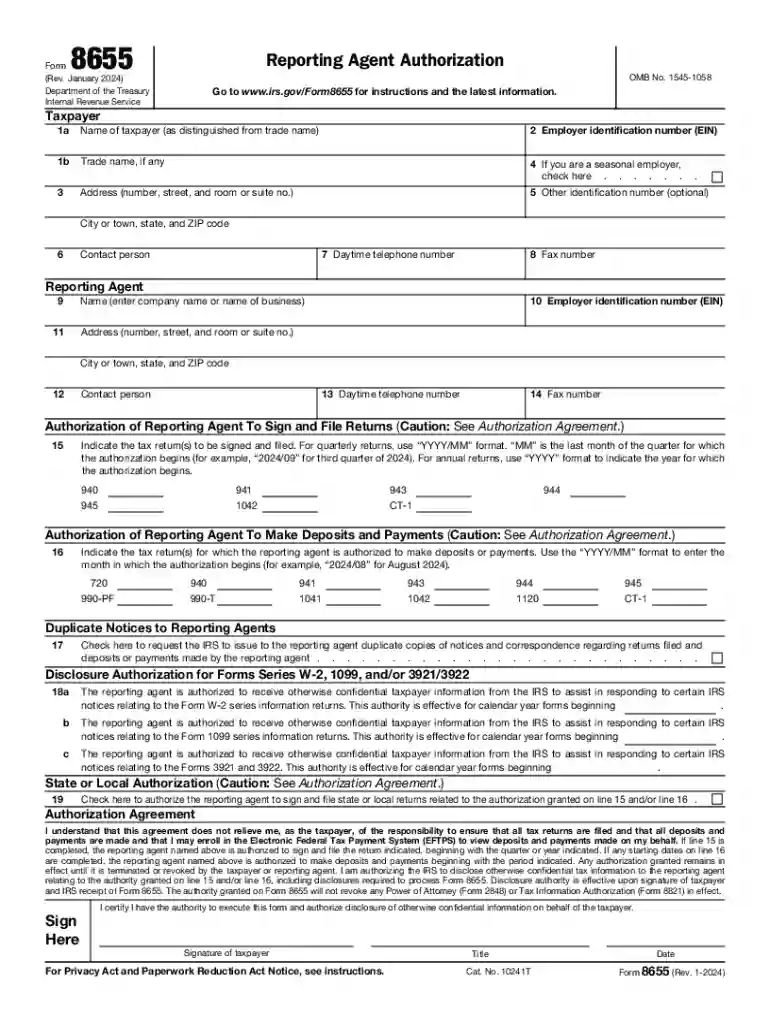
The Reporting Agent Authorization Form, more formally known as Form 8655, is a critical document provided by the IRS. This form allows taxpayers to authorize a reporting agent to sign and file tax returns, make deposits, and receive confidential taxpayer information on their behalf. By completing Form 8655, taxpayers can delegate responsibilities, ensuring that their tax obligations are managed efficiently by professionals.

Form 8655 primarily serves businesses that require assistance with tax filings. It grants the appointed reporting agent the authority to interact with the IRS on behalf of the taxpayer, streamlining communication and minimizing the burden on the taxpayer.

How to Use the Reporting Agent Authorization Instructions This Form Must

Utilizing the Reporting Agent Authorization Form involves understanding the procedures and steps required to complete it efficiently. Here’s a step-by-step breakdown to appropriately use the form:

  1. Access the Form: Obtain Form 8655 from official IRS resources or through authorized tax preparation software that supports this document.

  2. Complete Required Sections: Enter the taxpayer's information, including name, address, and identification number, as well as the reporting agent's details.

  3. Specify Authorizations: Clearly delineate the types of tax matters and tax periods the reporting agent is authorized to handle. Ensure that all intended authorizations are correctly marked.

  4. Sign and Date: The form must be signed and dated by both the taxpayer and an authorized representative of the reporting agent to be valid.

  5. Submit the Form: Submit the completed form according to the IRS guidelines, typically through mail or electronic submission, depending on the provisions stated in the instructions.

Steps to Complete the Reporting Agent Authorization Instructions This Form Must

Completing Form 8655 involves several critical steps to ensure accuracy and compliance. Here's a comprehensive guide:

  1. Identify Parties: Accurately fill out the taxpayer's and reporting agent's information, including legal names, addresses, and EINs or SSNs.

  2. Define Scope of Authority: Indicate the specific tax returns, forms, and operations the reporting agent is authorized to handle, such as payroll filings or business tax deposits.

  3. Designation of Tax Periods: Clearly list the tax periods covered by the authorization. This ensures precise delegation of tax responsibilities and periods for which the agent's authority is granted.

  4. Review IRS Instructions: Before finalizing, review the IRS instructions attached to the form to avoid common errors and omissions. This can prevent processing delays and legal complications.

  5. Obtain Necessary Signatures: Both the taxpayer and the reporting agent must sign the form. It is advisable to double-check all filled sections before submission.

  6. Track Submission: If filed electronically, ensure a confirmation receipt is received. For mail submissions, use certified mail or a similar service to track delivery to the IRS.

Key Elements of the Reporting Agent Authorization Instructions This Form Must

The essential components of Form 8655 enhance understanding and ensure compliance. Each element provides crucial information that defines the relationship and responsibilities between the taxpayer and the reporting agent:

  • Taxpayer Information: Includes name, address, EIN/SSN, and contact details.
  • Reporting Agent Details: Name, address, firm (if applicable), and EIN.
  • Authorization Scope: Specific tax forms and periods the agent is authorized to manage.
  • Signature Requirement: Signatures from both parties to authenticate the authorization.
  • Date of Authorization: The effective date from which the authorization begins.

Legal Use of the Reporting Agent Authorization Instructions This Form Must

Legal considerations are vital when utilizing Form 8655, as they govern the scope and execution of the authority given to the reporting agent. The form must be used in compliance with IRS regulations to avoid penalties or invalidation:

  • Adherence to IRS Guidelines: Ensure all instructions provided by the IRS are followed precisely.
  • Confidential Information Handling: Authorized agents must manage taxpayer information confidentially and adhere to any restrictions specified.
  • Revocation Procedures: If necessary, the taxpayer must follow official procedures to revoke an agent's authorization and notify the IRS immediately.

IRS Guidelines

IRS guidelines for Form 8655 provide critical instructions to ensure that the authorization is both valid and enforceable. These guidelines are designed to assist taxpayers and agents in correctly navigating the authorization process:

  • Submission Methods: Detailed instructions on submitting the form through different channels.
  • Updates on Tax Return Filings: Effective for filings from 2024, ensuring taxpayers are informed of any changes.
  • Guidance on Changes and Revocations: Processes to modify or cancel the authorization.

Filing Deadlines / Important Dates

Filing deadlines and timely submissions are crucial for compliance. Form 8655 needs to be updated and filed before any tax activities by the reporting agent take place:

  • Initial Filing Requirements: The form must be submitted before the agent undertakes any authorized activities.
  • Renewal or Update Deadlines: Taxpayers should check for updates regularly, especially during significant IRS changes to ensure continuity of authorization.

Penalties for Non-Compliance

Failing to adhere to the requirements and guidelines of Form 8655 can result in legal repercussions. Understanding these penalties helps prevent accidental non-compliance:

  • Civil Penalties: Monetary fines if the IRS determines the authorization was improperly granted or maintained.
  • Legal Repercussions: Possible legal action against either party if there are breaches of confidentiality or unauthorized access to taxpayer information.
  • Tax Filing Errors: Incorrect filings due to miscommunication between the taxpayer and agent.

Required Documents

When filing Form 8655, ensure all necessary documentation is readily available and submitted alongside the form if required:

  • Proof of Identity: Valid identification for both taxpayer and agent.
  • Supplementary Authorizations: Any additional documents that support the authorization if requested by the IRS.
  • Confirmation Receipts: For electronically submitted forms, maintaining a record of the confirmation number is crucial for future reference and clarifications.

See more Reporting Agent Authorization Instructions This form must versions

We've got more versions of the Reporting Agent Authorization Instructions This form must form. Select the right Reporting Agent Authorization Instructions This form must version from the list and start editing it straight away!
Versions Form popularity Fillable & printable
2024 4.6 Satisfied (56 Votes)
2018 4.8 Satisfied (38 Votes)
2014 4.4 Satisfied (550 Votes)
2012 4.2 Satisfied (74 Votes)
2012 4 Satisfied (52 Votes)
2009 4.6 Satisfied (37 Votes)
2008 4 Satisfied (22 Votes)
be ready to get more

Complete this form in 5 minutes or less

Get form

Got questions?

We have answers to the most popular questions from our customers. If you can't find an answer to your question, please contact us.
Contact us
This form is used by companies that provide payroll services, such as payroll providers and accountants, to file forms like the 940, 941, and 944 on behalf of their clients. The Form 8655 is required for any third-party reporting agent that wants to file forms electronically on behalf of their clients.
A Reporting Agent is an accounting service, franchiser, bank or other person who complies with Revenue Procedure 2012-32 and is authorized to prepare and sign employment tax returns electronically for a taxpayer. Reporting Agents may transmit their own returns or use the services of a third-party transmitter.
Use Form 2848 to authorize an individual to represent you before the IRS. The individual you authorize must be a person eligible to practice before the IRS.
A Reporting Agent must complete Form 8655, Reporting Agent Authorization PDF, for each client for whom a return will be filed. Reporting Agents must submit Form 8655 to the IRS prior to or at the same time that they submit an IRS e-file application.
Use this form to authorize a reporting agent to: Sign and file certain returns; Make deposits and payments for certain returns; Receive duplicate copies of tax information, notices, and other written and/or electronic communication regarding any authority granted; and.

Security and compliance

At DocHub, your data security is our priority. We follow HIPAA, SOC2, GDPR, and other standards, so you can work on your documents with confidence.

Learn more
ccpa2
pci-dss
gdpr-compliance
hipaa
soc-compliance
be ready to get more

Complete this form in 5 minutes or less

Get form

People also ask

Withdrawal/revocation A reporting agent can withdraw their authorities by filing a statement with the IRS or by using the delete process. The receipt of a new Form 8655 revokes a prior reporting agent authorization beginning with the period indicated on the new Form 8655.
IRS Form 8655, Reporting Agent Authorization, gives a reporting agent the ability to file forms and make payroll tax deposits on your behalf. An IRS reporting agent can use your EIN and sign forms for you. The reporting agent might be an accountant or a payroll tax filing service.
A credit report authorization form is a document authorizing an individual or organization to perform a credit check on an individual. The Fair Credit Reporting Act requires that a third party obtain consent before viewing another persons credit history.

medicare redetermination form