




01. Edit your 1099 div online
Type text, add images, blackout confidential details, add comments, highlights and more.

Type text, add images, blackout confidential details, add comments, highlights and more.

Draw your signature, type it, upload its image, or use your mobile device as a signature pad.

Send 1099 div form via email, link, or fax. You can also download it, export it or print it out.
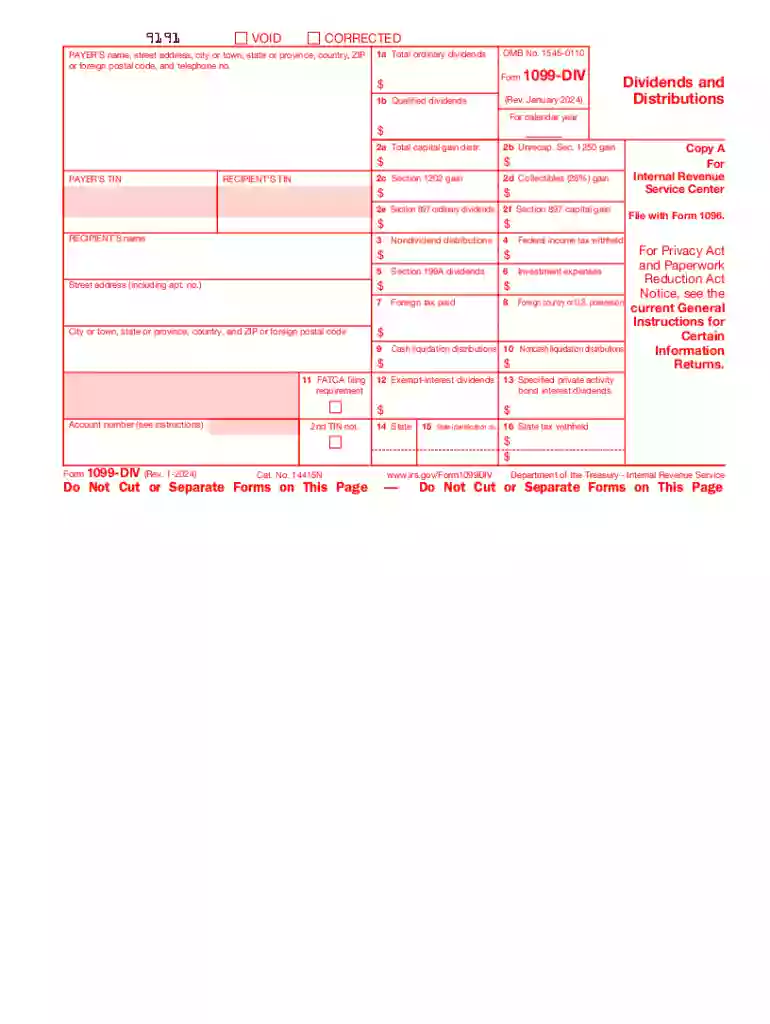
Form 1099-DIV, officially known as the "Dividends and Distributions," is a tax document utilized by the Internal Revenue Service (IRS). This form reports dividends and other distributions to taxpayers who receive payments of $10 or more in dividends, or any amount of capital gains distributions. It provides essential information for taxpayers to report specific income on their tax returns. The form ensures that all parties accurately report dividend income, helping to establish a transparent financial relationship between taxpayers and the IRS. By detailing the types of distributions received, it enables precise tax filing.
Form 1099-DIV is divided into several boxes designed to declare various types of dividends and distributions. Some key elements include:
Ordinary Dividends (Box 1a): Reflects total ordinary dividends received during the tax year. These dividends are generally taxable as ordinary income.
Qualified Dividends (Box 1b): Displays the portion of ordinary dividends that qualify for reduced tax rates.
Capital Gain Distributions (Box 2a): Represents the amount of capital gains distributed, typically subject to a different tax rate than ordinary income.
Nondividend Distributions (Box 3): Denotes distributions not subject to tax until the cost basis of the stock is recovered.
Federal Income Tax Withheld (Box 4): Reports any tax withheld from the distributions and payable to the IRS.
These components are vital for correctly assessing and reporting income to comply with tax obligations.
Form 1099-DIV is generally issued by financial institutions that distribute dividends. Taxpayers do not need to request this form manually. Instead, financial institutions and brokerage firms automatically send it to eligible recipients after the end of the calendar year. If taxpayers need a copy, they can contact their broker or download an official version from the IRS website. Ensuring accurate receipt and retention of this form is crucial for completing tax filings accurately and avoiding potential discrepancies with the IRS.
The form is primarily completed by the issuer, such as a bank or investment company. However, ensuring accuracy in the information provided is critical for recipients. Key steps include:
Review Personal Information: Verify name, address, and tax identification number.
Check Dividend Details: Ensure the ordinary and qualified dividends reflect accurate amounts from yearly income.
Confirm Distribution Values: Cross-check capital gain and nondividend distributions for inaccuracies.
Ensure Correct Tax Withholding: Validate any federal tax withheld relates accurately to the amounts reported.
Retain Form for Tax Filing: Use the information to report income accurately on tax returns.
Efficient verification prevents future complications and aligns financial records with IRS expectations.
A wide variety of taxpayers receive and use Form 1099-DIV. This group includes:
Individual Investors: Individuals with stock, mutual fund, or other financial investments.
Retirees: Citizens living on investment income.
Businesses: Corporate entities receiving distributions from investments.
Financial institutions and brokerage firms issue the form, so anyone involved in investment activities is likely to encounter it come tax season. For all recipients, understanding the details on this form is integral to fulfilling tax responsibilities and optimizing tax strategies.
The IRS stipulates specific guidelines for Form 1099-DIV. Issuers must provide these forms to recipients by January 31st. Filing with the IRS follows shortly thereafter, with electronic submissions required by March 31st. Compliance with these deadlines is mandatory to avoid penalties. Special guidelines exist for corrections, non-standard situations, or residents of particular regions, ensuring that all potential scenarios are accounted for in tax filings.
Penalties may arise if Form 1099-DIV is issued late, inaccurately, or not at all. Situations incurring penalties include:
Failing to Issue on Time: Missing the IRS stipulated deadline can result in fines.
Incomplete Information: Fines are applied if information provided is incorrect or missing necessary components.
Failure to File with IRS: Penalties escalate based on the length of the delay.
Ensuring compliance with requirements prevents costly fines and mitigates financial risk.
While Form 1099-DIV pertains to federal income taxes, state tax reporting can vary. Some states may not tax dividends or may tax them at different rates. It's important to consult state-specific tax forms and guidelines to ensure local requirements are met. Moreover, residents should examine any reciprocal agreements that impact dividend taxation. Understanding these nuances is crucial for accurate tax reporting and compliance with both federal and state regulations.
We've got more versions of the 1099 div form. Select the right 1099 div version from the list and start editing it straight away!
| Versions | Form popularity | Fillable & printable |
|---|---|---|
| 2024 | 4.6 Satisfied (33 Votes) | |
| 2022 | 4.1 Satisfied (42 Votes) | |
| 2021 | 4.8 Satisfied (68 Votes) | |
| 2020 | 4.2 Satisfied (95 Votes) | |
| 2019 | 4.4 Satisfied (737 Votes) | |
| 2018 | 4.3 Satisfied (130 Votes) | |
| 2017 | 4.3 Satisfied (61 Votes) | |
| 2016 | 4.4 Satisfied (496 Votes) | |
| 2015 | 4 Satisfied (23 Votes) | |
| 2014 | 4.3 Satisfied (65 Votes) | |
| 2013 | 4.2 Satisfied (31 Votes) | |
| 2012 | 4.3 Satisfied (40 Votes) | |
| 2011 | 4 Satisfied (50 Votes) | |
| 2010 | 4 Satisfied (27 Votes) | |
| 2009 | 4.3 Satisfied (63 Votes) |
At DocHub, your data security is our priority. We follow HIPAA, SOC2, GDPR, and other standards, so you can work on your documents with confidence.
Shows total ordinary dividends that are taxable. Include this amount on the Ordinary dividends line of Form 1040 or 1040-SR. Also report it on. Schedule B (Read more
Dec 31, 2025 The Form 1099DIV (box 2a) or the funds statement will tell you the amount you are to report as a capital gain distribution. Capital gainRead more


