Penalty and Interest RatesDepartment of Revenue 2026

Get Form
Penalty and Interest RatesDepartment of Revenue Preview on Page 1

Here's how it works

01. Edit your form online
Type text, add images, blackout confidential details, add comments, highlights and more.

02. Sign it in a few clicks
Draw your signature, type it, upload its image, or use your mobile device as a signature pad.

03. Share your form with others
Send it via email, link, or fax. You can also download it, export it or print it out.

How to use or fill out Penalty and Interest Rates Department of Revenue with our platform

Form edit decoration
9.5
Ease of Setup
DocHub User Ratings on G2
9.0
Ease of Use
DocHub User Ratings on G2
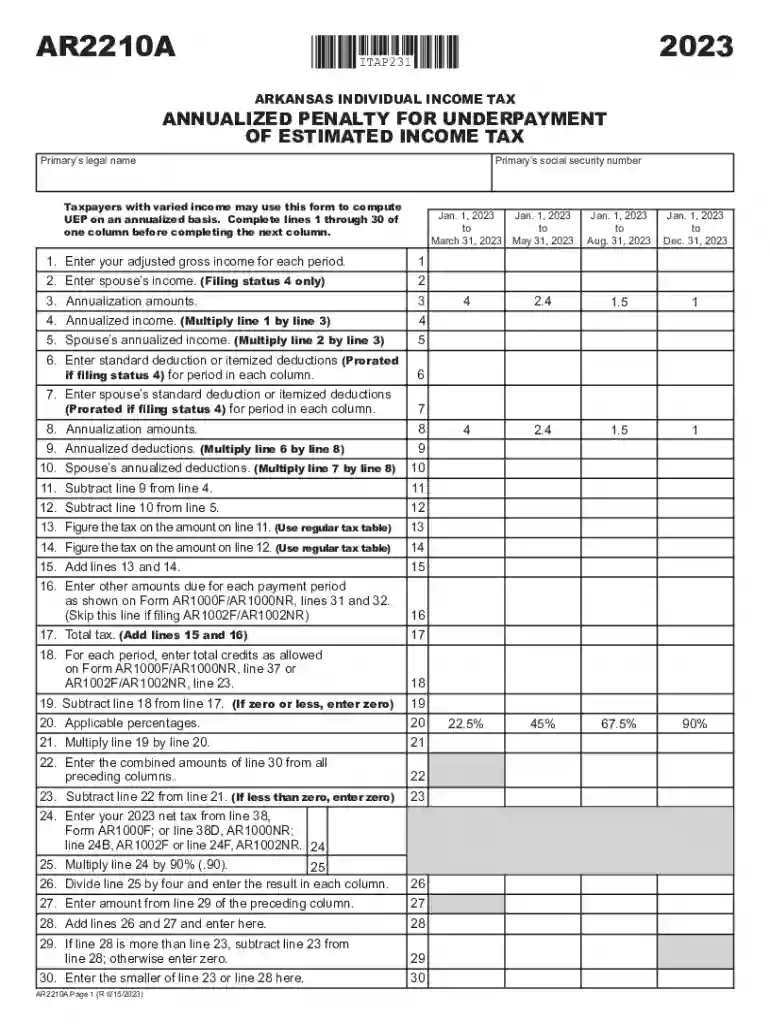
  1. Click ‘Get Form’ to open the Penalty and Interest Rates form in the editor.
  2. Begin by entering your adjusted gross income for each period in line 1. If applicable, enter your spouse’s income in line 2.
  3. Proceed to line 3 to input the annualization amounts, then calculate your annualized income by multiplying line 1 by line 3 in line 4.
  4. For deductions, enter either the standard deduction or itemized deductions in line 6, prorated for each period. Repeat this for your spouse's deductions in line 7.
  5. Continue filling out lines 11 through 30 as instructed, ensuring you accurately compute taxes and penalties based on the provided guidelines.

Start using our platform today to easily complete your Penalty and Interest Rates form for free!

See more Penalty and Interest RatesDepartment of Revenue versions

We've got more versions of the Penalty and Interest RatesDepartment of Revenue form. Select the right Penalty and Interest RatesDepartment of Revenue version from the list and start editing it straight away!
Versions Form popularity Fillable & printable
2023 4.1 Satisfied (40 Votes)
2022 4.5 Satisfied (25 Votes)
2021 4.9 Satisfied (47 Votes)
2020 4 Satisfied (55 Votes)
be ready to get more

Complete this form in 5 minutes or less

Get form

Got questions?

We have answers to the most popular questions from our customers. If you can't find an answer to your question, please contact us.
Contact us
HMRC charge interest on late tax payments (and late paid penalties) to compensate them for the delay in payment. Late payment interest broadly puts you and HMRC in a similar commercial position to that you would have been in had you paid the tax on time.
7% for underpayments (taxes owed but not fully paid). 9% for large corporate underpayments.
a penalty arises because of a lack of reasonable care, the penalty will be between 0% and 30% of the extra tax due. the error is deliberate, the penalty will be between 20 and 70% of the extra tax due. the error is deliberate and concealed, the penalty will be between 30 and 100% of the extra tax due.
The IRS charges 0.5% of your unpaid taxes for each month or part of a month that your taxes remain unpaid. The failure to pay penalty has a maximum charge of 25% of your unpaid taxes. Be sure to pay your taxes within 10 days of the failure to pay notice. After 10 days, the penalty charge increases to 1%.
The penalty for late payment is 1/2% (1/4% for months covered by an installment agreement) of the tax due for each month or part of a month your payment is late. The penalty increases to 1% per month if we send a notice of intent to levy, and you dont pay the tax due within 10 days from the date of the notice.

Security and compliance

At DocHub, your data security is our priority. We follow HIPAA, SOC2, GDPR, and other standards, so you can work on your documents with confidence.

Learn more
ccpa2
pci-dss
gdpr-compliance
hipaa
soc-compliance
be ready to get more

Complete this form in 5 minutes or less

Get form

People also ask

A credit card issuer can apply a penalty APR when you make late payments, your payment is returned because of insufficient funds or a closed account, or you exceed your credit limit.
What is a penal interest rate? The penal interest rate is the rate at which the financial institution will charge the penalty in case of delay in repayment. The rate is not fixed and depends on the financial institutions policy.

Related links