



01. Edit your 1120 reit online
Type text, add images, blackout confidential details, add comments, highlights and more.

Type text, add images, blackout confidential details, add comments, highlights and more.
Draw your signature, type it, upload its image, or use your mobile device as a signature pad.

Send 1120 reit form via email, link, or fax. You can also download it, export it or print it out.
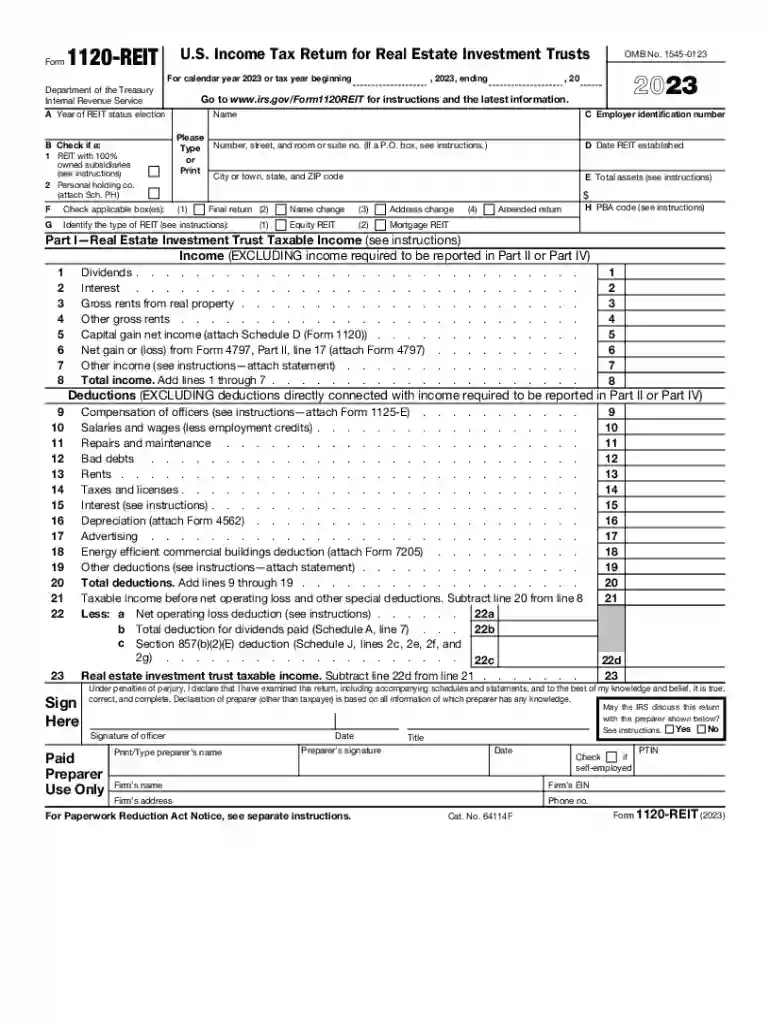
The Federal Form 1120-REIT is the U.S. Income Tax Return specifically for Real Estate Investment Trusts (REITs), focusing on reporting taxable income, deductions, and taxes owed for the fiscal year. This form enables REITs to comply with IRS regulations by providing a structured method to disclose their financial activities, ensuring taxation is appropriately applied. A REIT is a company that owns, operates, or finances income-generating real estate, and the specific tax return is adapted to address their unique financial structures and operations.
Gather Required Documents: Start by collecting documentation related to the REIT's income, expenses, and previous tax filings. This might include profit and loss statements, capital gains reports, and shareholder information.
Report Income Sources: Enter all rental income, dividends, and any other relevant income on the form. Ensure each source is accurately documented, as discrepancies can lead to IRS audits.
Deduct Eligible Expenses: List all applicable deductions, such as mortgage interest, depreciation, and maintenance costs. Accurately claiming these expenses can significantly impact the trust's taxable income.
Calculate Taxable Income: Subtract allowable deductions from the total income to identify the taxable income. This figure is critical as it forms the basis for assessing tax liabilities.
Complete Additional Sections: Fill out any additional parts of the form that pertain to specific operations or financial activities of the REIT. These sections may include detailed schedules related to debt and equity structures.
Review and Verify Information: Double-check all entries for accuracy and compliance with IRS guidelines to avoid potential penalties or the need for amendments post-submission.
Submit the Form: Choose the preferred submission method, whether by mail or electronically. Note that electronic submission is often faster and provides instant confirmation of receipt.
REIT: A Real Estate Investment Trust, which pools funds from multiple investors to purchase and manage real estate properties.
Taxable Income: The income amount on which the tax liability is assessed, calculated after all deductions and adjustments are applied.
Deduction: Specific expenses subtracted from gross income to reduce the taxable income, such as depreciation or interest expense.
Dividend: A portion of earnings distributed to shareholders, which must be reported on the form.
Comprehension of IRS regulations surrounding Form 1120-REIT is crucial for compliance. All instructions provided by the IRS should be followed meticulously to meet federal legal requirements. Important guidelines include maintaining accurate records of all financial transactions, adhering to deadlines, and ensuring that all reported information is truthful and complete. The IRS provides a detailed instruction booklet, which should be consulted to clarify complex matters or when new legislative changes come into effect.
The typical deadline for submitting the Form 1120-REIT is March 15 for calendar-year taxpayers. If this date falls on a weekend or federal holiday, the due date is the following business day. Late submissions may incur penalties unless an extension is filed and approved beforehand. It is essential for REITs to mark these dates on their calendars and prepare all necessary documents well in advance to avoid last-minute issues.
These documents include:
Forms can be submitted both electronically and through traditional mail. Electronic filing is fast and ensures immediate confirmation. Paper submissions should only be considered if electronic access is unavailable or if required by specific regulations or guidelines. Each method's specifications are distinct, so ensuring the selected method adheres to IRS instructions is important.
Failing to submit Form 1120-REIT accurately and on time results in monetary penalties and potentially more severe consequences from the IRS, such as audits or further investigations. Penalties can accrue rapidly, particularly for repeated offenses or intentional non-compliance. Ensuring full completion and timely submission is a critical compliance aspect for any REIT.
For ease, various tax software tools, such as TurboTax and QuickBooks, can assist in the completion and submission of Form 1120-REIT. These programs help automate calculations, check for errors, and streamline the entire process by directly interfacing with IRS systems for electronic submissions. Choosing the right software that complements your financial systems and accurately meets IRS requirements is advantageous.
We've got more versions of the 1120 reit form. Select the right 1120 reit version from the list and start editing it straight away!
| Versions | Form popularity | Fillable & printable |
|---|---|---|
| 2025 | 4.5 Satisfied (52 Votes) | |
| 2024 | 4.4 Satisfied (24 Votes) | |
| 2023 | 4.6 Satisfied (20 Votes) | |
| 2022 | 4.1 Satisfied (57 Votes) | |
| 2021 | 4.8 Satisfied (246 Votes) | |
| 2020 | 4.3 Satisfied (199 Votes) | |
| 2019 | 4.3 Satisfied (223 Votes) | |
| 2018 | 4.4 Satisfied (117 Votes) | |
| 2017 | 4.3 Satisfied (50 Votes) | |
| 2016 | 4.4 Satisfied (280 Votes) | |
| 2015 | 4.3 Satisfied (163 Votes) |
You need to use only trustworthy software solutions with strong data protection compliance to approve your paperwork electronically. DocHub is just the type of editor you need! It stores data on Amazon Web Servers and complies with all necessary security requirements and eSignature regulations, so it’s a trusted way to electronically sign your Federal Form 1120-REIT (U S Income Tax Return for Real or other documents using this tool.
Document editing with DocHub is equally convenient on desktop and mobile devices. You just need an internet browser to edit your Federal Form 1120-REIT (U S Income Tax Return for Real on Android. Open our site and sign in to access the tools you need. Add your file and introduce your intended changes. After that, you can keep your form in your file storage or send it out immediately.
At DocHub, your data security is our priority. We follow HIPAA, SOC2, GDPR, and other standards, so you can work on your documents with confidence.
Mar 31, 2026 Real Estate Investment Trusts file this form to report their income, gains, losses, deductions, credits, certain penalties and income tax
Reproducible copies of federal tax forms and instructions. Subjects. Real estate investment trusts -- Taxation -- United States -- Periodicals. Real estate


