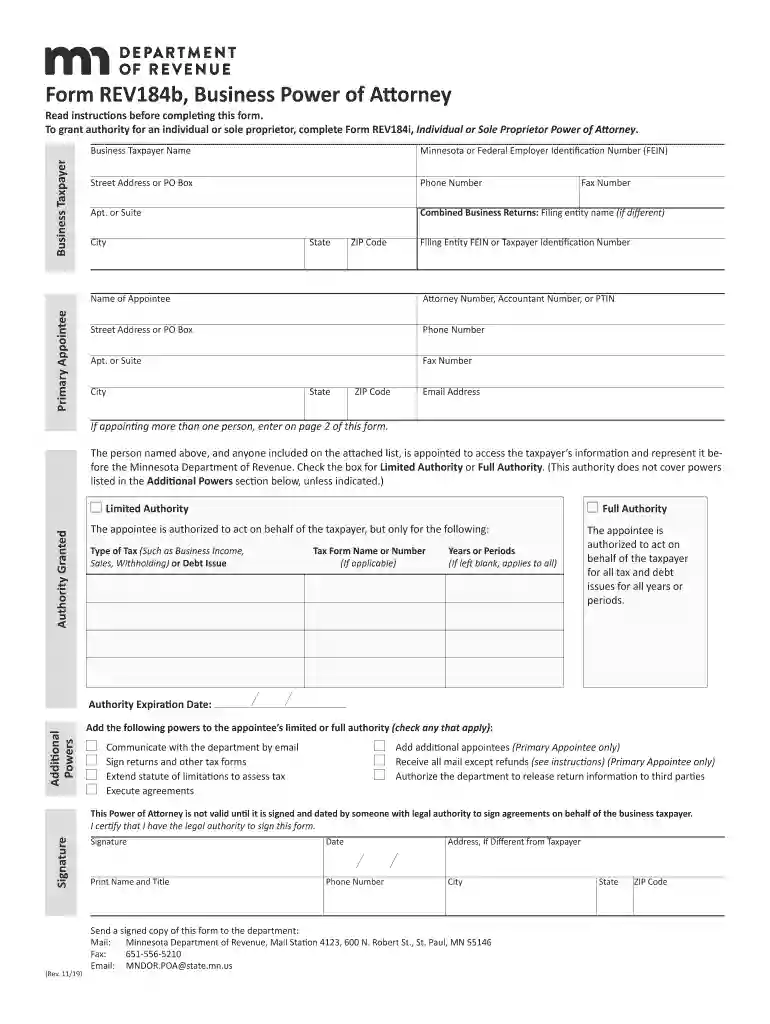
REV184-b, Business Power of Attorney 2026

Get Form
REV184-b, Business Power of Attorney Preview on Page 1

Here's how it works

01. Edit your form online
Type text, add images, blackout confidential details, add comments, highlights and more.

02. Sign it in a few clicks
Draw your signature, type it, upload its image, or use your mobile device as a signature pad.

03. Share your form with others
Send it via email, link, or fax. You can also download it, export it or print it out.

How to use or fill out REV184-b, Business Power of Attorney with our platform

Form edit decoration
9.5
Ease of Setup
DocHub User Ratings on G2
9.0
Ease of Use
DocHub User Ratings on G2
  1. Click ‘Get Form’ to open the REV184-b in the editor.
  2. Begin by entering the business taxpayer’s name and contact information. Ensure accuracy as this identifies your business.
  3. Input the Federal Employer Identification Number (FEIN) or Minnesota Tax ID number for proper identification.
  4. For businesses filing combined returns, provide the name and ID number of the entity responsible for filing.
  5. Enter the primary appointee’s details, including their name and contact information. Remember, only one primary appointee can receive correspondence from the department.
  6. Decide on granting full authority or limited authority to the appointee. Specify any tax types or periods if opting for limited authority.
  7. Select any additional powers you wish to grant, such as signing returns or communicating via email.
  8. Finally, sign and date the form. Ensure that it is signed by someone with legal authority on behalf of your business before submission.

Start using our platform today to streamline your document editing and signing process for free!

See more REV184-b, Business Power of Attorney versions

We've got more versions of the REV184-b, Business Power of Attorney form. Select the right REV184-b, Business Power of Attorney version from the list and start editing it straight away!
Versions Form popularity Fillable & printable
2019 4.8 Satisfied (83 Votes)
be ready to get more

Complete this form in 5 minutes or less

Get form

Got questions?

We have answers to the most popular questions from our customers. If you can't find an answer to your question, please contact us.
Contact us
While there are many types of powers of attorney, each with different functions, none of them persist through death. Put simply, there are no circumstances under which an agent can withdraw money after death. TELL US WHAT HAPPENED. WELL BE IN TOUCH SOON.
The Durable Power of Attorney or DPOA is the strongest among the different POAs. This document gives the agent broad and unlimited powers. Here are some reasons why: It remains in effect even if the principal becomes incapacitated.
As a business owner, you have the authority to make choices on behalf of your LLC. However, there may be instances where you cannot personally handle these matters due to illness, travel, or a busy schedule. In such cases, a Power of Attorney (POA) is instrumental in ensuring the smooth operation of the business.
A durable POA may be necessary if you want to ensure that your financial and legal affairs are taken care of in the event of incapacitation, while a limited or springing POA may be more appropriate if you only want to grant someone else the authority to make certain decisions under specific circumstances.
A Company Power of Attorney (PoA), also called a Corporate Power of Attorney, is a legal document that grants a business the ability to authorize an individual or entity to act on its behalf. This authority can cover signing contracts, managing finances, handling legal matters, and making key business decisions.

Security and compliance

At DocHub, your data security is our priority. We follow HIPAA, SOC2, GDPR, and other standards, so you can work on your documents with confidence.

Learn more
ccpa2
pci-dss
gdpr-compliance
hipaa
soc-compliance
be ready to get more

Complete this form in 5 minutes or less

Get form

People also ask

Unlike power of attorney, a California conservatorship is done through a court order, has more steps involved, and is not initiated by the person whose rights are being transferred. Here the court decides when a person is incapacitated and will benefit from a representative to make decisions.

Related links