




01. Edit your form 433 f online
Type text, add images, blackout confidential details, add comments, highlights and more.

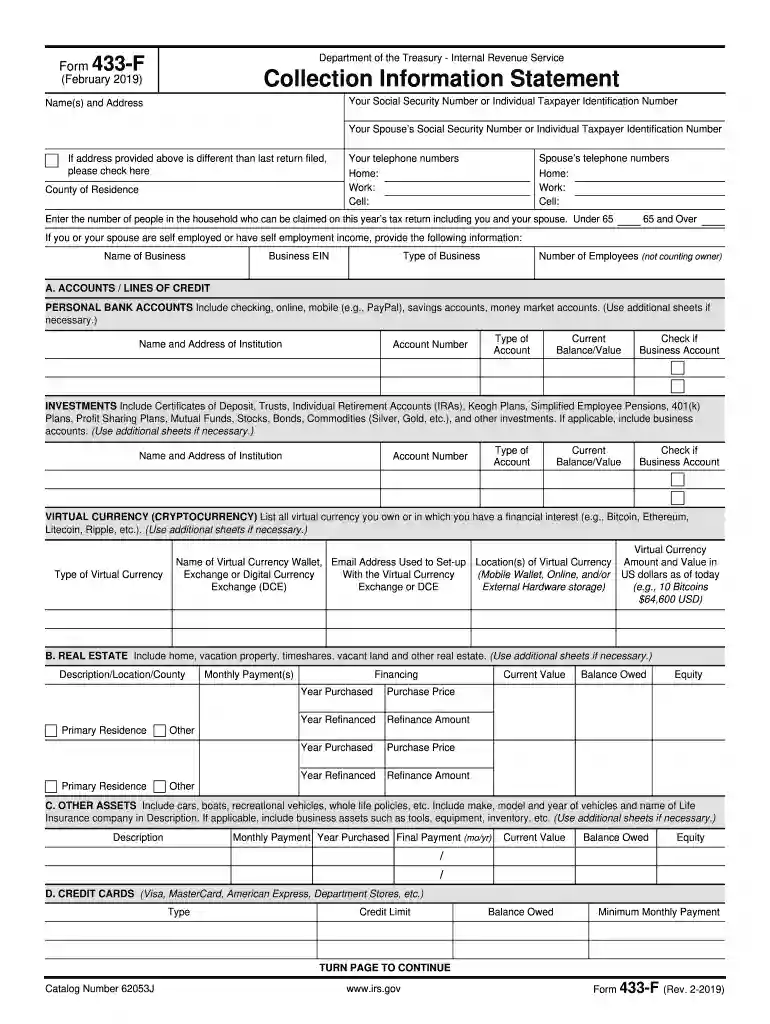
Type text, add images, blackout confidential details, add comments, highlights and more.

Draw your signature, type it, upload its image, or use your mobile device as a signature pad.

Send 433f instructions via email, link, or fax. You can also download it, export it or print it out.
IRS Form 433-F, or the Collection Information Statement, is designed to collect financial data from individuals and self-employed taxpayers. This information is instrumental for the IRS to evaluate the applicant's capacity to pay existing tax liabilities. The form encompasses details such as personal and business assets, liabilities, income streams, and regular living expenditures. Additionally, it provides instructions on form completion and guidance for negotiating payment plans with the IRS.
Completing IRS Form 433-F involves several steps. Begin by gathering detailed financial records, including all income sources and monthly expenses. Ensure all sections are filled out accurately, especially personal identification information. Each section requires a meticulous review of your financial status:
The IRS uses Form 433-F legally to ascertain a taxpayer’s ability to satisfy outstanding tax debts. By submitting this form, the taxpayer consents to provide a complete picture of their financial status, which in turn assists the IRS in determining eligibility for installment payment plans or other resolutions. It is essential to be accurate and truthful, as misrepresentations can lead to legal penalties.
The primary users of IRS Form 433-F include individuals who owe taxes and are seeking to establish a payment agreement. The form is applicable to both employed persons and self-employed individuals. It is often utilized by those unable to make full immediate payments and wishing to negotiate a payment strategy with the IRS.
Understanding key terms related to IRS Form 433-F is crucial:
The Internal Revenue Service (IRS) issues Form 433-F as part of its collection procedures for unpaid taxes. As a governmental body under the U.S. Department of the Treasury, the IRS is responsible for tax collection and enforcement of tax laws.
Supporting documents are necessary when filling out IRS Form 433-F. These can include pay stubs, bank statements, rent receipts, mortgage documents, and any other records that provide a clear picture of your financial status. The more comprehensive the documentation, the smoother the form completion process will be.
Form 433-F is available both in digital and paper formats. The digital format allows for electronic submissions, which can be more efficient and secure. Conversely, the paper version can be mailed or submitted in person at an IRS office. Digitally managing this form aligns well with platforms like DocHub, which streamline digital document workflows for user convenience.
Consider scenarios such as a self-employed worker who has incurred unexpected medical expenses leading to tax debts or a small business owner whose income varies seasonally. In both instances, IRS Form 433-F serves to present a full financial snapshot to aid in negotiating manageable tax payment terms. Another example might involve retirees who have seen their fixed incomes insufficient to cover accumulated tax debts, using the form to establish a reasonable payment agreement.
We've got more versions of the form 433 f form. Select the right form 433 f version from the list and start editing it straight away!
At DocHub, your data security is our priority. We follow HIPAA, SOC2, GDPR, and other standards, so you can work on your documents with confidence.
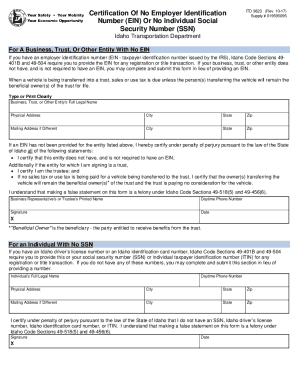


Form 433-F is used to obtain current financial information necessary for determining how a wage earner or self-employed individual can satisfy an outstandingRead more
Apr 15, 2015 You may be eligible to claim the premium tax credit if you, your spouse, or a dependent enrolled in health insurance through the HealthRead more


