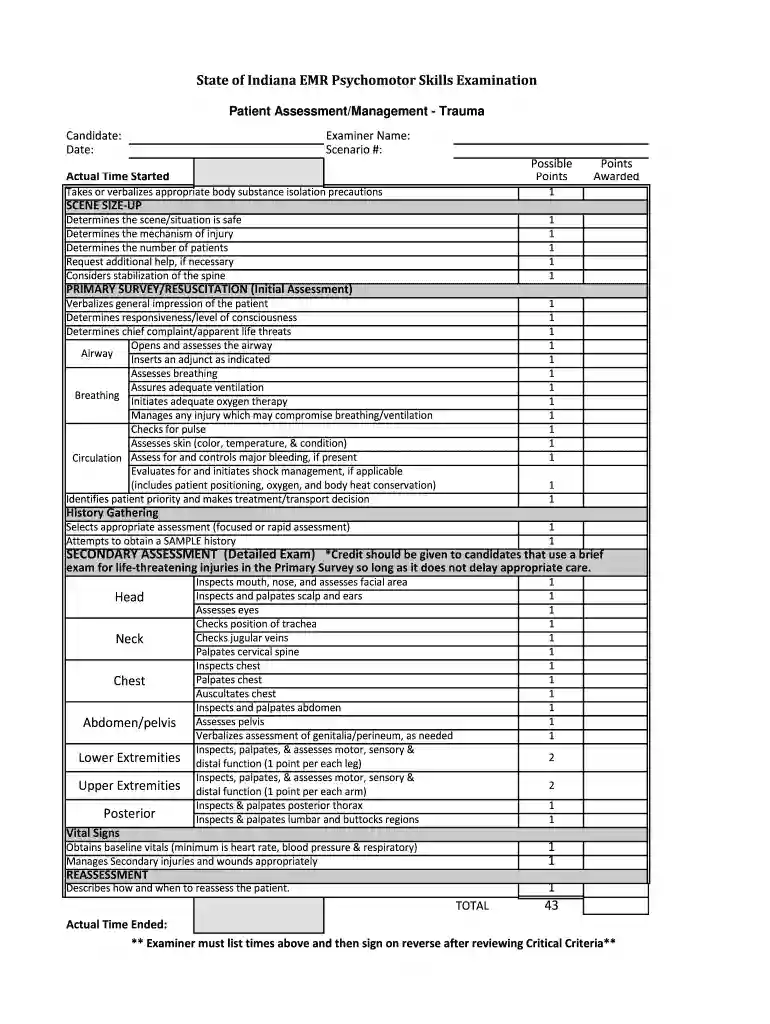
Emt patient assessment cheat sheet pdf 2026

Get Form
nremt trauma assessment Preview on Page 1

Here's how it works

01. Edit your nremt trauma assessment online
Type text, add images, blackout confidential details, add comments, highlights and more.

02. Sign it in a few clicks
Draw your signature, type it, upload its image, or use your mobile device as a signature pad.

03. Share your form with others
Send trauma assessment pdf via email, link, or fax. You can also download it, export it or print it out.

Overview of EMT Patient Assessment Cheat Sheet PDF

The EMT patient assessment cheat sheet PDF is a concise, structured tool specifically designed for emergency medical technicians. This document aids in the systematic evaluation of patients during emergency situations, ensuring that all essential elements of comprehensive patient care are addressed. The cheat sheet typically includes essential assessment components, vital signs, and clinical considerations vital for both trauma and medical emergencies.

Key Components of Patient Assessment

The cheat sheet encompasses several critical elements fundamental to patient assessment:

  • Scene Safety and BSI: Confirm the safety of the scene and the use of Body Substance Isolation (BSI) precautions to prevent infection.
  • Initial Assessment: This includes a primary survey to determine responsiveness (AVPU: Alert, Verbal, Painful, Unresponsive), airway, breathing, circulation, and any immediate life threats.
  • Secondary Assessment: Conducted after immediate threats are managed, this includes a focused evaluation based on mechanisms of injury or chief complaints.
  • Patient History: Collect pertinent medical history including allergies, medications, past medical history, last oral intake, and events leading up to the emergency.
  • Vital Signs Monitoring: Documenting heart rate, respiratory rate, blood pressure, skin signs, and oxygen saturation levels.

How to Effectively Use the Cheat Sheet

Users can maximize the utility of the EMT patient assessment cheat sheet PDF by following these steps:

  1. Familiarize with Key Sections: Understand each section of the cheat sheet to know where to find specific information quickly in real-time situations.
  2. Practice Scenarios: Use the tool during drills or mock assessments to reinforce memorization and improve speed and accuracy in patient assessments.
  3. Integrate with Protocols: Align the cheat sheet with local EMS protocols to ensure compliance and consistency across assessments.

Obtaining the EMT Patient Assessment Cheat Sheet PDF

To acquire the EMT patient assessment cheat sheet PDF, users typically have several options:

  • Online Resources: Many EMS educational sites and institutions provide free downloads of standardized assessment tools.
  • Training Programs: EMT courses often include these cheat sheets as part of the learning materials, allowing access through course enrollment.
  • Professional Organizations: Groups such as the National Registry of Emergency Medical Technicians (NREMT) may offer resources and templates through membership.

Steps to Complete the Assessment Using the Cheat Sheet

Effective patient assessment involves systematic steps as outlined in the cheat sheet:

  1. Prepare: Arrive at the scene prepared with the necessary equipment.
  2. Perform Initial Assessment:
    • Check responsiveness
    • Assess airway, breathing, and circulation
    • Control any immediate threats to life
  3. Conduct Secondary Assessment:
    • Gather patient history and perform a thorough physical examination.
    • Identify any critical conditions that require immediate intervention.
  4. Document Findings: Meticulously document all findings in the appropriate sections of the cheat sheet for ongoing patient care and reporting.

Importance of the EMT Patient Assessment Cheat Sheet PDF

The cheat sheet is an invaluable resource for both new and seasoned EMTs. It ensures that essential assessment procedures are not overlooked amid the chaos of emergency scenarios. Utilizing the cheat sheet can lead to:

  • Improved patient outcomes through thorough assessments
  • Streamlined processes in high-pressure situations
  • Elevated confidence levels for EMTs in conducting assessments

Users of the EMT Patient Assessment Cheat Sheet PDF

Primarily, the cheat sheet is utilized by:

  • Emergency Medical Technicians (EMTs): For rapid, efficient assessments in prehospital settings.
  • Paramedics: As a supplementary resource alongside advanced assessment tools.
  • Emergency response trainees: Easily accessible during skills practice and examinations.

The cheat sheet serves as an educational guide, improving assessment skills for aspiring and current emergency medical responders.

Legal Use and Considerations

The EMT patient assessment cheat sheet PDF should be used in a manner that adheres to established protocols and patient confidentiality laws, including:

  • HIPAA Compliance: Ensure that any records or notes made while using the cheat sheet do not compromise patient privacy.
  • Documentation Practices: Follow local legal requirements in documenting assessments and care provided.

By maintaining awareness of these regulations, EMTs can utilize the cheat sheet effectively and ethically.

be ready to get more

Complete this form in 5 minutes or less

Get form

Got questions?

We have answers to the most popular questions from our customers. If you can't find an answer to your question, please contact us.
Contact us

Microsoft Word doesn’t have signing tools to create legitimate eSignatures and enforceable paperwork. Fortunately, DocHub is an online eSignature-compliant editor that works with different document formats, including .doc files. Log in to your account and import the Word version of your emt patient assessment cheat sheet pdf from your device and cloud, or URL - our editor will automatically turn it into an editable PDF. Make all required changes in your form and click Sign to create your own legally-binding electronic signature. There are four signing options from which to choose.

Apart from a comprehensive toolset for editing PDFs on mobile devices, DocHub enables you to sign your emt trauma assessment sheet along the way. Open our editor in your internet browser, make changes using DocHub’s toolset, and complete your editing by eSigning the finished form.

Physical examination 1 Inspection. 2 Palpation. 3 Auscultation. 4 Percussion.
The steps are as follows: Assessment phase. Diagnosis phase. Planning phase. Implementing phase. Evaluation phase.

Security and compliance

At DocHub, your data security is our priority. We follow HIPAA, SOC2, GDPR, and other standards, so you can work on your documents with confidence.

Learn more
ccpa2
pci-dss
gdpr-compliance
hipaa
soc-compliance
be ready to get more

Complete this form in 5 minutes or less

Get form

People also ask

WHEN YOU PERFORM a physical assessment, you'll use four techniques: inspection, palpation, percussion, and auscultation. Use them in sequence\u2014unless you're performing an abdominal assessment. Palpation and percussion can alter bowel sounds, so you'd inspect, auscultate, percuss, then palpate an abdomen.
emergency call; determining scene safety, taking BSI precautions, noting the mechanism of injury or patient's nature of illness, determining the number of patients, and deciding what, if any additional resources are needed including Advanced Life Support.
The first step of any patient assessment, medical or trauma is to form a general impression of the patient's condition.
EMT Interview Questions Why Did You Decide to Become an EMT? What Have You Done in the Last Year to Increase Your EMT Skills or Knowledge? What Are Your Top EMT Skills? Describe a Challenging Call You've Had and How You Handled It. How Do You Remain Calm in Difficult Situations?
What are the skills and responsibilities of EMTs? Perform CPR and use an AED. Bandage wounds. Stabilize head and neck injuries. Stabilize broken bones. Resuscitate drowning victims. Provide oxygen to patients. Perform emergency childbirth procedures. Assess health emergencies.

nremt trauma assessment sheet