Type text, add images, blackout confidential details, add comments, highlights and more.

02. Sign it in a few clicks
Draw your signature, type it, upload its image, or use your mobile device as a signature pad.

03. Share your form with others
Send 8038 via email, link, or fax. You can also download it, export it or print it out.

How to use or fill out Form 8038 (Rev February 2022) Information Return for Tax-Exempt Private Activity Bond Issues with Our Platform
Ease of Setup
DocHub User Ratings on G2
Ease of Use
DocHub User Ratings on G2
Click ‘Get Form’ to open it in the editor.
Begin with Part I by entering the issuer’s name and employer identification number. Ensure accuracy as this information is crucial for IRS communication.
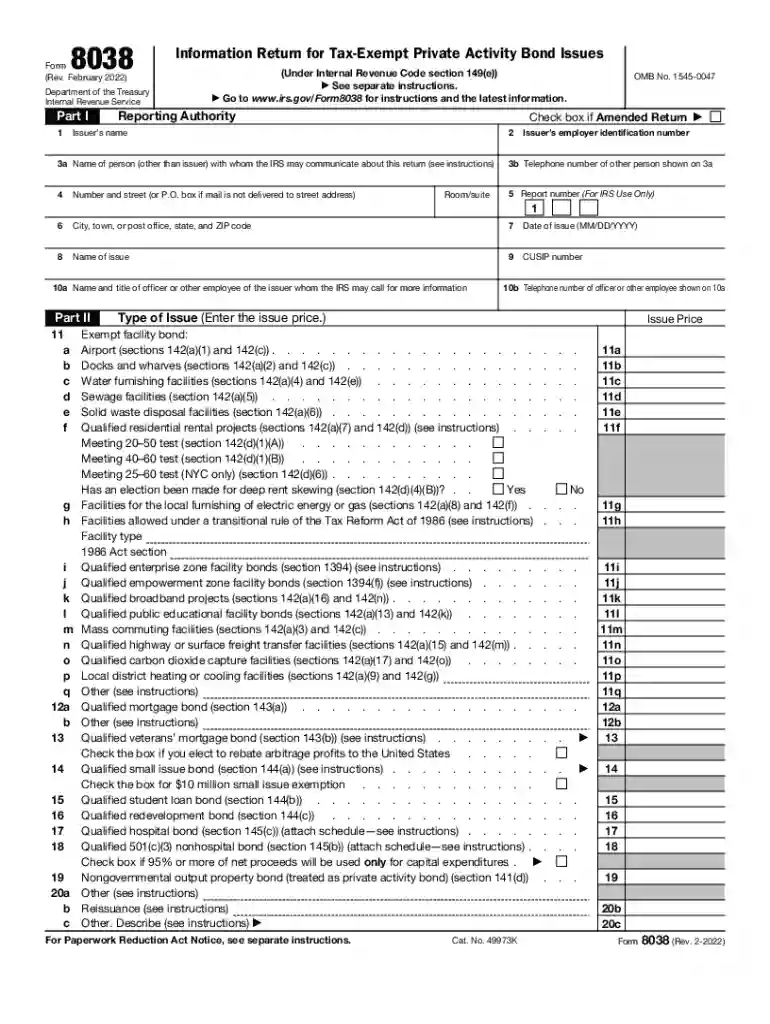
In Part II, select the type of issue and enter the issue price. This section includes various categories such as exempt facility bonds and qualified residential rental projects.
Proceed to Part III, where you will describe the bonds. Fill in details like final maturity date, issue price, and stated redemption price at maturity.
Complete Parts IV through VIII by detailing the uses of proceeds, property financed, and any volume caps applicable. Be thorough to avoid errors that could delay processing.
Start using our platform today for free to streamline your form completion process!
Fill out Form 8038 (Rev February 2022) Information Return for Tax-Exempt Private Activity Bond Issues online It's free
See more Form 8038 (Rev February 2022) Information Return for Tax-Exempt Private Activity Bond Issues versions
We've got more versions of the Form 8038 (Rev February 2022) Information Return for Tax-Exempt Private Activity Bond Issues form. Select the right Form 8038 (Rev February 2022) Information Return for Tax-Exempt Private Activity Bond Issues version from the list and start editing it straight away!
Form 8038-G is used by issuers of tax-exempt governmental bonds to provide the IRS with the information required by section 149(e) and to monitor compliance with the requirements of sections 141 through 150.
Are income bond issues exempt?
The interest you earn on corporate bonds is generally always taxable. Most all interest income earned on municipal bonds is exempt from federal income taxes. When you buy muni bonds issued by the state where you file state taxes, the interest you earn is usually also exempt from state income taxes.
What is an IRS form 8038?
Form 8038 is used by the issuers of tax-exempt private activity bonds to provide the IRS with the information required by section 149 and to monitor compliance with the requirements of sections 141 through 150.
What securities are exempt from federal income tax?
Examples include state and local municipal bonds, federal treasury securities, and certain mutual funds and ETFs. While these types of securities typically have lower yields than taxable securities, their low yield may be offset by their tax treatment, especially for investors in higher tax brackets.
What is a tax-exempt bond?
A bond, issued by a state or local government, the interest on which is exempt from taxation.
irs 8038
Download form 8038 rev february 2022 information return for tax exempt private activity bond issuesIRS Form 8038-GForm 8038-TForm 8023IRS Form 8308Form 8328Form 8038-G instructionsForm 8038 due date
Security and compliance
At DocHub, your data security is our priority. We follow HIPAA, SOC2, GDPR, and other standards, so you can work on your documents with confidence.
Will I have to pay tax on my savings? The interest you earn on Guaranteed Income Bonds will count towards your taxable income in the tax year(s) you receive it. But this doesnt mean youll have to pay tax on it. It all depends how much interest you earn in total and what rate of tax you pay.
Which bond is exempt from tax?
Income from bonds issued by state, city, and local governments (municipal bonds, or munis) is generally free from federal taxes.
8038 form
Instructions for Form 8038 (Rev. February 2022)
Form 8038 is used by the issuers of tax-exempt private activity bonds to provide the IRS with the information required by section 149 and to monitor complianceRead more
Nov 1, 2023 Did the organization have a tax-exempt bond issue with an outstanding principal amount of more than organizations current and formerRead more
Cookie consent notice
This site uses cookies to enhance site navigation and personalize your experience.
By using this site you agree to our use of cookies as described in our Privacy Notice.
You can modify your selections by visiting our Cookie and Advertising Notice.