Non-Residents and Income Tax 2022-2026

Get Form
Non-Residents and Income Tax 2022 Preview on Page 1

Here's how it works

01. Edit your form online
Type text, add images, blackout confidential details, add comments, highlights and more.

02. Sign it in a few clicks
Draw your signature, type it, upload its image, or use your mobile device as a signature pad.

03. Share your form with others
Send it via email, link, or fax. You can also download it, export it or print it out.

How to use or fill out Non-Residents and Income Tax 2022 with our platform

Form edit decoration
9.5
Ease of Setup
DocHub User Ratings on G2
9.0
Ease of Use
DocHub User Ratings on G2
  1. Click ‘Get Form’ to open the Non-Residents and Income Tax 2022 document in the editor.
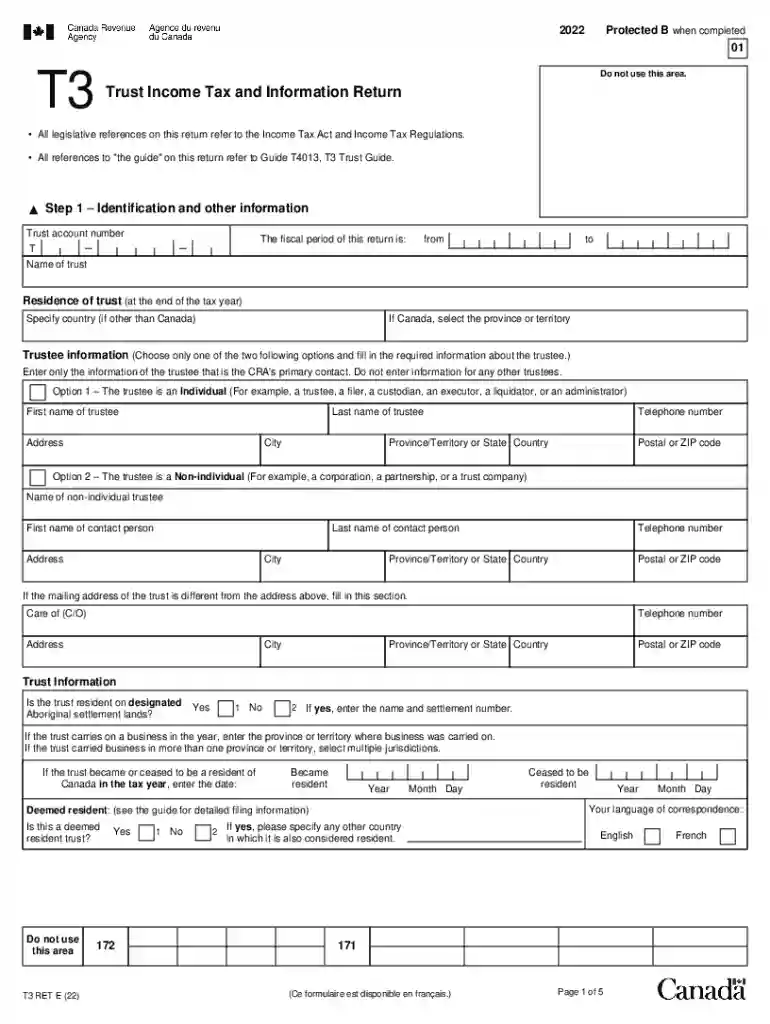
  2. Begin with Step 1, where you will provide identification details. Fill in the trust account number, name of the trust, and its residence information. Ensure to specify the country if it is outside Canada.
  3. Next, select whether the trustee is an individual or a non-individual. Complete the relevant fields for contact information, ensuring accuracy for effective communication.
  4. Proceed to Step 2 to calculate total income. Input figures for taxable capital gains, pension income, and other sources of income as outlined in the guide.
  5. Continue through Steps 3 and 4 to determine net income and taxable income by entering deductions as specified in each section.
  6. Finally, review Step 5 for a summary of tax and credits. Ensure all calculations are accurate before submitting your form.

Start using our platform today to simplify your form completion process for free!

See more Non-Residents and Income Tax 2022 versions

We've got more versions of the Non-Residents and Income Tax 2022 form. Select the right Non-Residents and Income Tax 2022 version from the list and start editing it straight away!
Versions Form popularity Fillable & printable
2022 4.3 Satisfied (25 Votes)
2019 4.9 Satisfied (39 Votes)
2018 4.4 Satisfied (269 Votes)
2016 4.3 Satisfied (139 Votes)
2012 4.4 Satisfied (248 Votes)
be ready to get more

Complete this form in 5 minutes or less

Get form

Got questions?

We have answers to the most popular questions from our customers. If you can't find an answer to your question, please contact us.
Contact us
The 90% rule refers to at least 90% of a non-residents income from the tax year being sourced in Canada. If you have earned at least 90% of your net income in the tax year in Canada you will be entitled to claim non-refundable tax credits, allowing you to earn up to $15,705 tax-free income in Canada.
Part 1: Overview of States Income Taxation of Nonresidents. As a rule, an individuals income can be taxed both by the state in which the taxpayer resides and by the state in which the taxpayers income is earned.
You generally dont have to pay taxes if your income is less than the standard deduction or the total of your itemized deductions, if you have a certain number of dependents, if you work abroad and are below the required thresholds, or if youre a qualifying non-profit organization.
As a nonresident, you pay tax on your taxable income from California sources. Sourced income includes, but is not limited to: Services performed in California. Rent from real property located in California.
If you are living and working in the U.S. as a nonresident alien, you may be required to file a federal tax return. The Internal Revenue Service (IRS) considers you a nonresident alien if you are not a lawful permanent resident (Green Card holder) or do not pass their substantial presence test.

Security and compliance

At DocHub, your data security is our priority. We follow HIPAA, SOC2, GDPR, and other standards, so you can work on your documents with confidence.

Learn more
ccpa2
pci-dss
gdpr-compliance
hipaa
soc-compliance

People also ask

As a general matter, under the U.S. Internal Revenue Code (Code), all U.S. citizens and U.S. residents are treated as U.S. tax residents. In order for a non-U.S. citizen (alien individual) to be treated as a resident alien, he or she must satisfy either the green card test or the substantial presence test.
If you are a nonresident alien, you are usually subject to U.S. income tax only on U.S. source income. Under limited circumstances, certain foreign source income is subject to U.S. tax.
If you are a U.S. citizen or resident living or traveling outside the United States, you generally are required to file income tax returns, estate tax returns, and gift tax returns and pay estimated tax in the same way as those residing in the United States.

Related links