
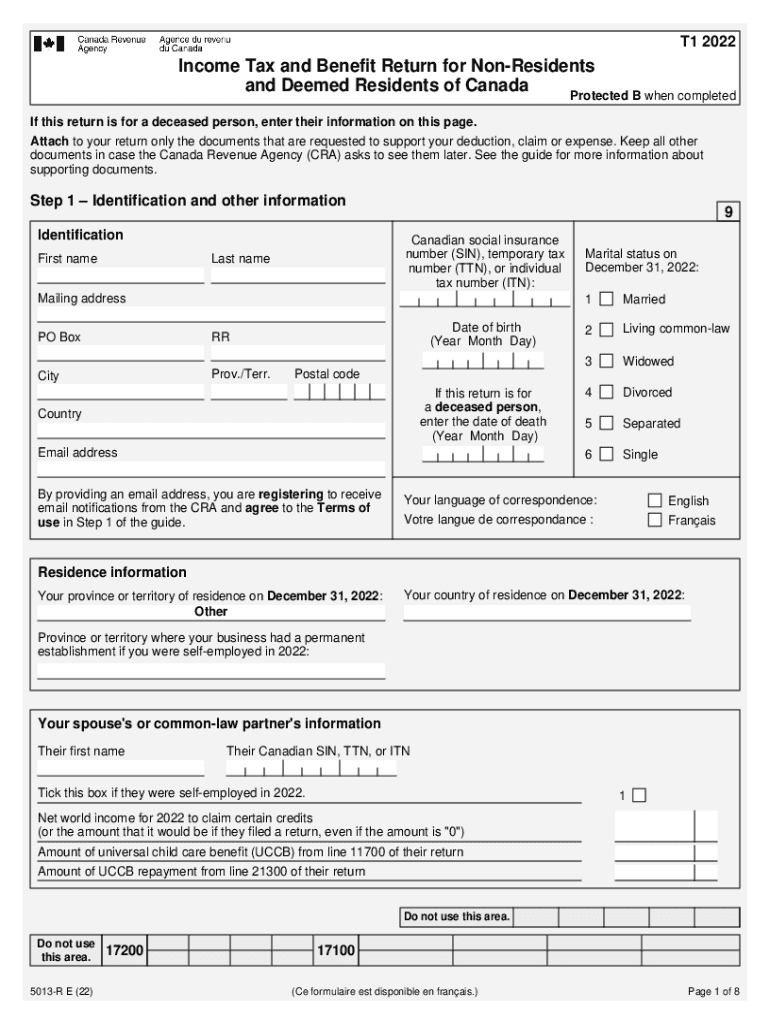




Here's how it works

01. Edit your 5013 r form online
Type text, add images, blackout confidential details, add comments, highlights and more.

02. Sign it in a few clicks
Draw your signature, type it, upload its image, or use your mobile device as a signature pad.

03. Share your form with others
Send 5013 r income tax via email, link, or fax. You can also download it, export it or print it out.
How to use or fill out Income Tax and Benefit Return for Non-residents and with DocHub

- Click ‘Get Form’ to open it in the editor.
- Begin with Step 1 – Identification. Fill in your first name, last name, and Canadian social insurance number (SIN), temporary tax number (TTN), or individual tax number (ITN). Provide your mailing address, date of birth, marital status, and email address for notifications.
- In the Residence Information section, indicate your province or territory of residence on December 31, 2022. If applicable, provide details about your spouse's information and their income.
- Proceed to Step 2 – Total Income. Enter all relevant income sources such as employment income, rental income, and any other taxable amounts. Ensure accuracy by cross-referencing with your slips.
- Continue through Steps 3 to 6 by calculating net income, taxable income, federal tax owed, and any refunds or balances owing. Follow the prompts carefully to ensure all fields are completed correctly.
Utilize our platform for free to streamline your document editing and form completion process!
Fill out Income Tax and Benefit Return for Non-residents and online
It's free
It's free
See more Income Tax and Benefit Return for Non-residents and versions
We've got more versions of the Income Tax and Benefit Return for Non-residents and form. Select the right Income Tax and Benefit Return for Non-residents and version from the list and start editing it straight away!
Got questions?
We have answers to the most popular questions from our customers. If you can't find an answer to your question, please contact us.
Contact us
How do I know if I am a non-resident for tax purposes?
If you have been in the U.S. for fewer than 5 calendar years** (including any previous F-1/F-2/J-1/J-2 statuses at any point), then you are considered a Non Resident for Tax Purposes.
What is the 90% rule for non-residents?
What is the 90% Rule? In a nutshell, the 90% rule is simple: if 90% or more of your worldwide income is from Canadian sources in the tax year, youre eligible for non-refundable tax credits reserved for residents.
Which return to file for non-resident?
ITR-3 - Applicable for Non-Resident Individual This return is applicable for Individual (whether Resident or Non-Resident) and Hindu Undivided Family (HUF). Having Income under the heads Salary/Pension, House Property, Profits or Gains of Business or Profession, Capital Gains or Income from Other Sources.
Whats the difference between resident and non-resident?
If you are not a U.S. citizen, you are considered a nonresident of the United States for U.S. tax purposes unless you meet one of two tests. You are a resident of the United States for tax purposes if you meet either the green card test or the substantial presence test for the calendar year (January 1 December 31).
What is tax residency in Brazil?
The Tax Law considers a resident to be anyone who: Stays in the country for more than 183 days during the last 12 months, consecutive or not. Has companies or properties in the country or their main income from Brazilian sources. Intends to stay in the country permanently.
Security and compliance
At DocHub, your data security is our priority. We follow HIPAA, SOC2, GDPR, and other standards, so you can work on your documents with confidence.
Learn more


People also ask
What does it mean to be a non-resident for tax purposes?
If you are an Australian resident for tax purposes, you are required to pay tax on your Australian income as well as your foreign income. Whereas, if you are a non-resident for tax purposes, you are only required to pay tax on the income you earned in Australia.
What to include in a non-resident tax return?
Non-Residents must also lodge a tax return if they earn income while in Australia. However, non-residents only have to include income earned in Australia and do not have to declare foreign income, including income from employment in other countries.


