MI-1041 - Fiduciary Income Tax Return-2026

Get Form
schedule k 1 form Preview on Page 1

Here's how it works

01. Edit your schedule k 1 form online
Type text, add images, blackout confidential details, add comments, highlights and more.

02. Sign it in a few clicks
Draw your signature, type it, upload its image, or use your mobile device as a signature pad.

03. Share your form with others
Send it via email, link, or fax. You can also download it, export it or print it out.

How to use or fill out MI-1041 - Fiduciary Income Tax Return with DocHub

Form edit decoration
9.5
Ease of Setup
DocHub User Ratings on G2
9.0
Ease of Use
DocHub User Ratings on G2
  1. Click ‘Get Form’ to open the MI-1041 in our editor.
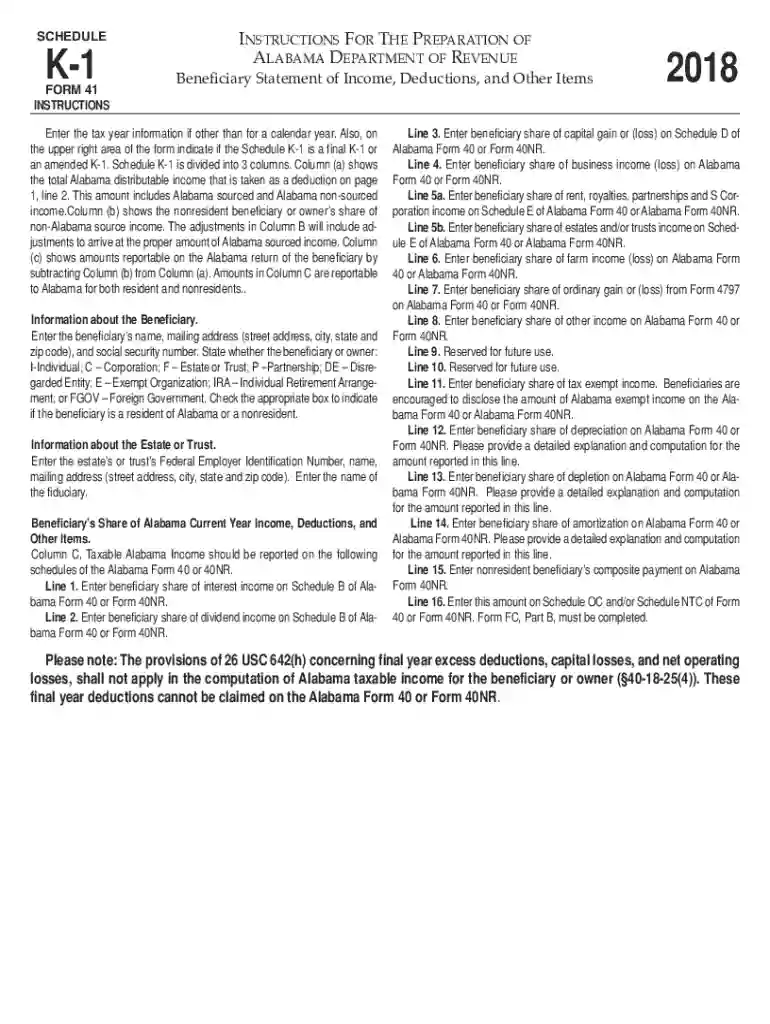
  2. Begin by entering the tax year information at the top of the form. If applicable, indicate whether this is a final or amended K-1 in the upper right area.
  3. In Section A, provide details about the beneficiary, including their name, mailing address, and social security number. Select the appropriate designation for the beneficiary (e.g., Individual, Corporation).
  4. Next, fill out Section B with information about the estate or trust. Enter its Federal Employer Identification Number and mailing address.
  5. Proceed to Section C where you will report the beneficiary’s share of Alabama current year income. Complete each line carefully, ensuring that amounts are reported on the correct schedules of Alabama Form 40 or 40NR.

Start using our platform today to easily complete your MI-1041 form online for free!

See more MI-1041 - Fiduciary Income Tax Return versions

We've got more versions of the MI-1041 - Fiduciary Income Tax Return form. Select the right MI-1041 - Fiduciary Income Tax Return version from the list and start editing it straight away!
Versions Form popularity Fillable & printable
2022 4.8 Satisfied (48 Votes)
2019 4.1 Satisfied (43 Votes)
2018 3.9 Satisfied (55 Votes)
2017 4.4 Satisfied (30 Votes)
2012 4 Satisfied (52 Votes)
be ready to get more

Complete this form in 5 minutes or less

Get form

Got questions?

We have answers to the most popular questions from our customers. If you can't find an answer to your question, please contact us.
Contact us
When preparing an estate or trusts income tax Form 1041, you may deduct fiduciary fees. Fiduciary fees are the amounts executors, administrators, or trustees charge for their services.
When one spouse dies, however, things change. At that point, the portion of that spouses assets in a revocable living trust become irrevocable. The trust must file a Form 1041 for that year, reporting and paying taxes on the income from the deceased spouses portion of the assets.
The fiduciary of a domestic decedents estate, trust, or bankruptcy estate files Form 1041 to report: The income, deductions, gains, losses, etc. of the estate or trust. The income that is either accumulated or held for future distribution or distributed currently to the beneficiaries.
The types of taxes a deceased taxpayers estate can owe are: Income tax on income generated by assets of the estate of the deceased. If the estate generates more than $600 in annual gross income, you are required to file Form 1041, U.S. Income Tax Return for Estates and Trusts.
An estate tax return (Form 706) must be filed if the gross estate of the decedent (who is a U.S. citizen or resident), increased by the decedents adjusted taxable gifts and specific gift tax exemption, is valued at more than the filing threshold for the year of the decedents death, as shown in the table below.

People also ask

If the estate generates more than $600 in annual gross income, you are required to file Form 1041, U.S. Income Tax Return for Estates and Trusts. An estate may also need to pay quarterly estimated taxes. See Form 1041 instructions for information on when to file quarterly estimated taxes.
When a person passes away, their estate becomes a separate taxable entity. Any income this entity earns from rental income, capital gains, interest, or dividends must be reported on IRS Form 1041.
Form 1041 is an income tax return, the same as an individual or business would file but for a decedents estate or a trust. The return reports income, capital gains, deductions, and losses, but subject to somewhat different rules than those that apply to living individuals.

Related links