Withholding oil gas 2026

Get Form
rpd 41284 Preview on Page 1

Here's how it works

01. Edit your rpd 41284 online
Type text, add images, blackout confidential details, add comments, highlights and more.
02. Sign it in a few clicks
Draw your signature, type it, upload its image, or use your mobile device as a signature pad.
03. Share your form with others
Send new mexico quarterly oil gas proceeds witholding fillable via email, link, or fax. You can also download it, export it or print it out.

How to use or fill out withholding oil gas with our platform

Form edit decoration
9.5
Ease of Setup
DocHub User Ratings on G2
9.0
Ease of Use
DocHub User Ratings on G2
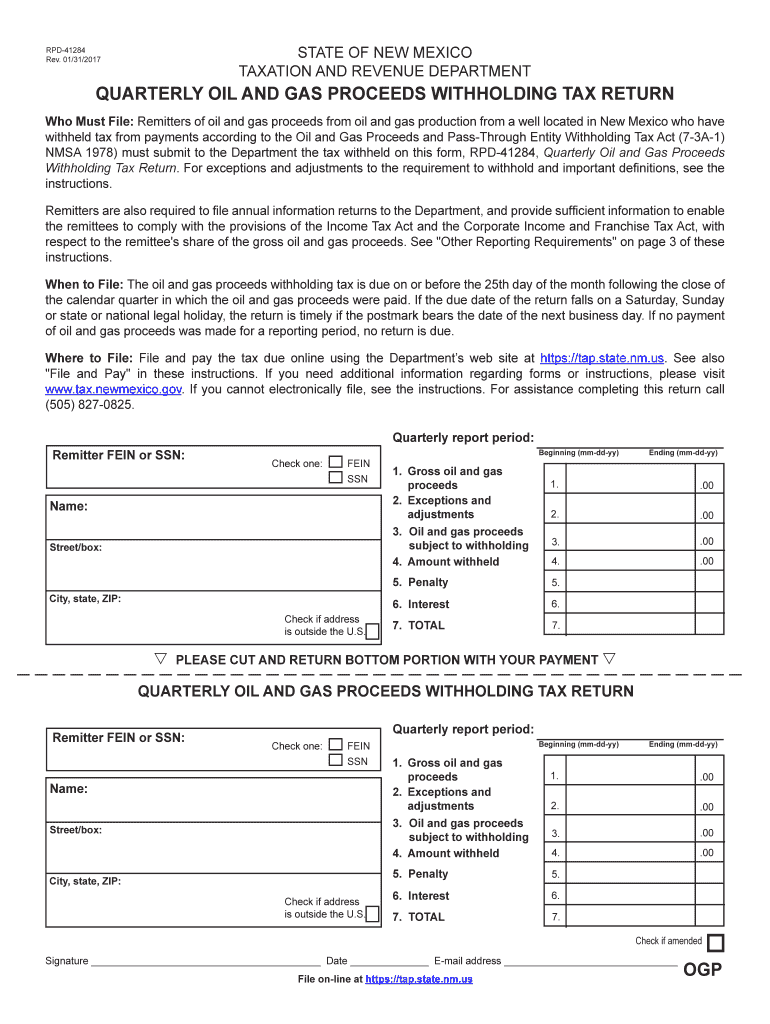
  1. Click ‘Get Form’ to open the Quarterly Oil and Gas Proceeds Withholding Tax Return in the editor.
  2. Enter your Remitter FEIN or SSN at the top of the form, ensuring you check the appropriate box for identification type.
  3. Fill in your name and mailing address. If your address is outside the U.S., mark the corresponding box.
  4. Specify the quarterly report period by entering the beginning and ending dates in mm-dd-yy format.
  5. In Line 1, input the total gross oil and gas proceeds paid during the reporting period. Round amounts to the nearest whole dollar.
  6. For Line 2, enter any exceptions or adjustments that apply to your situation as outlined in the instructions.
  7. Calculate Line 3 by subtracting Line 2 from Line 1 to determine proceeds subject to withholding.
  8. On Line 4, calculate and enter the amount withheld based on current tax rates applied to Line 3's amount.
  9. Complete Lines 5 (penalty) and 6 (interest) if applicable, then sum these with Line 4 for a total due on Line 7.
  10. Sign and date the form before submitting it online through our platform or via mail if necessary.

Start using our platform today for free to streamline your document editing and submission process!

See more withholding oil gas versions

We've got more versions of the withholding oil gas form. Select the right withholding oil gas version from the list and start editing it straight away!
Versions Form popularity Fillable & printable
2017 4.8 Satisfied (141 Votes)
2012 4.4 Satisfied (183 Votes)
2011 4 Satisfied (37 Votes)
be ready to get more

Complete this form in 5 minutes or less

Get form

Got questions?

We have answers to the most popular questions from our customers. If you can't find an answer to your question, please contact us.
Contact us
In short, both Withholding Tax and TDS involve the deduction of tax when a payment is made. However, the main difference lies in who the payment is made to and under what rules.
Royalties. Royalties from copyrights, patents, and oil, gas and mineral properties are taxable as ordinary income. You generally report royalties in Part I of Schedule E (Form 1040 or Form 1040-SR), Supplemental Income and Loss.
Chapter 4 withholding requires a withholding agent to withhold 30% on withholdable payments made to an entity that is a Foreign Financial Institution (FFI) unless the withholding agent is able to treat the FFI as a participating FFI, deemed-compliant FFI, or exempt beneficial owner.
As a royalty interest holder, the mineral owner is not liable for any effort or cost for exploring, extracting, and producing minerals in their land. So they get royalties without putting in the work, which qualifies oil royalties as passive income.
This income is subject to self-employment tax on Schedule SE. Royalty income is reported on Form 1099-MISC, Box 2, Royalties. The oil and gas company will generally also report related expenses, including production tax and other revenue deductions.

Security and compliance

At DocHub, your data security is our priority. We follow HIPAA, SOC2, GDPR, and other standards, so you can work on your documents with confidence.

Learn more
ccpa2
pci-dss
gdpr-compliance
hipaa
soc-compliance

People also ask

In general, you shall withhold the one percent (1%) creditable expanded withholding tax only on your purchases of goods and 2% on purchases of service (other than those covered by other withholding tax rates) from local suppliers from whom you regularly make your purchases.
Income Reporting: Individuals must report oil and gas royalties as income on their tax returns. This income is typically reported on Schedule E (Form 1040), Supplemental Income and Loss. Form 1099-MISC: Royalties are reported to the taxpayer and the IRS using Form 1099-MISC, with the amount shown in Box 2.
Apply the Depletion Deduction Fortunately, the IRS allows for taxpayers who own an economic interest in a mineral deposit (oil and gas minerals) to apply a depletion deduction to reduce their taxable income from oil and gas royalties.

rpd 41284