




Here's how it works

01. Edit your it182 online
Type text, add images, blackout confidential details, add comments, highlights and more.

02. Sign it in a few clicks
Draw your signature, type it, upload its image, or use your mobile device as a signature pad.

03. Share your form with others
Send ny it 182 via email, link, or fax. You can also download it, export it or print it out.
How to use or fill out Form IT-182 Passive Activity Loss Limitations - Tax NY with DocHub

- Click ‘Get Form’ to open it in the editor.
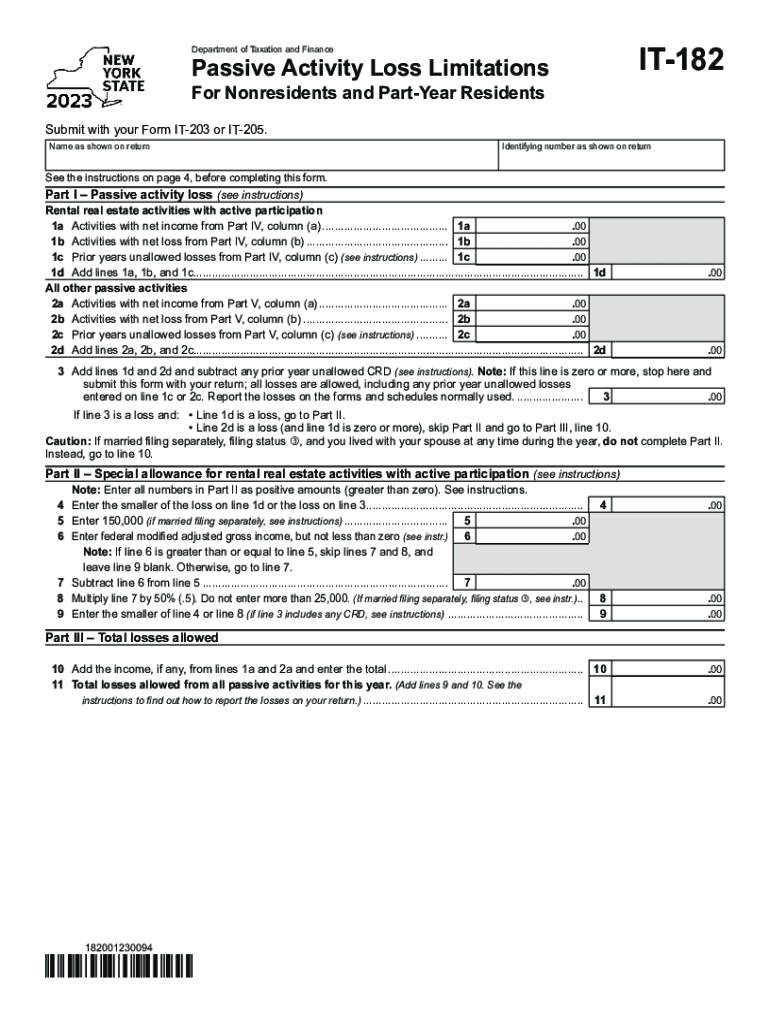
- Begin by entering your name and identifying number as shown on your tax return at the top of the form.
- In Part I, report your passive activity losses. Start with rental real estate activities, filling in lines 1a through 1d based on your net income and losses from previous years.
- Proceed to all other passive activities in lines 2a through 2d, ensuring you accurately reflect any net income or losses.
- If line 3 indicates a loss, follow the instructions for Part II to calculate any special allowances for rental real estate activities with active participation.
- Complete Parts IV through IX as necessary, detailing each activity's income and losses derived from New York sources.
- Finally, review all entries for accuracy before submitting the completed form along with your IT-203 or IT-205.
Start using our platform today to fill out Form IT-182 easily and for free!
Fill out Form IT-182 Passive Activity Loss Limitations - Tax NY online
It's free
It's free
See more Form IT-182 Passive Activity Loss Limitations - Tax NY versions
We've got more versions of the Form IT-182 Passive Activity Loss Limitations - Tax NY form. Select the right Form IT-182 Passive Activity Loss Limitations - Tax NY version from the list and start editing it straight away!
Got questions?
We have answers to the most popular questions from our customers. If you can't find an answer to your question, please contact us.
Contact us
What is the tax form for passive activity loss limitations?
IRS Form 8582: Calculating Passive Activity Losses for Real Estate. Form 8582 helps individuals who earn income from rentals or businesses in which they dont actively participateknown as passive activitiesdetermine the losses they can deduct on their tax return for that year.
Can you deduct losses from passive activity?
Generally, you may fully deduct any previously disallowed passive activity loss in the year you dispose of your entire interest in the activity. In contrast, you may not claim unused passive activity credits merely because you disposed of your entire interest in the activity.
What is the $25,000 passive loss exclusion?
If you actively participated in a passive rental real estate activity, you may be able to deduct up to $25,000 of loss from the activity from your nonpassive income. This special allowance is an exception to the general rule disallowing losses in excess of income from passive activities.
What are the limitations for passive rental losses?
If you or your spouse actively participated in a passive rental real estate activity, the amount of the passive activity loss that is disallowed is decreased and you therefore can deduct up to $25,000 of loss from the activity from your nonpassive income.
What is the loophole for passive activity loss?
What is the loophole for passive activity loss? The main loophole is qualifying as a real estate professional under IRS rules. If you meet the 750-hour rule and materially participate in your rentals, your losses are considered active and deductible against all income.
Security and compliance
At DocHub, your data security is our priority. We follow HIPAA, SOC2, GDPR, and other standards, so you can work on your documents with confidence.
Learn more


People also ask
Why are passive losses disallowed?
Passive Activity Loss Limitations Passive Activity Loss Limitations ``Disallowed means that you could not deduct it in the current year. The partnership may have invested in rental property, that may be why the losses are passive.
What losses can offset passive income?
Passive activity loss rules state that passive losses can be used only to offset passive income. A passive activity is one in which the taxpayer did not materially participate during the year in question. Common passive activity losses may stem from leasing equipment, real estate rentals, or limited partnerships.
What happens to passive activity losses in a 1031 exchange?
Treatment of Passive Activity Losses and 1031 Exchanges If a real estate owner disposes of his entire interest in a passive activity to an unrelated person in a fully taxable transaction, he may offset any gain with all passive activity losses allocable to the activity, not limited by the PAL rules.


