




Here's how it works

01. Edit your form online
Type text, add images, blackout confidential details, add comments, highlights and more.

02. Sign it in a few clicks
Draw your signature, type it, upload its image, or use your mobile device as a signature pad.

03. Share your form with others
Send it via email, link, or fax. You can also download it, export it or print it out.
How to use or fill out Instructions for Form IT-230 - Tax NY - New York State with our platform

- Click ‘Get Form’ to open the Instructions for Form IT-230 in the editor.
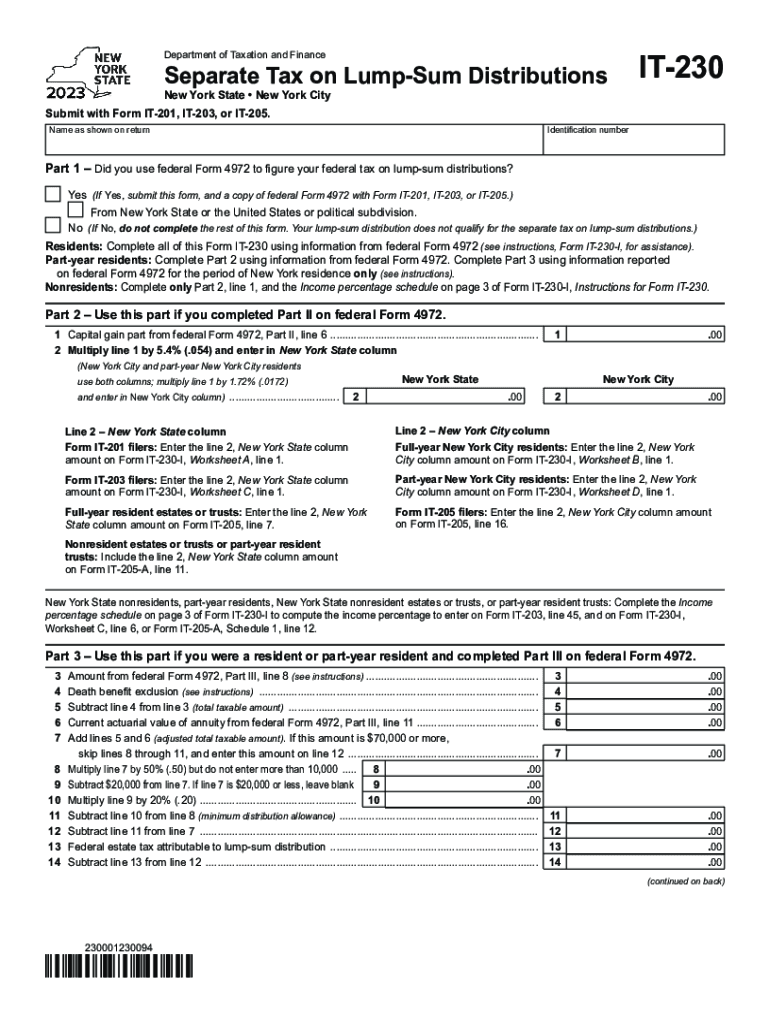
- Begin by entering your name and identification number as shown on your tax return at the top of the form.
- In Part 1, indicate whether you used federal Form 4972. If yes, proceed to complete all sections using information from that form. If no, skip to submission instructions.
- For residents, complete all sections of Part 2 and Part 3 using the relevant lines from federal Form 4972. Ensure you follow the specific instructions provided for each line.
- If you are a part-year resident or nonresident, carefully follow the tailored instructions for completing only the necessary parts of the form.
- Review all entries for accuracy before submitting with Forms IT-201, IT-203, or IT-205 as required.
Start editing your tax forms online for free today!
Fill out Instructions for Form IT-230 - Tax NY - New York State online
It's free
It's free
See more Instructions for Form IT-230 - Tax NY - New York State versions
We've got more versions of the Instructions for Form IT-230 - Tax NY - New York State form. Select the right Instructions for Form IT-230 - Tax NY - New York State version from the list and start editing it straight away!
Got questions?
We have answers to the most popular questions from our customers. If you can't find an answer to your question, please contact us.
Contact us
What are the allowances in New York?
Allowances: A withholding allowance is an exemption that lowers the amount of income tax your employer must deduct from your paycheck.
Is an inheritance tax waiver form required in New York?
When authorization is required for the release of personal property, it is usually referred to as an estate tax waiver or a consent to transfer. New York State does not require waivers for estates of anyone who died on or after February 1, 2000. For details, See Publication 603, Estate Tax Waivers.
What is the New York State income tax return form it-201 or it 203?
If one of you was a New York State resident and the other was a nonresident or part-year resident, you must each file a separate New York return. The resident must use Form IT-201. The nonresident or part-year resident, if required to file a New York State return, must use Form IT-203.
How many allowances should I claim in New York state?
A single filer with no children should claim a maximum of 1 allowance, while a married couple with one source of income should file a joint return with 2 allowances. You can also claim your children as dependents if you support them financially and theyre not past the age of 19.
What is a lump-sum distribution?
A lump-sum distribution is the distribution or payment within a single tax year of a plan participants entire balance from all of the employers qualified plans of one kind (for example, pension, profit-sharing, or stock bonus plans).
Security and compliance
At DocHub, your data security is our priority. We follow HIPAA, SOC2, GDPR, and other standards, so you can work on your documents with confidence.
Learn more


People also ask
Is it better to claim 1 or 0 allowances?
Claiming 0 means more withheld. It reduces the take-home pay but possibly leads to a refund. Claiming 1 means less withheld. This option presents a larger paycheck but increases the risk of owing amounts at tax time.
What are the risks of claiming many allowances?
Getting your federal tax allowances wrong can carry consequences: Too Many Allowances (Under-Withholding): Youll take home more pay during the year but risk owing taxes and possibly penalties when filing. Too Few Allowances (Over-Withholding): More money is withheld, which often results in a larger refund.