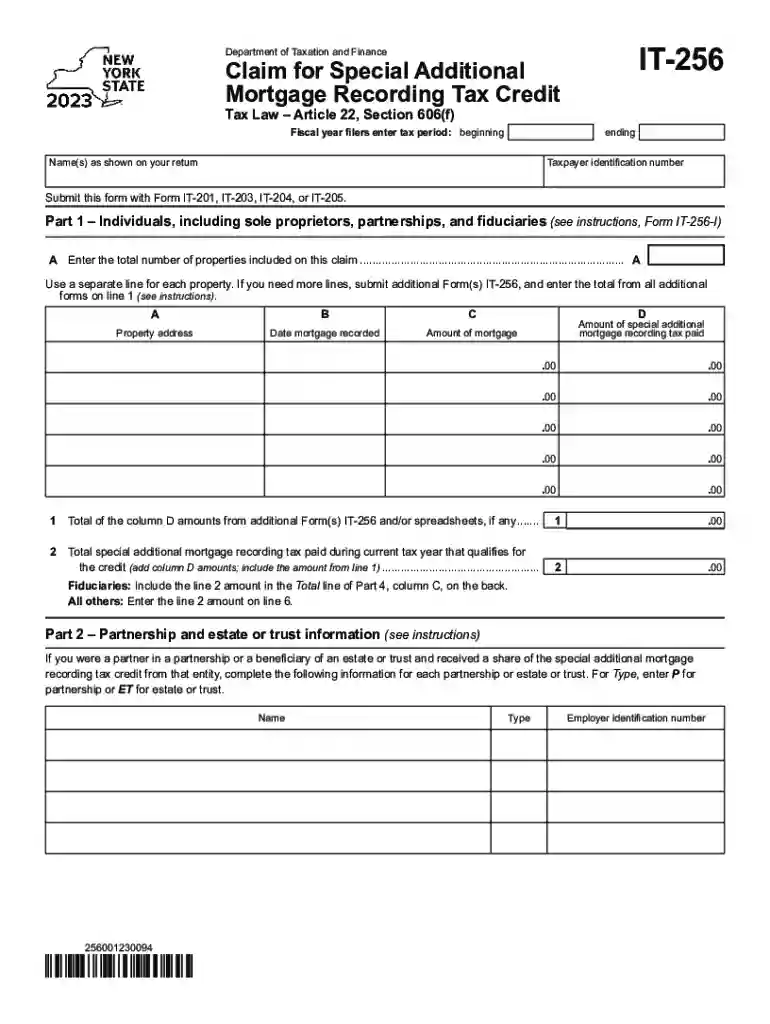
Form IT-256 Claim for Special Additional Mortgage 2026

Get Form
it256 Preview on Page 1

Here's how it works

01. Edit your it256 online
Type text, add images, blackout confidential details, add comments, highlights and more.

02. Sign it in a few clicks
Draw your signature, type it, upload its image, or use your mobile device as a signature pad.

03. Share your form with others
Send it via email, link, or fax. You can also download it, export it or print it out.

How to use or fill out Form IT-256 Claim for Special Additional Mortgage with DocHub

Form edit decoration
9.5
Ease of Setup
DocHub User Ratings on G2
9.0
Ease of Use
DocHub User Ratings on G2
  1. Click ‘Get Form’ to open it in the editor.
  2. Begin with Part 1, where you will enter the total number of properties included in your claim. Use a separate line for each property and submit additional forms if necessary.
  3. Fill in the property address, date the mortgage was recorded, amount of the mortgage, and the amount of special additional mortgage recording tax paid for each property listed.
  4. In Part 2, provide information about any partnerships or estates you are involved with. Enter the type (P for partnership or ET for estate/trust) along with their employer identification numbers.
  5. Complete Part 3 by entering your share of the credit from partnerships or estates. Add these amounts together in Part 5 to compute your total credit available for the current tax year.
  6. Finally, review all sections carefully before submitting your completed form along with Form IT-201, IT-203, IT-204, or IT-205.

Start using our platform today to fill out your Form IT-256 easily and efficiently!

See more Form IT-256 Claim for Special Additional Mortgage versions

We've got more versions of the Form IT-256 Claim for Special Additional Mortgage form. Select the right Form IT-256 Claim for Special Additional Mortgage version from the list and start editing it straight away!
Versions Form popularity Fillable & printable
2023 4.7 Satisfied (26 Votes)
2022 4.3 Satisfied (54 Votes)
2021 4.8 Satisfied (30 Votes)
2020 4.3 Satisfied (290 Votes)
be ready to get more

Complete this form in 5 minutes or less

Get form

Got questions?

We have answers to the most popular questions from our customers. If you can't find an answer to your question, please contact us.
Contact us
The mortgage recording tax is a fee for the registration and recording of the mortgaging and transfer of ownership of your property. Depending on your propertys location, this fee may include city, county, and state fees. This is determined based on the mortgage you secured to purchase the property.
Consider applying for a Consolidation, Extension, and Modification Agreement loan (CEMA). This will drastically reduce your mortgage recording tax liability, particularly for commercial real estate. Note that this method should only be used if your current interest rate is higher than the going rate.
special additional tax of 25 cents per $100 of mortgage debt or obligation secured.
Using the 1098, calculate how much of your mortgage interest qualifies for the deduction. Then, report the deduction on your tax return on Form 1040 (Schedule A) Line 8a the deductible amount reported in Box 1, deductible mortgage interest, and Box 6, points.
You can only deduct closing costs for a mortgage refinance if the costs are considered mortgage interest or real estate taxes. You closing costs are not tax deductible if they are fees for services, like title insurance and appraisals.

Security and compliance

At DocHub, your data security is our priority. We follow HIPAA, SOC2, GDPR, and other standards, so you can work on your documents with confidence.

Learn more
ccpa2
pci-dss
gdpr-compliance
hipaa
soc-compliance
be ready to get more

Complete this form in 5 minutes or less

Get form

People also ask

In most cases, you can deduct all of your home mortgage interest. How much you can deduct depends on the date of the mortgage, the amount of the mortgage, and how you use the mortgage proceeds.
Mortgage Tax States means, collectively, Alabama, Florida, Kansas, Georgia, Minnesota, New York, Oklahoma, Tennessee, Virginia and any other State in which an Individual Property or any Substitute Property may be located which imposes a mortgage recording or other mortgage tax.
Unlike mortgage interest, property taxes, or other deductions available to homeowners, MRT is considered a transactional expense and does not qualify as a personal tax deduction. The IRS does not allow taxpayers to deduct the cost of MRT when it is associated with purchasing or refinancing a primary residence.

Related links