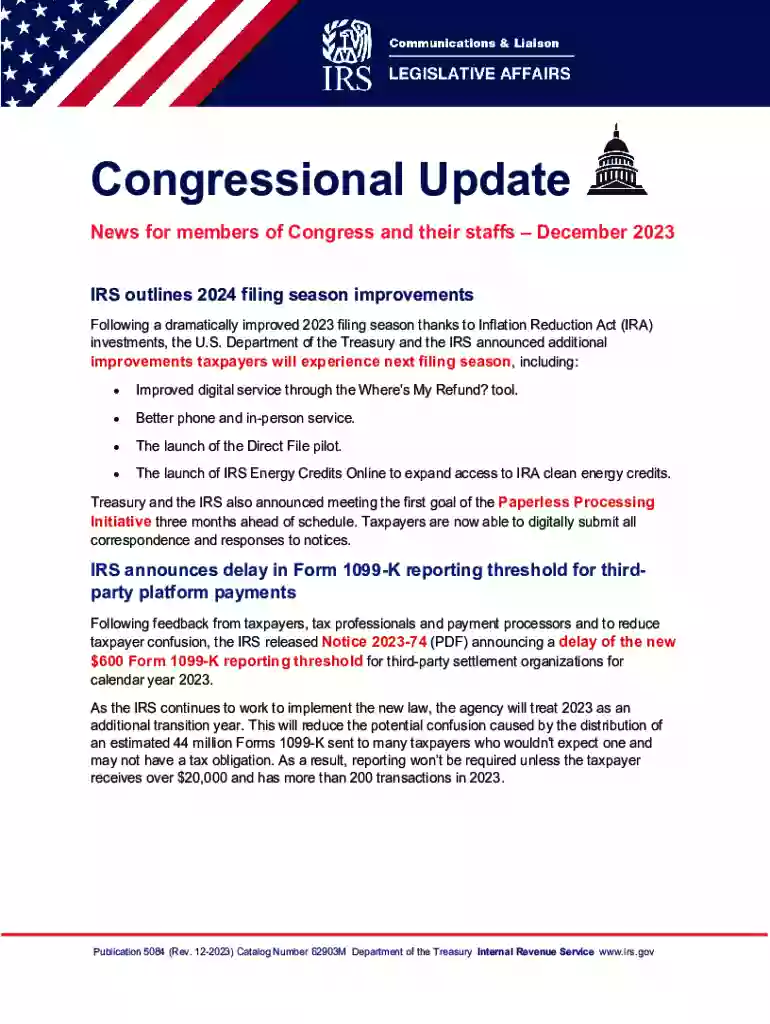
Publication 5084 (Rev 12-2023) IRS Congressional Update Newsletter-2026

Get Form
Publication 5084 (Rev 12-2023) IRS Congressional Update Newsletter Preview on Page 1

Here's how it works

01. Edit your form online
Type text, add images, blackout confidential details, add comments, highlights and more.

02. Sign it in a few clicks
Draw your signature, type it, upload its image, or use your mobile device as a signature pad.

03. Share your form with others
Send it via email, link, or fax. You can also download it, export it or print it out.

How to use or fill out Publication 5084 (Rev 12-2023) IRS Congressional Update Newsletter with Our Platform

Form edit decoration
9.5
Ease of Setup
DocHub User Ratings on G2
9.0
Ease of Use
DocHub User Ratings on G2
  1. Click ‘Get Form’ to open the Publication 5084 in the editor.
  2. Begin by reviewing the introductory section, which outlines key updates for the upcoming filing season. This will provide context for the information you need to fill out.
  3. Navigate through each section, such as tax withholding and estimated payments. Use our platform's text box feature to add notes or comments as needed.
  4. For specific fields related to tax credits or changes in reporting thresholds, ensure you input accurate data based on your situation. Utilize our platform’s highlighting tool to mark important sections for easy reference.
  5. Once all necessary information is filled out, review your entries for accuracy. You can easily edit any section using our intuitive editing tools.
  6. Finally, save your completed document and share it directly from our platform via email or download it for your records.

Start using our platform today to streamline your experience with Publication 5084 and make document management effortless!

See more Publication 5084 (Rev 12-2023) IRS Congressional Update Newsletter versions

We've got more versions of the Publication 5084 (Rev 12-2023) IRS Congressional Update Newsletter form. Select the right Publication 5084 (Rev 12-2023) IRS Congressional Update Newsletter version from the list and start editing it straight away!
Versions Form popularity Fillable & printable
2023 4.5 Satisfied (60 Votes)
2022 4.1 Satisfied (53 Votes)
2022 4.8 Satisfied (102 Votes)
2021 4.3 Satisfied (127 Votes)
2021 4.3 Satisfied (132 Votes)
2020 4.3 Satisfied (66 Votes)
be ready to get more

Complete this form in 5 minutes or less

Get form

Got questions?

We have answers to the most popular questions from our customers. If you can't find an answer to your question, please contact us.
Contact us
If you receive an IRS notice or letter We may send you a notice or letter if: You have a balance due. Your refund has changed. We have a question about your return.
The IRS opened on January 27, 2025 for this tax season. If the IRS accepted your return the day they started processing returns (usually late January), you may have received your refund as early as mid-February.
To qualify for a refund in June 2025, taxpayers must have: Filed their federal income tax return for the 2024 tax year between May 1 and May 31, 2025. Paid more in taxes than they owed. Chosen a valid payment method (either direct deposit or check)
$3,000 IRS Tax Refund Schedule 2025: When to Expect Your Refund Based on Filing Type. The IRS will begin issuing tax refunds averaging ~$3,000 to eligible U.S. taxpayers who filed their 2024 federal income tax returns between May 1 and May 31, as part of the $3000 IRS tax refund schedule 2025.
You receive a notice or letter from the IRS about a balance due on your account, missing returns, a lien, or a levy. There are several collection alternatives available to you to resolve these issues.

Security and compliance

At DocHub, your data security is our priority. We follow HIPAA, SOC2, GDPR, and other standards, so you can work on your documents with confidence.

Learn more
ccpa2
pci-dss
gdpr-compliance
hipaa
soc-compliance

People also ask

There is no official IRS program called the $3000 IRS tax refund. But the buzz didnt come out of nowhere. There are real tax credits that can result in refunds, even large ones, if you qualify.
Despite budget constraints and potential processing delays, most taxpayers who filed in May should receive their refunds in Juneparticularly if they filed electronically and opted for direct deposit. The IRS began processing refunds after the April tax deadline.
The IRS sends notices and letters for the following reasons: You have a balance due. The IRS changed your return - You are due a larger or smaller refund The IRS has a question about your tax return. The IRS needs to verify your identity. The IRS needs additional information.

Related links