Schedule R (Form 1040): Credit for the Elderly or Disabled-2026

Get Form
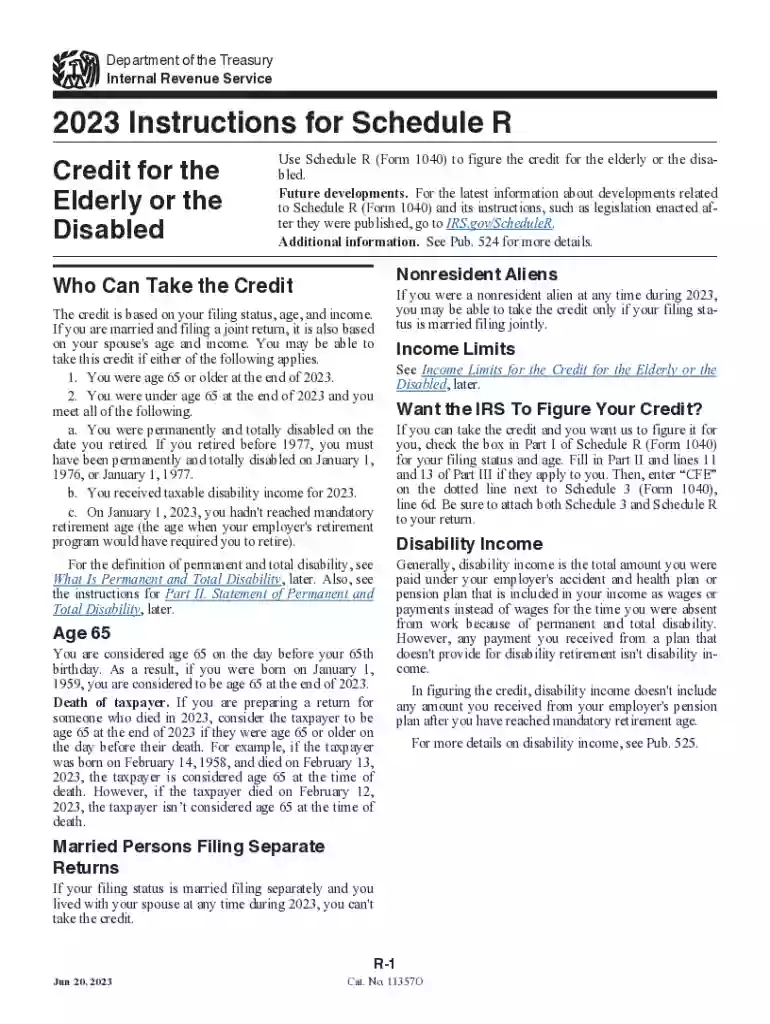
2023 instructions schedule r Preview on Page 1

Here's how it works

01. Edit your 2023 instructions schedule r online
Type text, add images, blackout confidential details, add comments, highlights and more.

02. Sign it in a few clicks
Draw your signature, type it, upload its image, or use your mobile device as a signature pad.

03. Share your form with others
Send 2023 instructions schedule r 1040 via email, link, or fax. You can also download it, export it or print it out.

How to use or fill out Schedule R (Form 1040): Credit for the Elderly or Disabled with our platform

Form edit decoration
9.5
Ease of Setup
DocHub User Ratings on G2
9.0
Ease of Use
DocHub User Ratings on G2
  1. Click ‘Get Form’ to open Schedule R (Form 1040) in the editor.
  2. Begin by filling out Part I, where you will indicate your filing status and age. Ensure that you check the appropriate box based on your eligibility for the credit.
  3. Proceed to Part II, where you will need to provide a statement of permanent and total disability if applicable. If required, have your physician complete the necessary certification.
  4. In Part III, calculate your credit by entering any disability income received and follow the instructions to determine if you qualify based on income limits outlined in the form.
  5. Finally, review all entries for accuracy before saving or exporting your completed form directly from our platform.

Start using our platform today to fill out Schedule R (Form 1040) easily and for free!

See more Schedule R (Form 1040): Credit for the Elderly or Disabled versions

We've got more versions of the Schedule R (Form 1040): Credit for the Elderly or Disabled form. Select the right Schedule R (Form 1040): Credit for the Elderly or Disabled version from the list and start editing it straight away!
Versions Form popularity Fillable & printable
2023 4.8 Satisfied (23 Votes)
2022 4.9 Satisfied (23 Votes)
2021 4.9 Satisfied (26 Votes)
2020 4.3 Satisfied (77 Votes)
2019 4.4 Satisfied (229 Votes)
2018 4.3 Satisfied (143 Votes)
2017 4.3 Satisfied (48 Votes)
be ready to get more

Complete this form in 5 minutes or less

Get form

Got questions?

We have answers to the most popular questions from our customers. If you can't find an answer to your question, please contact us.
Contact us
Examples of qualified activities Improving existing product functionality, quality, reliability or performance. Evaluating alternatives to existing products or processes. Testing product prototypes. Researching solutions intended to reduce time-to-market for a product.
As a result, the new $6,000 deduction is stacked on top of both the regular standard deduction $15,750 for single filers or $31,500 for married couples filing jointly in 2025 and the 65-plus addition. For instance, a 65-year-old single taxpayer who qualifies for the full $6,000 deduction would be able to deduct a
Credit for the elderly or the disabled at a glance aged 65 or older OR retired on permanent and total disability and received taxable disability income for the tax year; AND. with an adjusted gross income OR the total of nontaxable Social Security, pensions annuities or disability income under specific limits.
How to Fill Out Schedule R Part I: Qualification. Indicate your age or disability status and attach supporting documentation. Part II: Income. Enter your total adjusted gross income and calculate the allowable limits. Part III: Credit Calculation.
Schedule R to claim a nonrefundable credit for the elderly or disabled. Taxpayers age 65 or older, or under age 65 and receiving disability income due to permanent and total disability, may be eligible for the credit.

Security and compliance

At DocHub, your data security is our priority. We follow HIPAA, SOC2, GDPR, and other standards, so you can work on your documents with confidence.

Learn more
ccpa2
pci-dss
gdpr-compliance
hipaa
soc-compliance

People also ask

Starting with 2025 federal returns (filed in 2026), taxpayers 65 and older can claim up to $6,000 in addition to the extra standard deduction for seniors enacted back in 1948. The latest write-off is available whether you itemize or not.
Disability tax credits are available to US citizens and residents who are either 65 or older or permanently and totally disabled, as certified by a physician.

Related links