




Here's how it works

01. Edit your form online
Type text, add images, blackout confidential details, add comments, highlights and more.

02. Sign it in a few clicks
Draw your signature, type it, upload its image, or use your mobile device as a signature pad.

03. Share your form with others
Send it via email, link, or fax. You can also download it, export it or print it out.
How to use or fill out Family Educational Rights and Privacy Act (FERPA) - NCES with our platform

- Click ‘Get Form’ to open it in the editor.
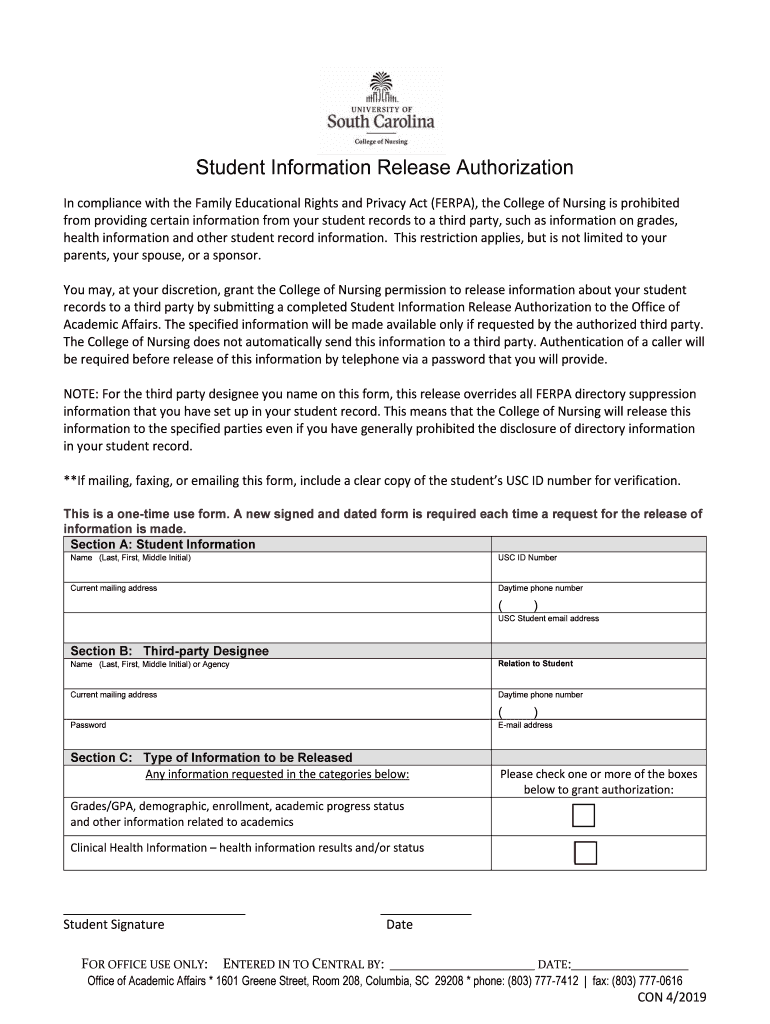
- In Section A, enter your personal information including your name, USC ID number, current mailing address, daytime phone number, and USC student email address.
- Proceed to Section B to designate a third party. Fill in their name, relation to you, mailing address, daytime phone number, password for verification, and email address.
- In Section C, specify the type of information you wish to release by checking the appropriate boxes for grades/GPA, demographic data, enrollment status, or clinical health information.
- Finally, sign and date the form at the bottom. Ensure all fields are completed accurately before submission.
Start using our platform today for free to streamline your document editing and form completion!
Fill out Family Educational Rights and Privacy Act (FERPA) - NCES online
It's free
It's free
See more Family Educational Rights and Privacy Act (FERPA) - NCES versions
We've got more versions of the Family Educational Rights and Privacy Act (FERPA) - NCES form. Select the right Family Educational Rights and Privacy Act (FERPA) - NCES version from the list and start editing it straight away!
| Versions | Form popularity | Fillable & printable |
|---|---|---|
| 2019 | 4.8 Satisfied (243 Votes) |
Got questions?
We have answers to the most popular questions from our customers. If you can't find an answer to your question, please contact us.
Contact us
What is the purpose of the Family Educational Rights and Privacy Act FERPA )?
The Family Educational Rights and Privacy Act (FERPA) is a federal law that affords parents the right to have access to their childrens education records, the right to seek to have the records amended, and the right to have some control over the disclosure of personally identifiable information from the education
What is the purpose of the Family Educational Rights and Privacy Act?
FERPA serves a two-fold purpose: (1) to grant parents (and students 18 or older) access to information in the students education record, and (2) to protect that information from disclosure to third parties without parental consent.
What is the purpose of the Family Educational Rights and Privacy Act quizlet?
The purpose of the Family Educational Rights and Privacy Act (FERPA) is to: Provide parents certain rights over their childrens educational records. Which of the following types of information may schools disclose without consent from the parent or student to a researcher at a local university?
What is an example of a FERPA violation?
What Are the Most Common FERPA Violations? Accidentally or purposefully emailing student information to unauthorized parties. Sharing a student athletes academic status with unauthorized parties. Sharing a students grades or identifying information with unauthorized parties.
What is the purpose of the Family Educational Rights and Privacy Act FERPA is to allow school counselors to access students grades?
The purpose of FERPA is to give parents certain rights with regard to the release of their childrens educational records. School personnel such as teachers, counselors, and principals may access student records for legitimate school functions.
Security and compliance
At DocHub, your data security is our priority. We follow HIPAA, SOC2, GDPR, and other standards, so you can work on your documents with confidence.
Learn more


People also ask
What are the 5 FERPA identifiers?
(a) The students name; (b) The name of the students parent or other family members; (c) The address of the student or students family; (d) A personal identifier, such as the students social security number, student number, or biometric record; (e) Other indirect identifiers, such as the students date of birth,
What is the purpose of FERPA Quizlet?
The FERPA provides access rights to the parents of a student until the student reaches the age of 18.