Steps in a civil action - Ministry of the Attorney General 2026

Get Form
Steps in a civil action - Ministry of the Attorney General Preview on Page 1

Here's how it works

01. Edit your form online
Type text, add images, blackout confidential details, add comments, highlights and more.

02. Sign it in a few clicks
Draw your signature, type it, upload its image, or use your mobile device as a signature pad.

03. Share your form with others
Send it via email, link, or fax. You can also download it, export it or print it out.

How to use or fill out Steps in a civil action - Ministry of the Attorney General

Form edit decoration
9.5
Ease of Setup
DocHub User Ratings on G2
9.0
Ease of Use
DocHub User Ratings on G2
  1. Click ‘Get Form’ to open it in the editor.
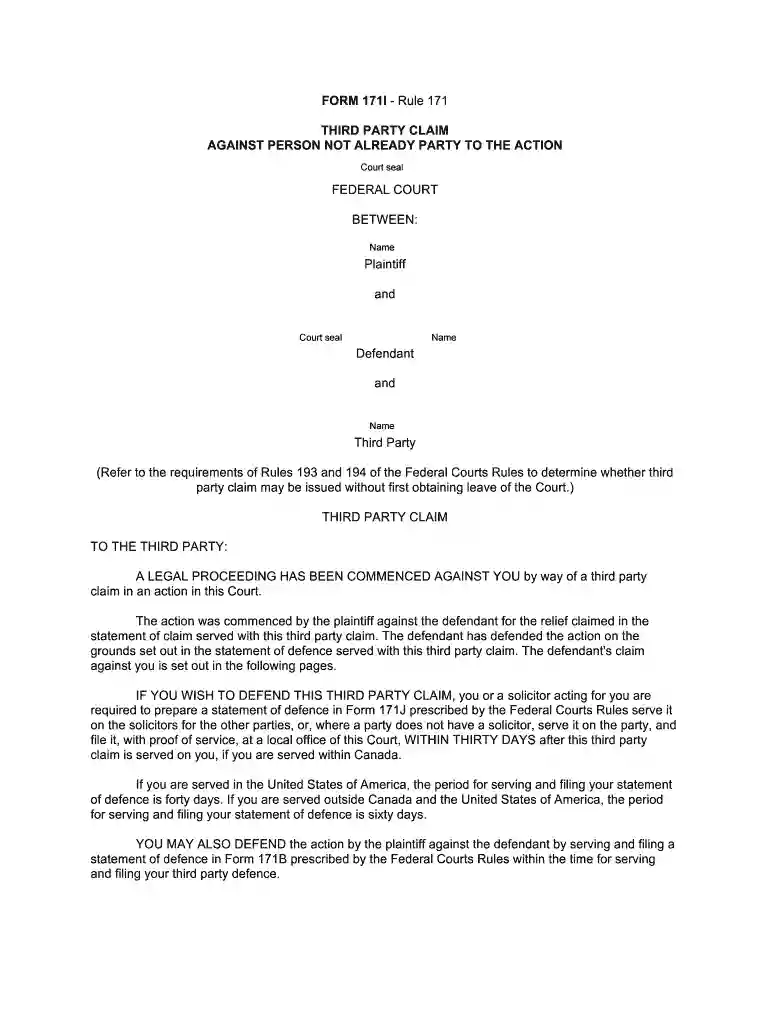
  2. Begin by entering the names of the plaintiff and defendant in the designated fields. Ensure accuracy as these details are crucial for the court's records.
  3. In the 'Third Party' section, input the name of the third party against whom the claim is made. This is essential for identifying all parties involved in the action.
  4. Carefully read through the instructions provided regarding timelines for serving your statement of defense. Fill in any relevant dates to keep track of your deadlines.
  5. In the 'Claim' section, clearly state the relief you are claiming against the third party. Use numbered paragraphs to outline each allegation supporting your claim.
  6. Finally, ensure that you sign and date the document at the bottom. Include your contact information if you are representing yourself.

Start using our platform today to streamline your document editing and form completion process for free!

See more Steps in a civil action - Ministry of the Attorney General versions

We've got more versions of the Steps in a civil action - Ministry of the Attorney General form. Select the right Steps in a civil action - Ministry of the Attorney General version from the list and start editing it straight away!
Versions Form popularity Fillable & printable
2016 4.8 Satisfied (100 Votes)
be ready to get more

Complete this form in 5 minutes or less

Get form

Got questions?

We have answers to the most popular questions from our customers. If you can't find an answer to your question, please contact us.
Contact us
The Rule of 7 is a marketing principle that suggests a potential customer needs to encounter a brands message at least seven times before they take action and make a purchase.
The Legal Process In The United States: A Civil Case The Basics. There are two types of lawsuits: civil and criminal. Pleadings/Filing The Complaint. Filing the complaint is what begins a lawsuit. Scheduling Order. Preliminary Injunction. Motion to Dismiss. Motion for Summary Judgment. Mediation. Hearing.
Order XLVII, rule 7(1) provides that any order granting an application for review may be objected to on the ground that the application was in contravention of the provisions of rule 4, or after the expiration of the period of limitation and without sufficient cause.
Every plaint shall state specifically the relief which the plaintiff claims either simply or in the alternative, and it shall not be necessary to ask for general or other relief which may always be given as the Court may think just to the same extent as if it had been asked for.
When Most Civil Cases Settle. It may be surprising to individuals considering a civil lawsuit that most civil cases settle before ever proceeding with the trial process. A judicial order can also resolve a case before a trial commences.

Security and compliance

At DocHub, your data security is our priority. We follow HIPAA, SOC2, GDPR, and other standards, so you can work on your documents with confidence.

Learn more
ccpa2
pci-dss
gdpr-compliance
hipaa
soc-compliance

People also ask

A civil action begins when a party to a dispute files a complaint, and pays a filing fee required by statute. A plaintiff who is unable to pay the fee may file a request to proceed in forma pauperis. If the request is granted, the fee is waived.
Key Rules of Order 7 Rule 1: Details the particulars to be contained in the plaint. Rule 2: Specifies particulars for money suits. Rule 3: Pertains to suits involving immovable property. Rule 4: Covers cases where the plaintiff sues as a representative. Rule 5: Discusses the defendants interest and liability.

Related links