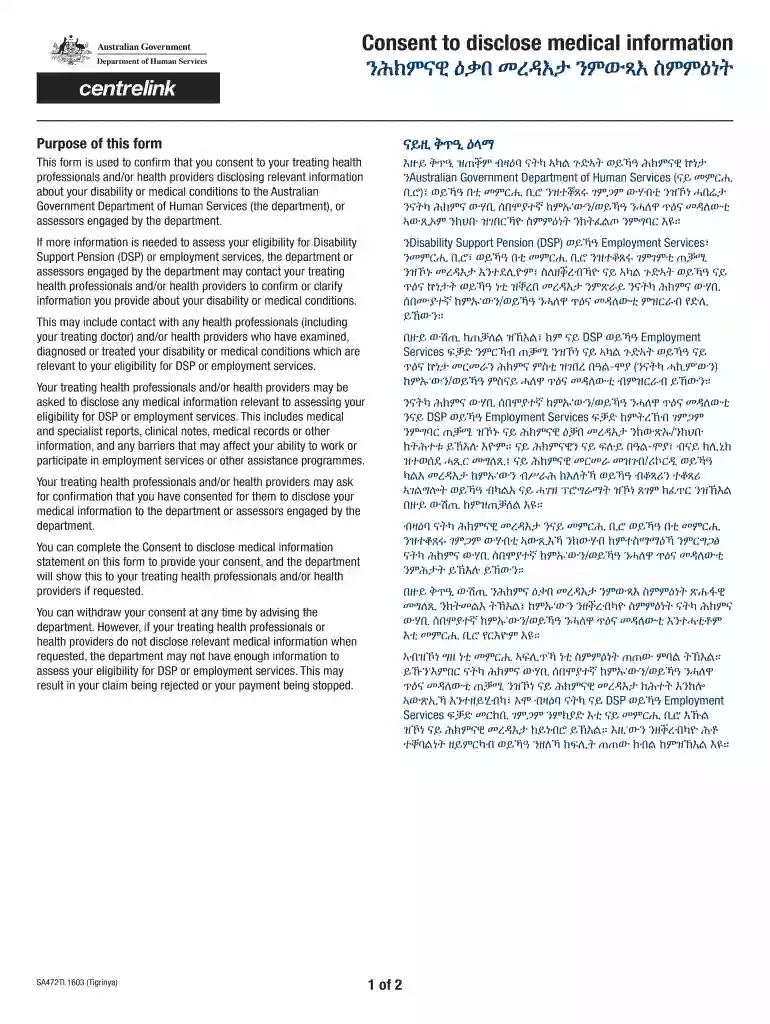
Consent to disclose medical information - Tigrinya - Australian 2025

Get Form
australia dhs centrelink consent disclose medical Preview on Page 1

Here's how it works

01. Edit your australia dhs centrelink consent disclose medical online
Type text, add images, blackout confidential details, add comments, highlights and more.

02. Sign it in a few clicks
Draw your signature, type it, upload its image, or use your mobile device as a signature pad.

03. Share your form with others
Send australia dhs centrelink disclose medical information via email, link, or fax. You can also download it, export it or print it out.

How to use or fill out Consent to disclose medical information - Tigrinya - Australian with our platform

Form edit decoration
9.5
Ease of Setup
DocHub User Ratings on G2
9.0
Ease of Use
DocHub User Ratings on G2
  1. Click ‘Get Form’ to open it in the editor.
  2. Begin by entering your full name in the designated field. This is essential for identifying your consent.
  3. Next, provide your date of birth. Ensure you select the correct day, month, and year to avoid any discrepancies.
  4. Fill in your address, including the postcode. This information helps the department contact you if necessary.
  5. In the consent section, clearly indicate that you allow your health professionals to share relevant medical information with the Australian Government Department of Human Services.
  6. Finally, sign and date the form at the bottom. Your signature confirms your consent and understanding of the document's purpose.

Start using our platform today to easily complete and manage your Consent to disclose medical information form for free!

See more Consent to disclose medical information - Tigrinya - Australian versions

We've got more versions of the Consent to disclose medical information - Tigrinya - Australian form. Select the right Consent to disclose medical information - Tigrinya - Australian version from the list and start editing it straight away!
Versions Form popularity Fillable & printable
2016 4.8 Satisfied (121 Votes)
be ready to get more

Complete this form in 5 minutes or less

Get form

Got questions?

We have answers to the most popular questions from our customers. If you can't find an answer to your question, please contact us.
Contact us
The patient should be provided with all relevant information that is necessary to allow her to make an informed decision about treatment. The law requires that a doctor has a duty to warn a patient of a material risk inherent in any proposed procedure or treatment.
Charter of rights This includes informed consent, which is a persons voluntary decision about their health care that is made with knowledge and understanding of the benefits and risks involved.
Under the CMIA, medical information must be released when compelled: by court order. by a board, commission or administrative agency for purposes of adjudication. by a party to a legal action before a court, arbitration, or administrative agency, by subpoena or discovery request.
You can use or disclose health information where the use or disclosure is required or authorised by or under an Australian law or a court/tribunal order. If the law requires you to use or disclose information, you must do so.
Obtaining informed consent in medicine is a process that should include describing the proposed intervention, emphasizing the patients role in decision-making, discussing alternatives to the proposed intervention, discussing the risks and benefits of the proposed intervention, and eliciting the patients preference,

People also ask

All state and territory definitions state that consent must be free and voluntary (e.g. without threats, fear or intimidation). All jurisdictions, except Western Australia, outline provisions about capacity to consent (e.g. a person does not have capacity to consent if they are asleep, unconscious or intoxicated).
To legally provide informed consent in Australia, you must be able to understand the information provided and be capable of voluntarily making an informed decision. If you dont have legal capacity to give informed consent, a substitute decision-maker or guardian may be able to consent on your behalf.
Everyone must be presumed to have capacity to make decisions about their treatment and medical treatment and to give informed consent, and a person can make a decision that others may regard as unwise, regardless of their age or legal status under the Act.

Related links