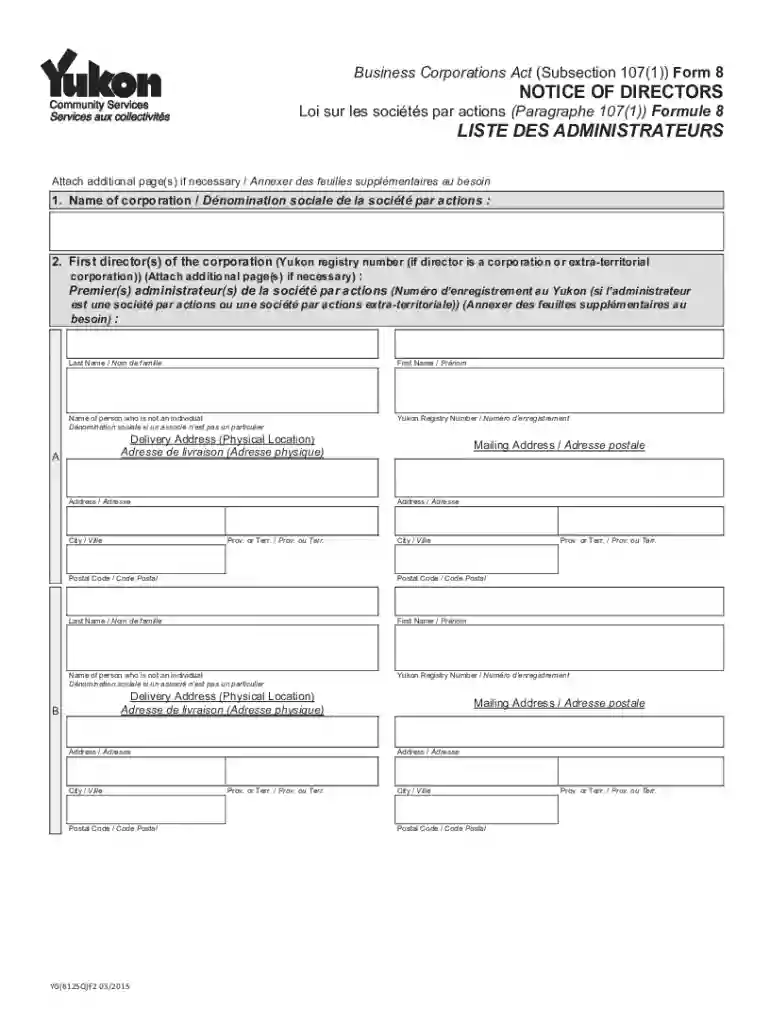
Business Corporations Act (Subsection 107(1)) Form 8 2026

Get Form
Business Corporations Act (Subsection 107(1)) Form 8 Preview on Page 1

Here's how it works

01. Edit your form online
Type text, add images, blackout confidential details, add comments, highlights and more.

02. Sign it in a few clicks
Draw your signature, type it, upload its image, or use your mobile device as a signature pad.

03. Share your form with others
Send it via email, link, or fax. You can also download it, export it or print it out.

How to use or fill out Business Corporations Act (Subsection 107(1)) Form 8 with our platform

Form edit decoration
9.5
Ease of Setup
DocHub User Ratings on G2
9.0
Ease of Use
DocHub User Ratings on G2
  1. Click ‘Get Form’ to open it in the editor.
  2. Begin by entering the name of the corporation in the designated field. Ensure that it matches the official registration details.
  3. List the first director(s) of the corporation. If a director is a corporation, include their Yukon registry number. You can attach additional pages if necessary.
  4. For each director, fill in their last name, first name, and if applicable, the name of any non-individual entity. Also, provide their delivery address and mailing address.
  5. Next, enter the name of the incorporator along with their last and first names.
  6. Sign in the designated area for the incorporator's signature and date it appropriately using YYYY/MM/DD format.

Start using our platform today to complete your Business Corporations Act Form 8 easily and for free!

See more Business Corporations Act (Subsection 107(1)) Form 8 versions

We've got more versions of the Business Corporations Act (Subsection 107(1)) Form 8 form. Select the right Business Corporations Act (Subsection 107(1)) Form 8 version from the list and start editing it straight away!
Versions Form popularity Fillable & printable
2015 4.9 Satisfied (59 Votes)
be ready to get more

Complete this form in 5 minutes or less

Get form

Got questions?

We have answers to the most popular questions from our customers. If you can't find an answer to your question, please contact us.
Contact us
Oppression vs. While both may overlap, oppression claims focus on personal harm to the complainant, whereas derivative actions address wrongs done to the corporation itself. Unlike derivative actions, oppression claims do not require leave of the court.
The Oppression Remedy under the Ontario Business Corporations Act (OBCA) provides a powerful legal tool for shareholders, directors, and other stakeholders in closely held corporations to protect their interests when they are unfairly treated or oppressed by the actions of those in control of the company.
First, check the shareholders agreement for any removal clauses. Next, call a special meeting and vote on the resolution to remove the shareholder. Document everything properly to stay compliant with the law. Seek legal advice if needed.
3 (1) This Act applies to every corporation and, to the extent provided for in Part 19, to bodies corporate without share capital incorporated by a special Act of Parliament. (2) The following do not apply to a corporation: (a) the Canada Business Corporations Act ; and.
248 of the Business Corporations Act, a shareholder or former shareholder may apply to the court for a remedy when the powers of the directors of a corporation have been exercised in a manner that is oppressive, unfairly prejudicial, or in a way that unfairly disregards the interests of the shareholder.

Security and compliance

At DocHub, your data security is our priority. We follow HIPAA, SOC2, GDPR, and other standards, so you can work on your documents with confidence.

Learn more
ccpa2
pci-dss
gdpr-compliance
hipaa
soc-compliance

People also ask

Overview of Section 232 The key components of section 232 are as follows: Oppressive Conduct: This refers to situations where the conduct of the company or its management is detrimental to the interests of one or more shareholders, or the company itself.
The oppression remedy can be used to protect the interests of shareholders, directors, officers or creditors against the acts of other shareholders, the board of directors or other affiliates of the corporation.
1.2 Part 7.10A of the Corporations Act established the AFCA scheme to resolve disputes about products and services provided by financial firms. The AFCA scheme replaced several other dispute resolution bodies, including the Superannuation Complaints Tribunal.

Related links