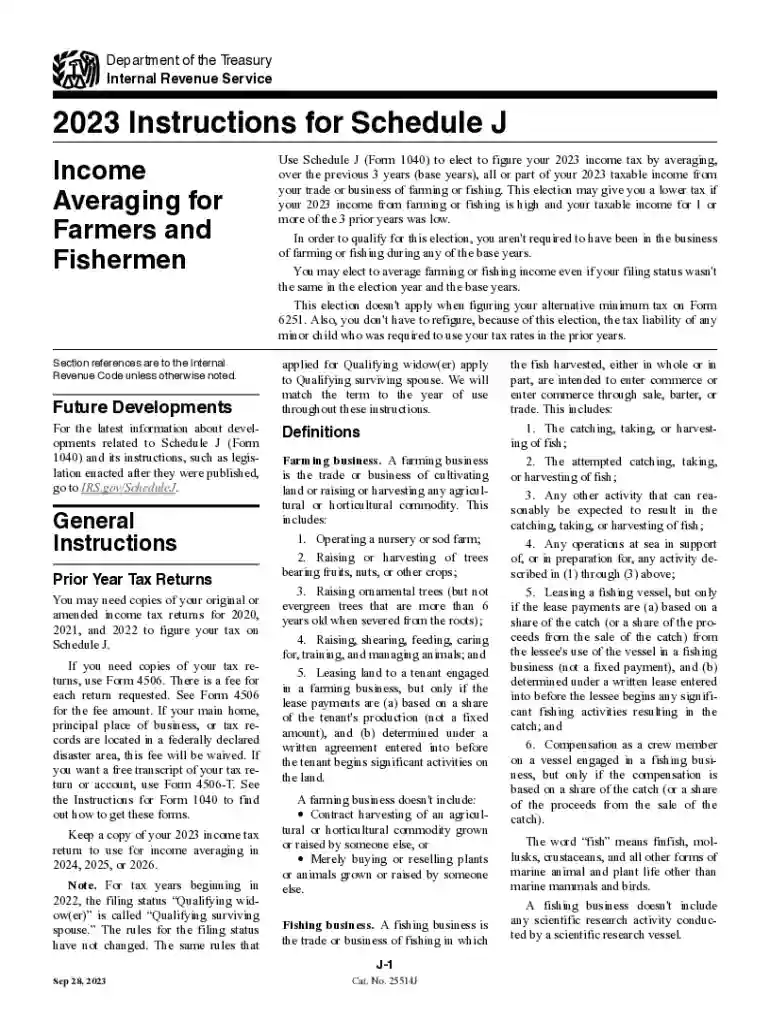
Schedule J (Form 1040) Income Averaging for Farmers-2026

Get Form
Schedule J (Form 1040) Income Averaging for Farmers Preview on Page 1

Here's how it works

01. Edit your form online
Type text, add images, blackout confidential details, add comments, highlights and more.

02. Sign it in a few clicks
Draw your signature, type it, upload its image, or use your mobile device as a signature pad.

03. Share your form with others
Send it via email, link, or fax. You can also download it, export it or print it out.

How to use or fill out Schedule J (Form 1040) Income Averaging for Farmers with DocHub

Form edit decoration
9.5
Ease of Setup
DocHub User Ratings on G2
9.0
Ease of Use
DocHub User Ratings on G2
  1. Click ‘Get Form’ to open Schedule J (Form 1040) in our platform's editor.
  2. Begin by entering your elected farm income on line 2a. This should include all taxable income from your farming or fishing business over the past three years.
  3. If applicable, complete lines 2b and 2c to report any net capital gain associated with your elected farm income. Ensure that these amounts do not exceed the limits specified in the instructions.
  4. Proceed to line 4, where you will calculate the tax based on the amount from line 3 using the appropriate tax tables provided in the instructions.
  5. For lines 5 through 13, enter prior year amounts as instructed, ensuring you reference previous tax returns if necessary. This is crucial for accurate averaging.
  6. Finally, review all entries for accuracy before saving or exporting your completed form directly from our platform.

Start editing your Schedule J today for free with our intuitive online editor!

See more Schedule J (Form 1040) Income Averaging for Farmers versions

We've got more versions of the Schedule J (Form 1040) Income Averaging for Farmers form. Select the right Schedule J (Form 1040) Income Averaging for Farmers version from the list and start editing it straight away!
Versions Form popularity Fillable & printable
2023 4.5 Satisfied (46 Votes)
2022 4.1 Satisfied (43 Votes)
2021 4.8 Satisfied (231 Votes)
2013 4 Satisfied (49 Votes)
be ready to get more

Complete this form in 5 minutes or less

Get form

Got questions?

We have answers to the most popular questions from our customers. If you can't find an answer to your question, please contact us.
Contact us
Overview of income averaging As a primary producer, income averaging allows you to even out your income and tax payable over a maximum of 5 years to take good and bad income years into account. This ensures you dont pay more tax over time than taxpayers on similar, but steady, incomes.
If youre a farmer or fisherman, you can use Schedule J to calculate your income tax using income averaging. This allows you to average your income from farming or fishing over the past three years to determine your income tax liability.
Income Averaging: An Explainer Historically, the LIHTC program served families with incomes below 60 percent AMI. Income averaging allows for the averaging of incomes up to 80 percent AMI in a project, or as low as 30 percent AMI, as long as the average stays below 60 percent AMI.
The Internal Revenue Code only allows income averaging to farmers and fishermen. If you are a farmer or fisherman, you need to complete Schedule J, Income Averaging for Farmers and Fishermen.
Forward averaging allows taxpayers to spread that lump-sum retirement income over several prior years, typically either five or ten years. Without forward averaging, a lump-sum distribution from a retirement plan may push a taxpayer into a higher tax bracket.

Security and compliance

At DocHub, your data security is our priority. We follow HIPAA, SOC2, GDPR, and other standards, so you can work on your documents with confidence.

Learn more
ccpa2
pci-dss
gdpr-compliance
hipaa
soc-compliance

People also ask

Who can use Income Averaging? You must be engaged in farming, ranching, or commercial fishing. The IRS states that income from your trade or business of farming or fishing. There are some additional limitations so please refer to the below link.
Income averaging was a tax break that assisted people with large income deviations up until 1986. After the 1986 Tax Reform Act, income averaging was eliminated for everyone except fishermen and farmers.

Related links