




01. Edit your form online
Type text, add images, blackout confidential details, add comments, highlights and more.

Type text, add images, blackout confidential details, add comments, highlights and more.

Draw your signature, type it, upload its image, or use your mobile device as a signature pad.

Send it via email, link, or fax. You can also download it, export it or print it out.
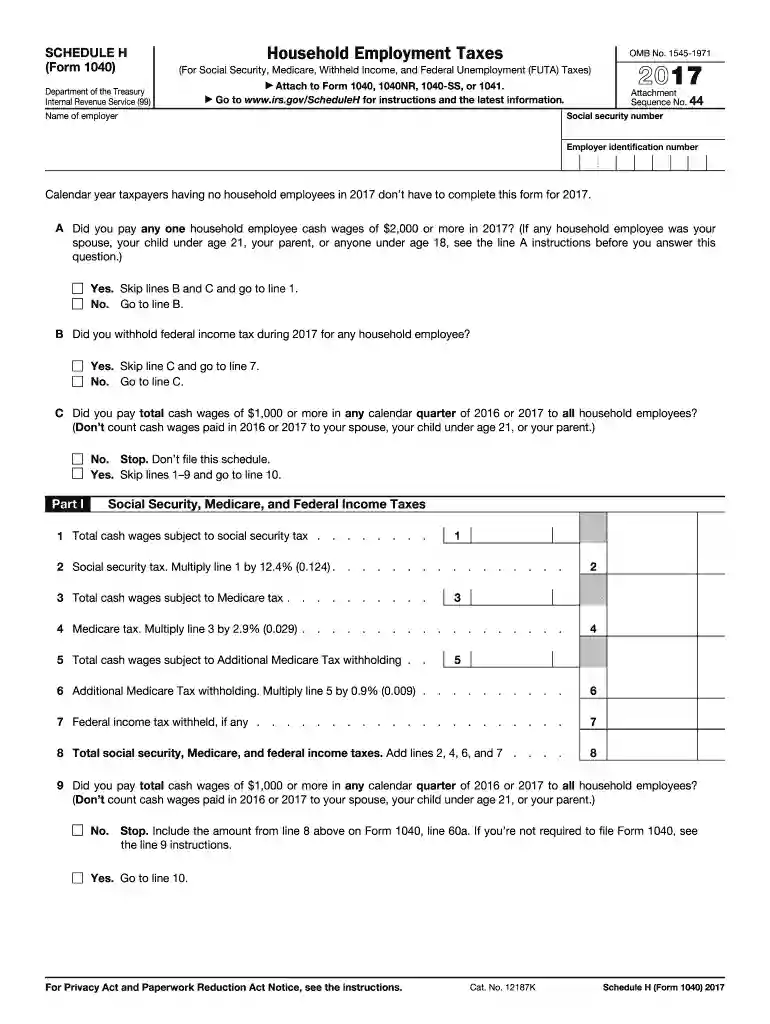
Schedule H (Form 1040) is a federal tax form used by U.S. taxpayers to report household employment taxes. It primarily covers Social Security, Medicare, and Federal Unemployment Taxes (FUTA) paid on behalf of household employees. This form is a critical component for individuals who employ domestic workers, such as nannies, housekeepers, or caregivers, ensuring compliance with federal tax obligations.
Completing Schedule H involves several detailed steps, each requiring precision to ensure accuracy in tax reporting.
Consider an employer who paid a household employee $3,000 in 2017. This employer must report:
Each section demands careful attention to detail to avoid mistakes that could result in penalties.
Using Schedule H effectively involves understanding its structure and the information needed.
For a household with multiple employees, each individual's wages and respective taxes are separately calculated and summed to determine total employer liability.
Grasping the terminology associated with Schedule H is essential for accurate form completion.
Understanding these terms clarifies the form's requirements, preventing common filing errors.
Legal compliance is a critical aspect of using Schedule H, governed by tax laws.
Failure to comply may result in fines or audits from the IRS, emphasizing the importance of meticulous form handling.
The IRS provides comprehensive guidelines to aid taxpayers in completing Schedule H accurately.
These guidelines are invaluable for ensuring accurate reporting and meeting all legal requirements.
Timely submission of Schedule H is crucial to avoid penalties.
Understanding these deadlines helps ensure compliance and prevent late-filing penalties.
Taxpayers have multiple options for submitting Schedule H to fit varied preferences and situations.
Each method provides a distinct pathway for form submission, suiting diverse taxpayer needs.
We've got more versions of the schedule h 2017 form form. Select the right schedule h 2017 form version from the list and start editing it straight away!
| Versions | Form popularity | Fillable & printable |
|---|---|---|
| 2025 | 4.2 Satisfied (49 Votes) | |
| 2024 | 4.6 Satisfied (41 Votes) | |
| 2023 | 4.6 Satisfied (40 Votes) | |
| 2022 | 4.5 Satisfied (52 Votes) | |
| 2021 | 4.8 Satisfied (145 Votes) | |
| 2020 | 4.4 Satisfied (225 Votes) | |
| 2019 | 4.3 Satisfied (110 Votes) | |
| 2018 | 4.4 Satisfied (69 Votes) | |
| 2017 | 4.3 Satisfied (80 Votes) | |
| 2016 | 4.4 Satisfied (45 Votes) | |
| 2015 | 4 Satisfied (21 Votes) | |
| 2014 | 4.3 Satisfied (68 Votes) | |
| 2013 | 4 Satisfied (26 Votes) | |
| 2011 | 4.2 Satisfied (33 Votes) | |
| 2010 | 4.2 Satisfied (61 Votes) |
At DocHub, your data security is our priority. We follow HIPAA, SOC2, GDPR, and other standards, so you can work on your documents with confidence.
Calendar year taxpayers having no household employees in 2017 dont have to complete this form for 2017. A Did you pay any one household employee cash wages ofRead more
Jan 2, 2018 Household employment taxes. But if you are filing a return only because you owe these taxes, you can file. Schedule H (Form 1040) by itself.Read more
Enter federal AGI of tax filing unit (Line 1, Section A, Schedule H or. 1. Line 8, Section B, Schedule H). 2. Enter property taxes paid in 2017 or 20% of rentRead more


