




01. Edit your form 990 pf 2023 online
Type text, add images, blackout confidential details, add comments, highlights and more.

Type text, add images, blackout confidential details, add comments, highlights and more.

Draw your signature, type it, upload its image, or use your mobile device as a signature pad.

Send 990 filings search via email, link, or fax. You can also download it, export it or print it out.
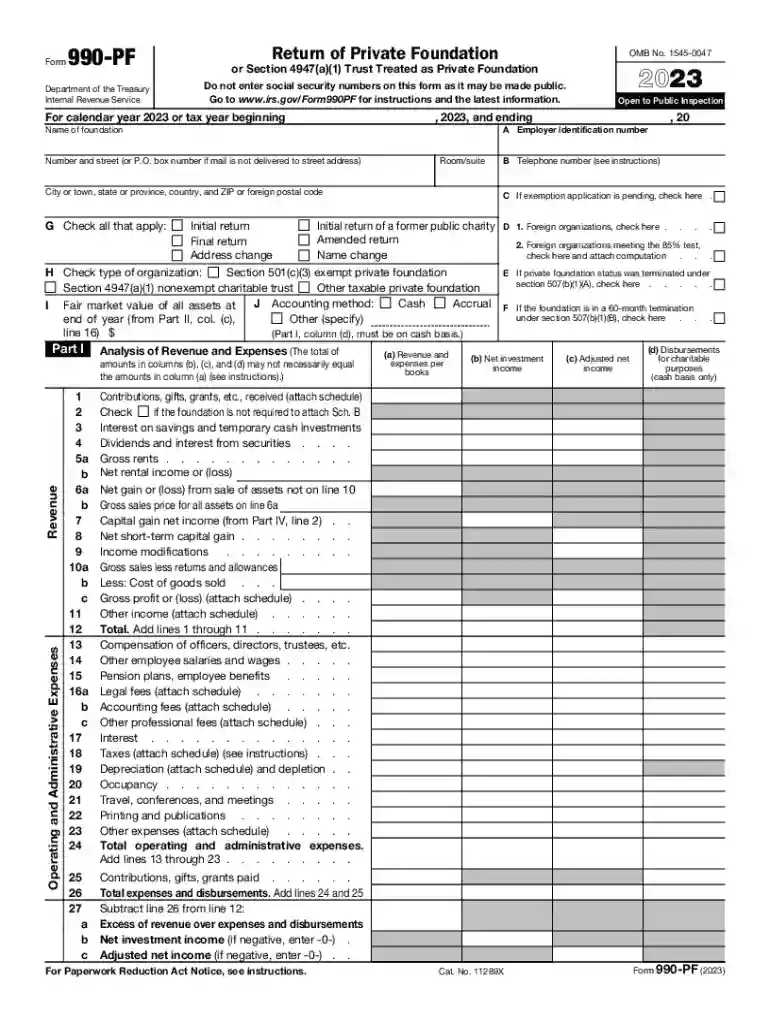
The 2023 Form 990-PF, officially known as the "Return of Private Foundation or Section 4947(a)(1) Trust Treated as Private Foundation," is an essential tax document required by the IRS for private foundations. It serves as a financial disclosure document, providing detailed information about a foundation's operations, including revenue, expenditures, assets, and liabilities for the tax year 2023. This form also requires reporting on grants, contributions, and any political activities engaged in by the foundation. Understanding this form ensures compliance with federal tax regulations and helps maintain a foundation's tax-exempt status.
The 2023 Form 990-PF encompasses several critical sections that must be accurately completed:
These components are pivotal for transparency and legal compliance.
Each step requires meticulous attention to ensure accuracy and adherence to regulations.
The primary users of the 2023 Form 990-PF include:
These entities use the form to report financial activities and verify compliance with the IRS.


Private foundations must file the 2023 Form 990-PF by the 15th day of the fifth month following the end of their fiscal year. For foundations with a calendar year, the deadline is May 15, 2024. Timely filing is crucial to avoid penalties and maintain good standing with the IRS. Extensions can be requested using Form 8868.
The Form 990-PF is legally mandated for private foundations and Section 4947(a)(1) trusts to:
These legal imperatives reinforce the form's role in regulatory compliance.
The IRS provides specific instructions to aid in the accurate completion of Form 990-PF. These guidelines cover:
Following these guidelines helps ensure a compliant and successful filing process.
Failure to file Form 990-PF timely or accurately can result in significant penalties, such as:
Penalties underline the importance of diligence in completing and submitting the form.
We've got more versions of the form 990 pf 2023 form. Select the right form 990 pf 2023 version from the list and start editing it straight away!
| Versions | Form popularity | Fillable & printable |
|---|---|---|
| 2025 | 4.7 Satisfied (39 Votes) | |
| 2024 | 4.6 Satisfied (30 Votes) | |
| 2023 | 4.2 Satisfied (21 Votes) | |
| 2022 | 4.9 Satisfied (57 Votes) | |
| 2021 | 4.8 Satisfied (110 Votes) | |
| 2020 | 4.3 Satisfied (151 Votes) | |
| 2019 | 4.3 Satisfied (59 Votes) | |
| 2018 | 4.3 Satisfied (90 Votes) | |
| 2017 | 4.1 Satisfied (75 Votes) | |
| 2016 | 4.4 Satisfied (629 Votes) | |
| 2015 | 4.3 Satisfied (64 Votes) | |
| 2014 | 4.1 Satisfied (66 Votes) | |
| 2013 | 4.1 Satisfied (49 Votes) | |
| 2012 | 4.2 Satisfied (29 Votes) | |
| 2011 | 4.1 Satisfied (53 Votes) |
At DocHub, your data security is our priority. We follow HIPAA, SOC2, GDPR, and other standards, so you can work on your documents with confidence.
Form 990-PF. 501(c)(3) exempt private foundation. 4947(a)(1) nonexempt charitable trust treated as a private foundation. 501(c)(3) taxable private foundation.
Form 990-PF is used to figure the tax based on investment income, and to report charitable distributions and activities.Read more


