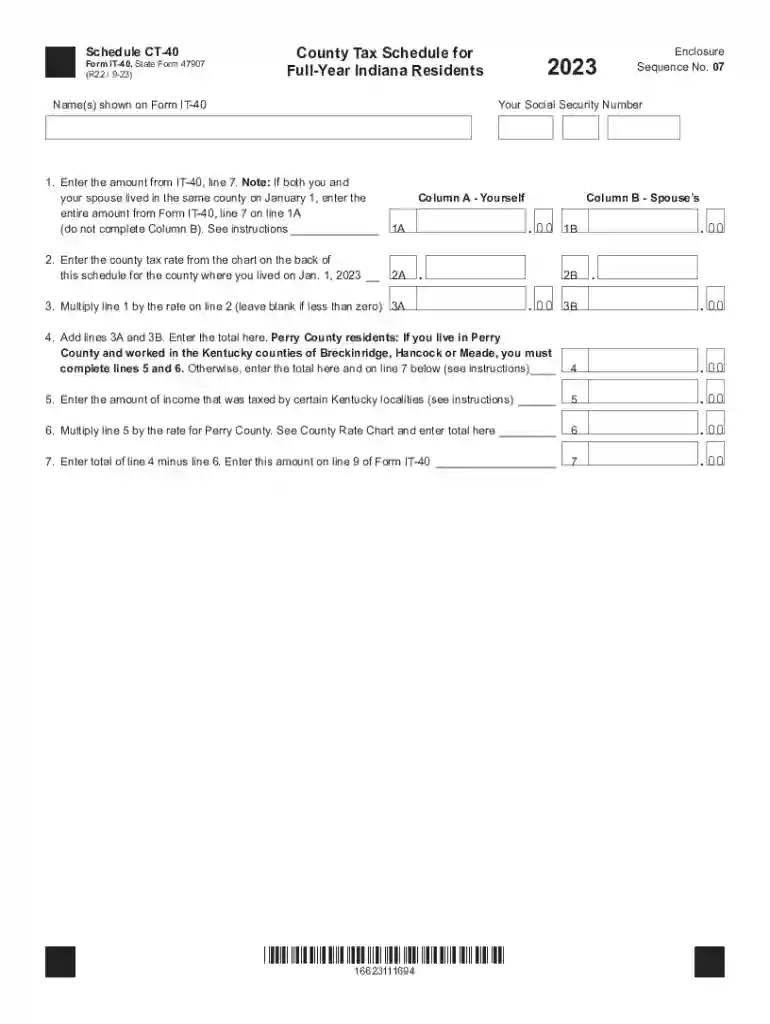
Form IT-40, State Form 47907: County Tax Schedule (State 2026

Get Form
Form IT-40, State Form 47907: County Tax Schedule (State Preview on Page 1

Here's how it works

01. Edit your form online
Type text, add images, blackout confidential details, add comments, highlights and more.

02. Sign it in a few clicks
Draw your signature, type it, upload its image, or use your mobile device as a signature pad.

03. Share your form with others
Send it via email, link, or fax. You can also download it, export it or print it out.

How to use or fill out Form IT-40, State Form 47907: County Tax Schedule (State)

Form edit decoration
9.5
Ease of Setup
DocHub User Ratings on G2
9.0
Ease of Use
DocHub User Ratings on G2
  1. Click ‘Get Form’ to open it in the editor.
  2. Begin by entering your name(s) as shown on Form IT-40 at the top of the schedule.
  3. In line 1A, input the amount from IT-40, line 7. If both you and your spouse lived in the same county on January 1, enter the entire amount here and skip Column B.
  4. For line 2A, refer to the county tax rate chart provided on the back of this schedule and enter the applicable rate for your county as of January 1, 2023.
  5. Multiply the amount from line 1 by the rate from line 2 to complete line 3A. If this value is less than zero, leave it blank.
  6. Add lines 3A and any applicable amounts from your spouse's column (if applicable) to complete line 4.
  7. If you reside in Perry County and worked in specific Kentucky counties, complete lines 5 and 6; otherwise, proceed to enter total from line 4 on line 7.

Start using our platform today for free to simplify your form completion process!

be ready to get more

Complete this form in 5 minutes or less

Get form

Got questions?

We have answers to the most popular questions from our customers. If you can't find an answer to your question, please contact us.
Contact us
IT-40 is the full-year resident individual state tax return for Indiana. IT-40PNR is the part-year or full-year nonresident individual state tax return for Indiana. Indiana Schedule IN-OCC Other Certified Credits may be removed if the form is not needed in your tax return.
Yes. Some taxing jurisdictions impose a workplace location, or non-resident earned income tax on those who work within their borders but who do not live there. If the tax rate where you work is higher than the tax rate where you live, your employer is required to withhold at the higher of the two rates.
Each of the 92 counties in Indiana has its own rate. For the purpose of determining the proper county tax rate, it doesnt matter if the taxpayers county of residency status or county of employment status changes during the year.
Individual nonresidents and part-year residents are taxed at a flat state tax rate of 3.23%, plus any applicable county tax. Indiana no longer gives the option for nonresident individuals to opt-out of filing composite returns; it is now required.
Indiana Tax Rates, Collections, and Burdens Indiana has a flat 3.05 percent individual income tax rate. There are also jurisdictions that collect local income taxes. Indiana has a 4.9 percent corporate income tax rate. Indiana also has a 7.00 percent state sales tax rate and does not have local sales taxes.

Security and compliance

At DocHub, your data security is our priority. We follow HIPAA, SOC2, GDPR, and other standards, so you can work on your documents with confidence.

Learn more
ccpa2
pci-dss
gdpr-compliance
hipaa
soc-compliance

People also ask

An individual who lives or works in an Indiana County that has a county tax is subject to county tax. Tax is due to the county where the individual LIVED on January 1 regardless of where he/she worked. No tax will be due to the county where he worked.
A county tax is a property tax levied by the county to fund things like law enforcement, public education, and road maintenance.
For purposes of county tax, an individuals county of residence is determined by the county where the taxpayer maintains their primary home. The taxpayers county of principal business or employment is also determined as of January 1 each year.

Related links