
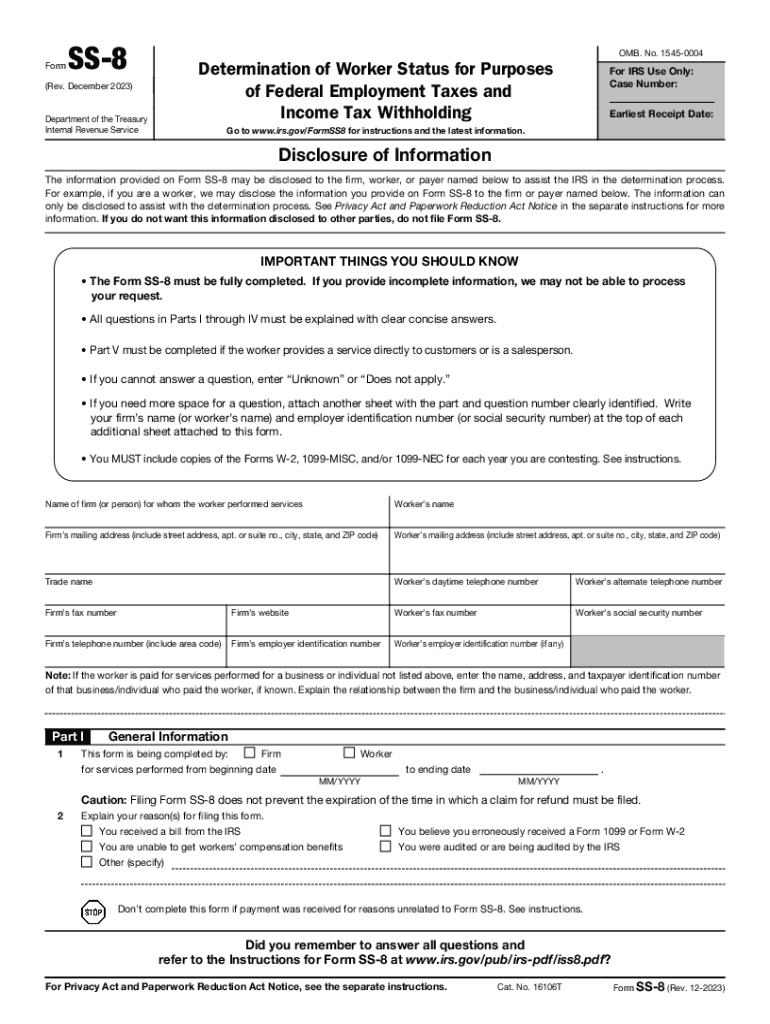







Definition & Meaning
Form SS-8, known as "Determination of Worker Status for Purposes of Federal Employment Taxes and Income Tax Withholding," is used by the IRS to ascertain if a worker is classified as an employee or an independent contractor. This distinction is crucial because it impacts how federal employment taxes and income tax withholdings are managed. For businesses and organizations, correctly classifying workers helps ensure compliance with federal tax laws and avoid potential legal complications. The determination can affect the withholding of Medicare and Social Security taxes, therefore, accurate categorization is pivotal for both compliance and financial planning.
How to Use the Form SS-8
To utilize Form SS-8 effectively, the form must be completed with accurate information about the worker's job duties, relationship specifics, and circumstances of employment. It requires detailed responses that describe the nature of the work, the degree of control a business has over the worker, and how the worker is paid. Practically, this includes providing insights into whether the worker supplies their own equipment, if the work is integral to the business, and if the worker has the freedom to take on additional projects. Submitting a comprehensive and truthful account increases the chances of a swift and accurate determination by the IRS.
Steps to Complete the Form SS-8
-
Gather Necessary Information: Collect all necessary documentation detailing the worker’s tasks, responsibilities, and how they have been compensated.
-
Fill in Worker Information: Complete the sections about the worker’s personal details, job description, and the company's basic information.
-
Describe Work Relationship: Provide a comprehensive overview of the worker-company relationship, focusing on control and financial aspects.
-
Include Additional Attachments: Attach any supplementary documents that can provide a clearer picture of the working arrangement, such as contracts or job descriptions.
-
Review and Verify: Double-check the filled form for accuracy and completeness to avoid processing delays.
-
Submit to IRS: Send the completed form to the IRS. The processing time can vary, so confirm receipt and keep copies for your records.
IRS Guidelines
The IRS provides comprehensive guidelines to aid in the completion of Form SS-8. Understanding these guidelines can clarify the distinctions between an employee and an independent contractor, which hinge on behavioral control, financial control, and the nature of the relationship. Exploring IRS publications and resources can help in understanding these distinctions more deeply, ensuring that the form is filled out in alignment with IRS expectations. Furthermore, the IRS outlines legal obligations concerning tax payments and reporting, ensuring compliance mitigates risk of penalties.
Important Terms Related to Form SS-8
- Employee: A worker whose work is directed by an employer, taking into account how, when, and where the work is done.
- Independent Contractor: A worker who offers services to the public and is not controlled by the business owner in terms of work methods.
- Behavioral Control: The degree to which a business can dictate the work methods used.
- Financial Control: Considers whether the worker has a significant investment in their tasks and the opportunity for profit or loss.
- Relationship Factors: Includes considerations about contracts, benefits, and the permanence of the relationship.
Key Elements of the Form SS-8
The core sections of Form SS-8 include detailed inquiries about the work performed and the conditions of employment. This includes sections focusing on:
- Behavioral Control: Examples include specific instructions and training protocols.
- Financial Control: Examine items like method of payment, worker investments, and unreimbursed expenses.
- Nature of Relationship: Review aspects such as the presence of written contracts or the entitlement to benefits.
Accurate and detailed responses in these sections directly influence the IRS determination.
Eligibility Criteria
Form SS-8 can be filed by either the business seeking clarification on worker classification or by workers themselves. A common scenario involves ambiguity around contract terms, where either party wishes to seek official IRS oversight to accurately determine tax obligations. Workers who don't receive employee benefits or have unclear contractual terms may find the form beneficial in affirming their classification. Businesses unsure about employee vs. contractor implications can also appropriately utilize this process to ensure proper compliance and avoid misclassification.


Penalties for Non-Compliance
Non-compliance with classification laws and Form SS-8 determination may lead to financial penalties. These can include back taxes, interest on unpaid taxes, and additional fines. Businesses that incorrectly categorize employees might also face audits, which could uncover other compliance issues. Therefore, ensuring accurate worker classification not only safeguards financial interests but also maintains legal standing. Being proactive in filing Form SS-8 can provide an extra layer of protection against such liabilities.
Who Typically Uses the Form SS-8
Form SS-8 is commonly used by both businesses and individuals who face challenges in determining correct worker classification.

Businesses:
- Startups: Often deal with remote workers and varied contracts.
- Small Enterprises: Without dedicated HR departments to make clear classifications.
Workers:
- Freelancers: Seeking clarity on tax liability.
- Gig Workers: Wanting to ensure they've accurately understood their standing.
Such stakeholders might file Form SS-8 to seek clarity and avoid potential future discrepancies with their tax liabilities or employment rights.




