
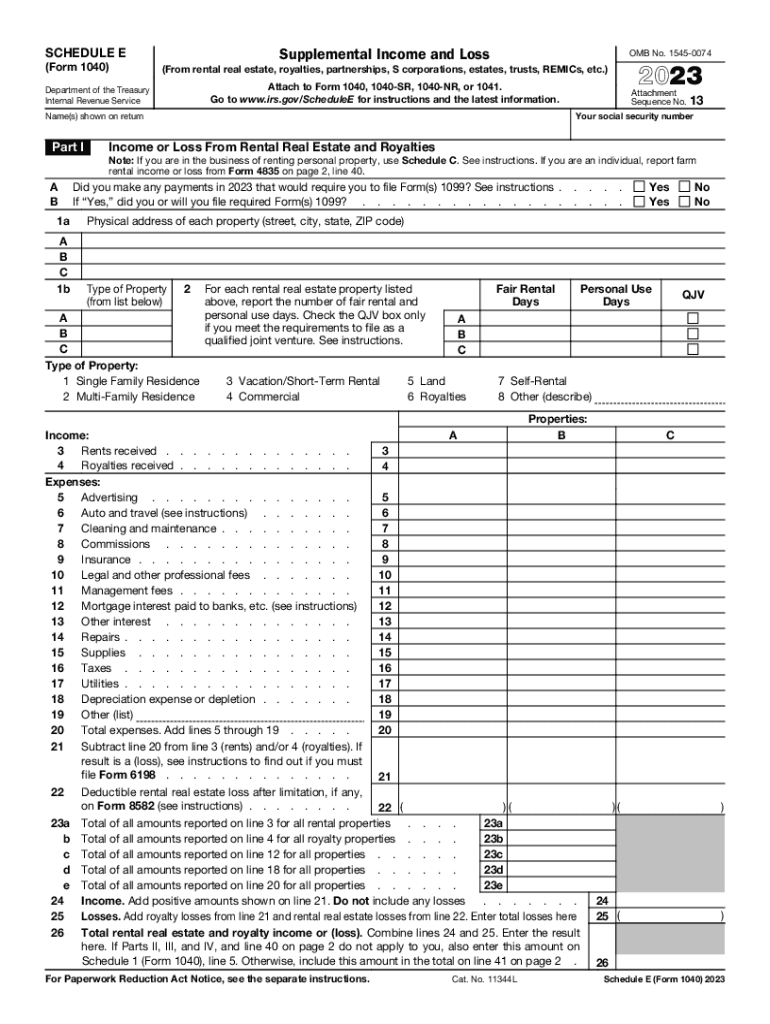







Definition and Purpose of Schedule E (Form 1040)
Schedule E (Form 1040) is primarily used to report supplemental income and losses from activities such as rental real estate, royalties, partnerships, S corporations, and trusts. This form enables taxpayers to detail different sources of income and corresponding expenses, providing a clearer picture of overall supplemental earnings. It is crucial for anyone involved in these types of business activities to accurately report their financial transactions to comply with IRS requirements.
Key Elements of Schedule E
The form is divided into different sections to align with the type of income or loss being reported. Each section focuses on particular types of income such as:
-
Part I: Income or Loss from Rental Real Estate and Royalties
- Allows for the reporting of income and expenses associated with properties owned or royalties received.
-
Part II: Income or Loss from Partnerships and S Corporations
- Used to report any profit or loss from partnerships or S corporations in which you hold an interest.
-
Part III: Income or Loss from Estates and Trusts
- Details any income received from fiduciaries involved in managing estates or trusts.
-
Part V: Summary and Totals
- Summarizes all calculations to determine final supplemental income or loss.
Each section requires specific types of documentation and precise financial figures to ensure accuracy.
Steps to Complete Schedule E
Completing Schedule E involves several key steps, outlined below for clarity:
-
Gather Necessary Documents
- Collect relevant forms like 1099-MISC or Schedule K-1 that provide income details.
-
Review Partnership or S Corporation Earnings
- Cross-check with financial statements or tax returns for these business interests.
-
Accounting for Depreciation
- Use the IRS Publication 527 to calculate allowable depreciation for rental properties.
-
Itemize Income and Expenses
- Detail all income streams including rental and royalties with associated expenses such as maintenance or legal fees.
-
Complete Calculations in all Applicable Sections
- Make sure to calculate income and loss comprehensively for every relevant section.
-
Summarize Figures in Part V
- Ensure all calculations align, and final numbers are accurately reflected in the summary.
-
Submission
- File the Schedule E with Form 1040 per IRS guidelines.
Who Typically Uses Schedule E
Schedule E is commonly used by individuals with diversified income portfolios beyond standard employment, such as:
- Real Estate Investors: Those who own and rent out multiple properties.
- Partnership Members: Individuals involved in partnerships or S corporations.
- Receivers of Royalties: Individuals receiving royalty income from intellectual property.
- Estate and Trust Beneficiaries: Persons receiving income through estates or trusts.
Understanding the usage of this form helps tailor it to specific needs and compliance with IRS standards.
Important Terms Related to Schedule E
Several specific terms are essential to effectively fill out Schedule E:
- Depreciation: The gradual reduction in the value of property, which can affect reported income.
- Passive Activity Loss: Losses from rental activities or businesses in which the taxpayer does not actively participate, subject to specific limitations.
- K-1 Form: A document used to report individual income, deductions, and credits from a partnership or S corporation.
- At-Risk Rules: IRS rules that limit the amount of deductibility of losses in certain activities based on the taxpayer's financial risk.
A solid grasp of these terms aids in accurate completion and compliance.
Legal Use and Compliance
Ensuring proper legal use of Schedule E involves understanding IRS statutes and maintaining adequate documentation. IRS requires substantiation of reported figures with supporting documents, such as:
- Receipts for Expenses: Proving deductions with receipts from legitimate business activities.
- Contracts/Agreements: Justifying income and partnership involvement with legal contracts and agreements.
Non-compliance can lead to penalties, including fines or audits, making accurate reporting critical.
Filing Deadlines and Important Dates
Schedule E must be submitted alongside your annual tax return (Form 1040) by April 15th. If the deadline falls on a weekend or holiday, submission moves to the next business day. Filing an extension using Form 4868 gives additional time until October 15th, but any taxes owed are still due on the original filing date.
Examples and Scenarios of Using Schedule E
Multiple examples of how individuals utilize Schedule E provide practical understanding:
- Real Estate Income: An owner collecting rents while managing expenses like repairs and taxes.
- Royalty Earnings: Authors or inventors receiving periodic payments for their works.
- Partnerships: A dentist part of a multi-member practice claiming a share of the profit/loss.
In each scenario, detailed financial records support Schedule E filings, enhancing accuracy and compliance.
Understanding these aspects provides a comprehensive view of how to effectively use Schedule E (Form 1040) for reporting various income types, fulfilling legal obligations, and enhancing financial transparency.


