
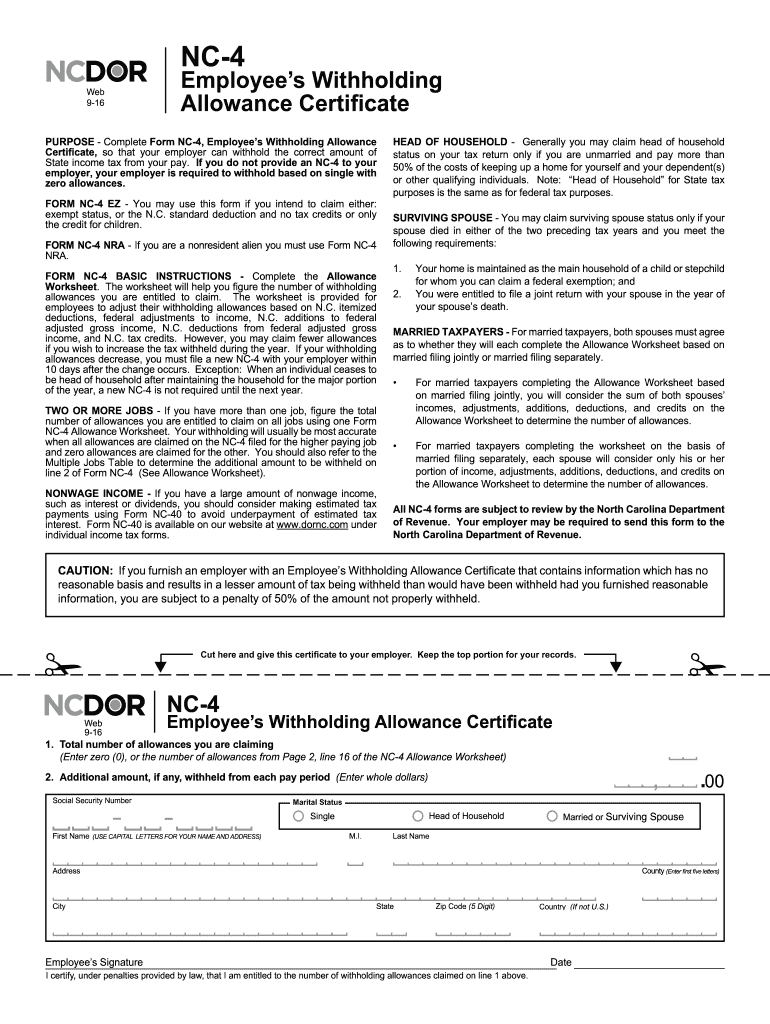







Definition and Meaning of Form NC-4
Form NC-4, formally known as the Employee's Withholding Allowance Certificate, is a crucial document utilized by employees in North Carolina to inform their employers about the appropriate amount of state income tax to withhold from their wages. This form aims to ensure that the correct withholding aligns with an employee's tax situation, thus helping avoid underpayment or overpayment of state income taxes throughout the year.
The NC-4 form encompasses various allowances that employees may claim based on their specific financial situations, such as dependents, filing status, and other personal circumstances. Employees may choose between different types of NC-4 forms designed for various categories, including NC-4 EZ for those claiming exempt status and NC-4 NRA for non-resident aliens. These options highlight the form's adaptability to meet diverse taxpayer needs, ensuring compliance with North Carolina's tax regulations.
How to Obtain Form NC-4
Acquiring Form NC-4 is straightforward through several channels. The form is accessible online from the North Carolina Department of Revenue's official website. Here are the various ways to obtain it:
-
Online Download: Directly visit the North Carolina Department of Revenue website, where the NC-4 is available as a fillable PDF file. This allows employees to complete the form digitally for ease of use.
-
Paper Copies: Employers may also have hard copies of the form available for their employees, especially during onboarding.
-
Tax Preparation Offices: Many tax professionals and preparation services also have copies on hand for their clients.
-
State Tax Office: Employees can visit their local state tax office to pick up a physical copy if needed.
Regardless of the method chosen, obtaining the NC-4 is essential for ensuring accurate withholding on wages.
Steps to Complete Form NC-4
Filling out Form NC-4 involves several clear steps to ensure accurate information is provided:
-
Personal Information: Employees must start by entering their personal details, including name, address, and Social Security number.
-
Filing Status: Indicate the appropriate filing status. This will typically be single, married, or head of household. Understanding the implications of each status is crucial as it affects withholding allowances.
-
Allowances Calculation: Use the allowance worksheet provided on the back of the form to calculate the number of allowances to claim based on personal circumstances, including dependents and tax credits.
-
Additional Amounts: If applicable, employees can also specify any additional tax amounts they would like withheld from their paychecks. This may be pertinent for those with additional income sources.
-
Signature and Date: Ensure to sign and date the form at the bottom. A handwritten signature is important for validating the document.
-
Submission: Submit the completed NC-4 to the employer or payroll department rather than the state tax office.
These steps are vital in accurately reflecting the employee's tax situation, ensuring compliance with state tax laws.
Important Terms Related to Form NC-4
Understanding key terms associated with the NC-4 can enhance clarity for its users. Here are several essential terms:
-
Withholding Allowance: A deduction amount that reduces taxable income. The more allowances claimed, the less tax is withheld from an employee's paycheck.
-
Filing Status: A category that defines an individual's tax situation (e.g., single, married). It is critical for calculating the correct withholding.
-
Tax Exempt Status: A declaration that an employee qualifies not to have state income tax withheld due to specific criteria, such as income level.
-
Dependents: Individuals for whom the taxpayer is financially responsible. Dependent status can increase the number of allowances an employee may claim.
-
NC-4 EZ Form: A simplified version of the NC-4 for employees claiming exempt status, simplifying the process for eligible individuals.
Familiarity with these terms helps employees effectively complete the form while understanding its implications on their finances.
Examples of Using Form NC-4
Understanding practical applications of Form NC-4 can enhance user comprehension. Below are examples illustrating its use:
-
Example 1: A single employee with no dependents might complete the NC-4 by claiming one allowance. This ensures a moderate amount of tax is withheld, balancing tax liability and take-home pay.
-
Example 2: A married employee with two children can potentially claim four allowances, significantly reducing the withholding. By doing so, the family may manage their monthly budget more effectively, but it is critical to calculate potential refunds or liabilities accurately during tax season.
-
Example 3: A non-resident alien working in North Carolina would utilize the NC-4 NRA variant. This scenario allows the employee to indicate their specific withholding needs while complying with both federal and state tax requirements.
Real-world scenarios demonstrate the form's versatility and the importance of tailoring withholding based on personal circumstances to avoid year-end tax surprises.
Filing Deadlines / Important Dates for Form NC-4
Awareness of filing deadlines is paramount for employees submitting Form NC-4. Here are some essential dates to consider:
-
New Employees: Newly hired employees should complete and submit Form NC-4 promptly, usually within the first pay period after employment begins, to ensure correct withholding right from the start.
-
Annual Review: Employees may need to review and potentially submit a new NC-4 during tax season each year. Changes in personal situations, such as marriage, having a child, or changes in residence, should prompt a reevaluation of withholding allowances.
-
Tax Filing Season: While Form NC-4 itself is not submitted to the state, it directly influences the employee's year-end tax situation. Ensuring proper withholding throughout the year can alleviate stress during tax preparation.
Maintaining awareness of these deadlines helps employees manage their tax obligations effectively and ensures compliance with state requirements.




