




01. Edit your 2016 form 8917 online
Type text, add images, blackout confidential details, add comments, highlights and more.

Type text, add images, blackout confidential details, add comments, highlights and more.

Draw your signature, type it, upload its image, or use your mobile device as a signature pad.

Send it via email, link, or fax. You can also download it, export it or print it out.
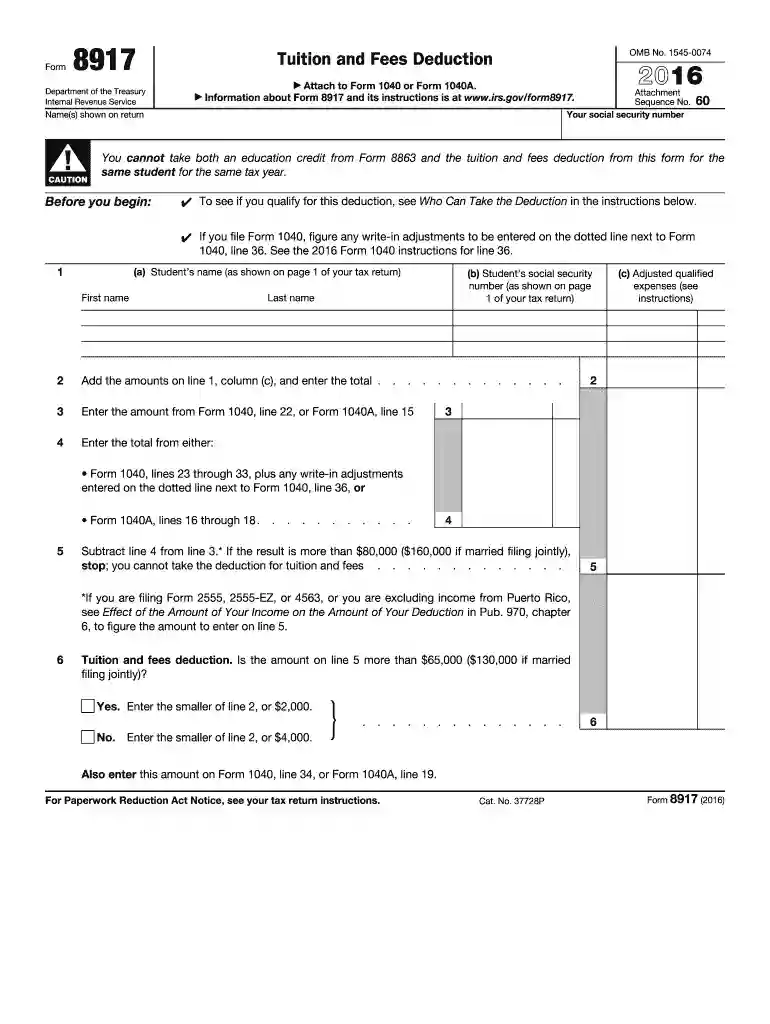
Form 8917, also known as the Tuition and Fees Deduction form, is utilized by taxpayers in the United States to calculate and claim deductions for qualified education expenses paid within the year 2016. This deduction applies to tuition and required fees related to postsecondary education, providing tax relief by reducing taxable income. It is critical for taxpayers seeking to ease the financial burden of educational costs through applicable tax benefits.
Using Form 8917 effectively requires careful attention to detail to ensure accurate reporting of educational expenses. Taxpayers are required to list eligible expenses incurred for themselves, their spouse, or dependents. The form helps in determining adjusted qualified education expenses after excluding personal expenses like room and board. This deduction is then used to lower the overall taxable income, potentially resulting in a reduced tax liability.
Eligibility for using Form 8917 depends on meeting certain conditions. Taxpayers must be paying for qualifying educational expenses for higher education, and the expenses must be borne by either the taxpayer, spouse, or eligible dependents. Additionally, there are income caps that determine eligibility, ensuring that the deduction is only available to those with a MAGI under the established threshold. It is important for taxpayers to understand these criteria to ensure compliance and maximize their tax benefits.


Form 8917 encompasses several key sections designed to capture comprehensive information regarding educational expenses:
Form 8917 can be acquired through several avenues:
To illustrate the practical use of Form 8917, consider the following scenarios:
While Form 8917 specifically addresses tuition and fee deductions, taxpayers should also be aware of related forms or options that may offer similar benefits, such as:
The IRS issues detailed guidelines and instructions accompanying Form 8917 to assist taxpayers in accurately completing their tax returns. Compliance with these guidelines ensures that claims are valid and can help avoid penalties. The instructions cover necessary calculations, eligible expenses, and how to properly integrate the deduction into the taxpayer's overall tax return.
Failing to properly report or incorrectly claiming deductions using Form 8917 can result in penalties. The IRS may impose fines or require repayment of claimed deductions if inaccuracies or fraudulent claims are identified. Understanding the form's requirements and adhering to all submission protocols is crucial to avoid these penalties and ensure compliance with tax laws.
We've got more versions of the 2016 form 8917 form. Select the right 2016 form 8917 version from the list and start editing it straight away!
| Versions | Form popularity | Fillable & printable |
|---|---|---|
| 2020 | 4.8 Satisfied (51 Votes) | |
| 2018 | 4.3 Satisfied (241 Votes) | |
| 2017 | 4.4 Satisfied (86 Votes) | |
| 2016 | 4.4 Satisfied (587 Votes) | |
| 2015 | 3.9 Satisfied (46 Votes) | |
| 2014 | 4 Satisfied (51 Votes) | |
| 2013 | 4 Satisfied (42 Votes) | |
| 2012 | 4 Satisfied (34 Votes) | |
| 2011 | 3.9 Satisfied (36 Votes) | |
| 2010 | 4 Satisfied (28 Votes) | |
| 2009 | 4 Satisfied (60 Votes) |
At DocHub, your data security is our priority. We follow HIPAA, SOC2, GDPR, and other standards, so you can work on your documents with confidence.
Use Form 8917 to figure and take the deduction for tuition and fees expenses paid in 2016. This deduction is based on adjusted qualified education expenses paidRead more
2014; Li et al., 2016). In this study, a linear F(8917 . 106 The direct link is the simplest form of link in the CTM which connects two cells.


