




01. Edit your form 8689 irs online
Type text, add images, blackout confidential details, add comments, highlights and more.

Type text, add images, blackout confidential details, add comments, highlights and more.

Draw your signature, type it, upload its image, or use your mobile device as a signature pad.

Send irs form 8689 via email, link, or fax. You can also download it, export it or print it out.
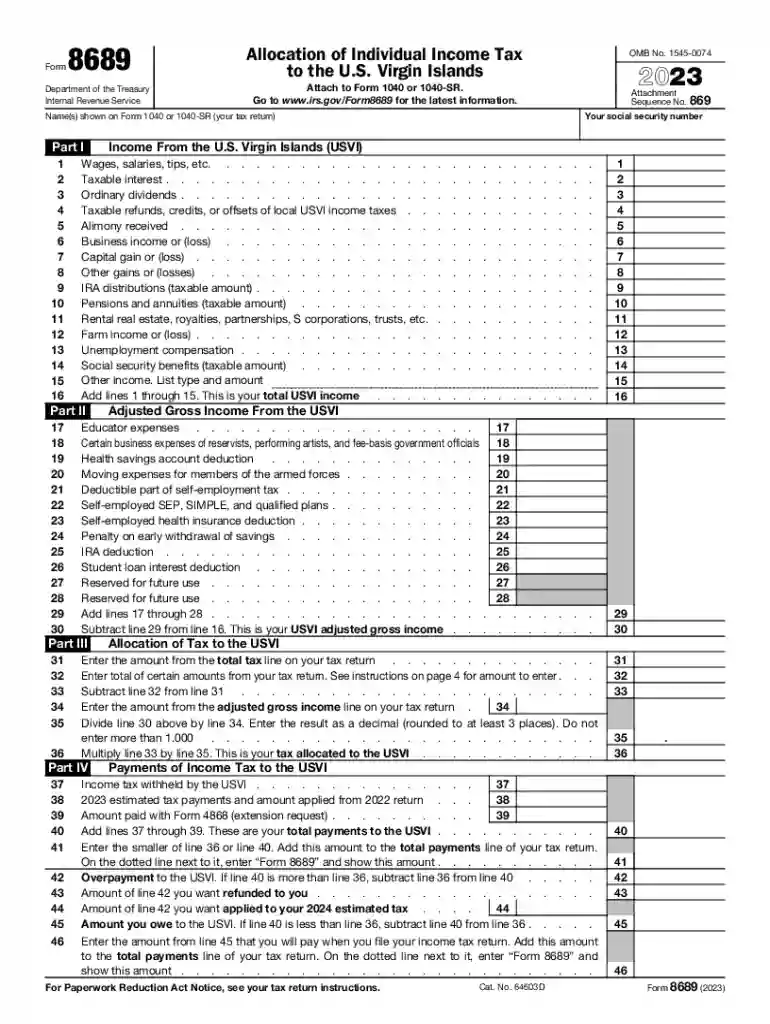
Form 8689 is primarily used by U.S. citizens or resident aliens who have income sourced from the U.S. Virgin Islands (USVI). It facilitates the allocation of tax responsibilities between the United States and the USVI, ensuring proper reporting and tax compliance for individuals with income ties to these jurisdictions. This form documents critical aspects of both U.S. federal and USVI tax obligations, making it a necessary tool for individuals who derive income from these territories.
Effective allocation on Form 8689 ensures appropriate tax contributions to both the United States and USVI. Failure to accurately allocate taxes can result in penalties or overpayment. The process involves determining which portion of a taxpayer's income is attributable to USVI sources and subsequently calculating the tax owed to each taxing authority.
Gather Required Documentation:
Complete Income Sections:
Calculate Allocations:
Review and Verify:
Desktop applications such as TurboTax or QuickBooks may offer support for managing allocations and completing Form 8689 efficiently. These tools can aid in ensuring calculations conform to current tax guidelines and help in comparing results against manual computations.
The IRS stipulates that Form 8689 must be filed alongside the individual's U.S. federal income tax return. This ensures proper documentation and transparency of cross-jurisdictional income and tax obligations.
All taxpayers using Form 8689 must comply with IRS guidelines, including submitting supporting documentation demonstrating their eligibility and the accuracy of reported amounts. Maintaining precise records helps in case of an audit or inquiry by the IRS.
Form 8689 must adhere to the same filing deadlines as the U.S. federal tax return. Typically due by April 15, extensions may be available, yet taxpayers must apply directly with both U.S. and USVI jurisdictions.
Failing to file Form 8689 on time can result in penalties. Taxpayers are encouraged to file an extension if they envisage delays, ensuring that both due dates and extension conditions are understood for both US and USVI filings.


Form 8689 is mandatory for all U.S. citizens and resident aliens who have sourced income originating from the USVI, requiring the allocation of income taxes effectively between the two regions.
Certain types of income might be exempt based on the residency or specific tax treaties. Reviewing specific IRS bulletins or consulting with a tax professional can offer clarity on these scenarios.
Non-compliance with Form 8689 requirements can lead to significant penalties, including fines for underreporting income or failing to allocate tax appropriately. Ensuring accuracy is paramount to avoiding such repercussions.
If errors are discovered post-submission, taxpayers should file an amended return promptly to rectify the mistake and avoid further sanctions. Consulting with a tax advisor can provide guidance on rectifying the issue compliantly.
Ensuring all sections are thoroughly reviewed and signed off by the taxpayer is critical in validating the authenticity and accuracy of the submission. Comprehensive review before submission ensures compliance and reduces errors.
We've got more versions of the form 8689 irs form. Select the right form 8689 irs version from the list and start editing it straight away!
| Versions | Form popularity | Fillable & printable |
|---|---|---|
| 2025 | 4.4 Satisfied (56 Votes) | |
| 2024 | 4.7 Satisfied (45 Votes) | |
| 2023 | 4.8 Satisfied (57 Votes) | |
| 2022 | 4.3 Satisfied (49 Votes) | |
| 2021 | 4.9 Satisfied (51 Votes) | |
| 2020 | 4.4 Satisfied (208 Votes) | |
| 2019 | 4.4 Satisfied (34 Votes) | |
| 2018 | 4.3 Satisfied (196 Votes) | |
| 2017 | 4.4 Satisfied (168 Votes) | |
| 2016 | 4.4 Satisfied (532 Votes) | |
| 2015 | 4.1 Satisfied (46 Votes) | |
| 2014 | 3.9 Satisfied (31 Votes) | |
| 2013 | 4.3 Satisfied (66 Votes) | |
| 2012 | 4 Satisfied (29 Votes) | |
| 2011 | 4 Satisfied (35 Votes) |
At DocHub, your data security is our priority. We follow HIPAA, SOC2, GDPR, and other standards, so you can work on your documents with confidence.


