IRS Posts Form 4972, Used to Claim Special Tax-2026

Get Form
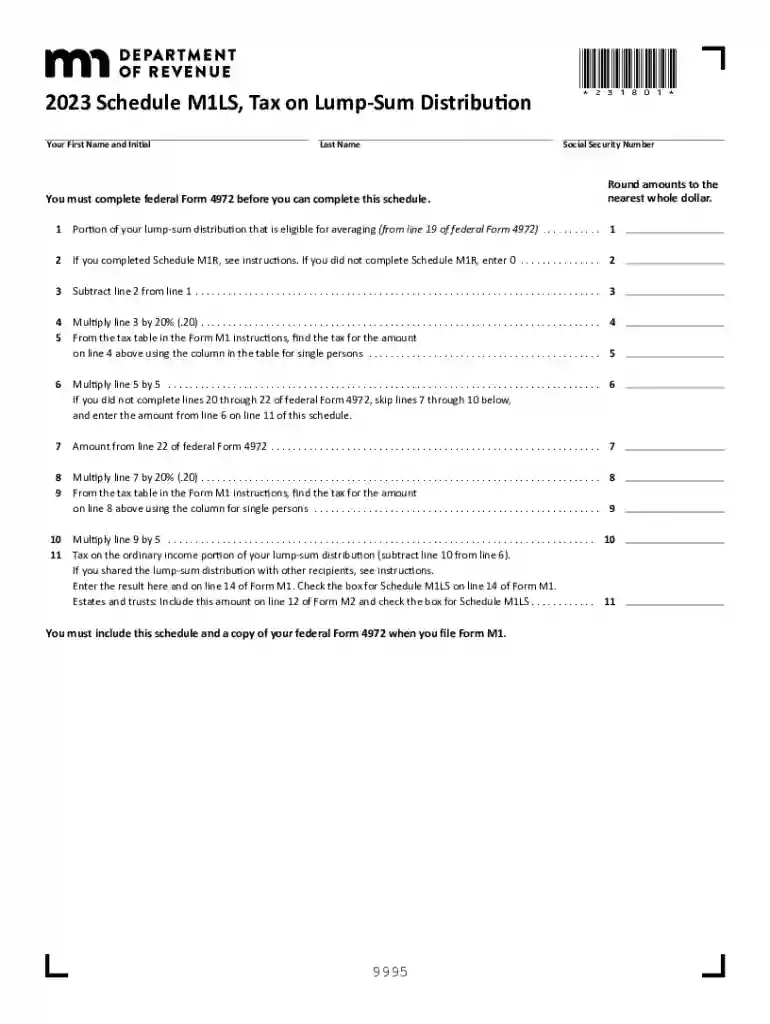
m1ls Preview on Page 1

Here's how it works

01. Edit your m1ls online
Type text, add images, blackout confidential details, add comments, highlights and more.

02. Sign it in a few clicks
Draw your signature, type it, upload its image, or use your mobile device as a signature pad.

03. Share your form with others
Send schedule m1ls via email, link, or fax. You can also download it, export it or print it out.

How to use or fill out IRS Posts Form 4972, Used to Claim Special Tax with our platform

Form edit decoration
9.5
Ease of Setup
DocHub User Ratings on G2
9.0
Ease of Use
DocHub User Ratings on G2
  1. Click ‘Get Form’ to open it in the editor.
  2. Begin by entering your first name, middle initial, and last name at the top of the form. Ensure that your Social Security Number is accurately filled in as this is crucial for identification.
  3. In line 1, input the portion of your lump-sum distribution eligible for averaging from federal Form 4972. This amount should be rounded to the nearest whole dollar.
  4. If you completed Schedule M1R, refer to its instructions for line 2; otherwise, enter '0'.
  5. Subtract line 2 from line 1 and record the result on line 3. This calculation is essential for determining your tax liability.
  6. Multiply the amount on line 3 by 20% and enter this value on line 4. This step helps in calculating your tax based on the distribution.
  7. Consult the tax table in the Form M1 instructions to find the corresponding tax for the amount on line 4 and write it down on line 5.
  8. Continue with similar calculations through lines 6 to 11 as instructed, ensuring all amounts are rounded appropriately and follow any specific guidelines provided.

Start using our platform today to easily fill out IRS Forms for free!

See more IRS Posts Form 4972, Used to Claim Special Tax versions

We've got more versions of the IRS Posts Form 4972, Used to Claim Special Tax form. Select the right IRS Posts Form 4972, Used to Claim Special Tax version from the list and start editing it straight away!
Versions Form popularity Fillable & printable
2023 4.3 Satisfied (30 Votes)
2022 4.6 Satisfied (35 Votes)
2021 4.6 Satisfied (167 Votes)
2020 4.3 Satisfied (68 Votes)
be ready to get more

Complete this form in 5 minutes or less

Get form

Got questions?

We have answers to the most popular questions from our customers. If you can't find an answer to your question, please contact us.
Contact us
26 U.S. Code 4972 - Tax on nondeductible contributions to qualified employer plans. In the case of any qualified employer plan, there is hereby imposed a tax equal to 10 percent of the nondeductible contributions under the plan (determined as of the close of the taxable year of the employer).
Tax Information The taxable portion of the Basic Death Benefit, Retired Death Benefit, Option 1 balance, and Temporary Annuity balance is subject to a mandatory 20 percent federal tax withholding rate.
If you were older than 59-1/2 before you received a lump sum from a qualified employee retirement plan, you may have some other options that can reduce your tax bill. To use any of these special treatments, you must complete IRS Form 4972, Tax on Lump-Sum Distributions, and attach it to your tax return.
Form 4972, Tax on Lump-Sum Distributions, is used to calculate and report taxes on a lump-sum distribution from a qualified retirement plan. This could include distributions from a pension, 401(k), or IRA. Learn more about how a lump-sum distribution can impact your taxes and whether you qualify to use Form 4972.
The important dates for Form 4972 in 2024 and 2025 include the tax filing deadlines, typically April 15th of each year. Additional deadlines may apply for amended returns and specific submission requirements.

Security and compliance

At DocHub, your data security is our priority. We follow HIPAA, SOC2, GDPR, and other standards, so you can work on your documents with confidence.

Learn more
ccpa2
pci-dss
gdpr-compliance
hipaa
soc-compliance
be ready to get more

Complete this form in 5 minutes or less

Get form

People also ask

Capital gains tax is typically reported and paid when you file your federal income tax return, due in April each year for individuals.
You can defer taxes on a lump-sum pension payment by rolling it into a traditional IRA. This allows the funds to grow tax-deferred, and you only pay taxes when you withdraw money from the IRA. However, if you cash out the lump sum without rolling it into another retirement account, the entire amount will be taxable.
The due date for filing ITR is July 31 every year, however this time the Income Tax Department had extended it to September 15, 2025 in view of changes required on the Income Tax e-filing portal for the new ITR forms.

Related links