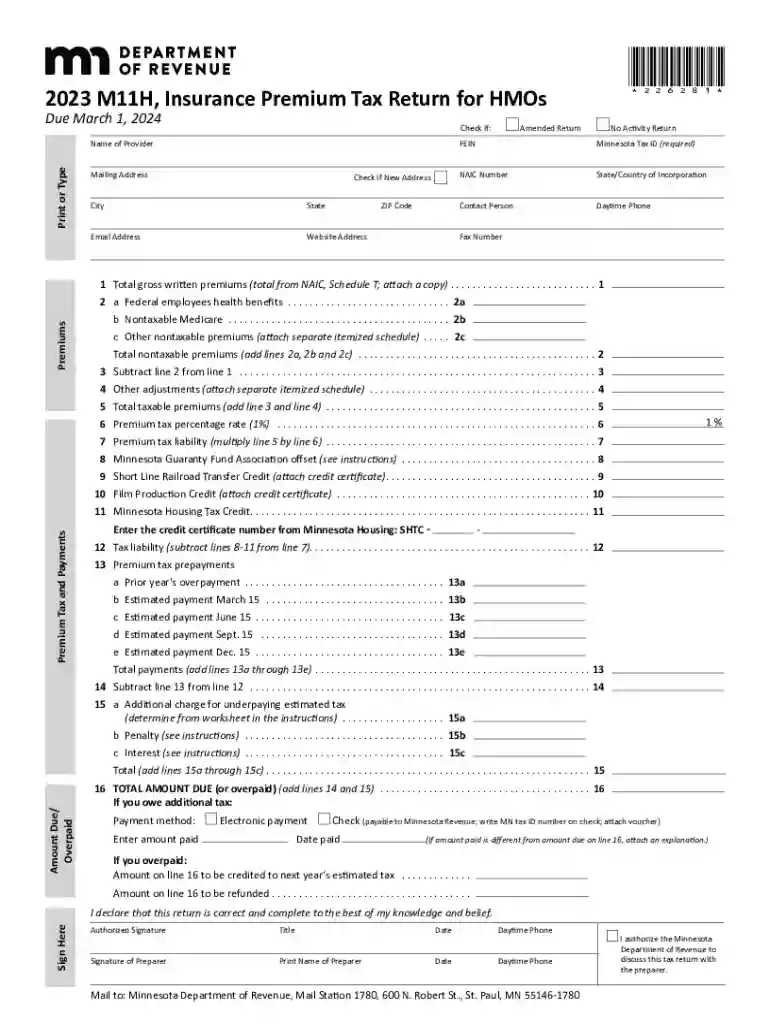
Form 25-100 Annual Insurance Premium Tax Report 2026

Get Form
Form 25-100 Annual Insurance Premium Tax Report Preview on Page 1

Here's how it works

01. Edit your form online
Type text, add images, blackout confidential details, add comments, highlights and more.

02. Sign it in a few clicks
Draw your signature, type it, upload its image, or use your mobile device as a signature pad.

03. Share your form with others
Send it via email, link, or fax. You can also download it, export it or print it out.

How to use or fill out Form 25-100 Annual Insurance Premium Tax Report with our platform

Form edit decoration
9.5
Ease of Setup
DocHub User Ratings on G2
9.0
Ease of Use
DocHub User Ratings on G2
  1. Click ‘Get Form’ to open it in the editor.
  2. Begin by entering your provider's name and mailing address. If there is a new address, check the corresponding box.
  3. Fill in your city, state, ZIP code, email address, and website. Ensure all information is accurate for proper processing.
  4. Indicate if this is an amended return or a no activity return by checking the appropriate boxes at the top of the form.
  5. Enter your Federal Employer Identification Number (FEIN) and Minnesota Tax ID number. These are essential for identification purposes.
  6. Proceed to report total gross written premiums on line 1. Attach any necessary schedules as indicated.
  7. Complete sections for non-taxable premiums (lines 2a, 2b, and 2c) and calculate total taxable premiums on line 5.
  8. Finally, review all entries for accuracy before signing and submitting your form electronically or via mail.

Start using our platform today to streamline your form completion process for free!

See more Form 25-100 Annual Insurance Premium Tax Report versions

We've got more versions of the Form 25-100 Annual Insurance Premium Tax Report form. Select the right Form 25-100 Annual Insurance Premium Tax Report version from the list and start editing it straight away!
Versions Form popularity Fillable & printable
2023 4.5 Satisfied (35 Votes)
2022 4.5 Satisfied (47 Votes)
2021 4.3 Satisfied (72 Votes)
2020 4.4 Satisfied (62 Votes)
be ready to get more

Complete this form in 5 minutes or less

Get form

Got questions?

We have answers to the most popular questions from our customers. If you can't find an answer to your question, please contact us.
Contact us
The answer is generally yes. The Internal Revenue Service views some insurance premiums as a cost of doing business and may accept them as tax deductions. This article helps small business owners understand which insurance premiums may be considered tax deductible.
While insurance premiums are typically exempt from VAT, VAT on related expenses, such as repairs or professional services, can often be reclaimed by VAT-registered businesses.
You may be able to deduct the amount you paid for health insurance, which includes medical, dental, and vision insurance and qualified long-term care insurance for yourself, your spouse, and your dependents.
Retirees can deduct health insurance premiums as part of their medical and dental expenses if they itemize their deductions on Schedule A (Form 1040). The total medical expenses must exceed 7.5% of their adjusted gross income (AGI) to be deductible.
Insurance services are taxable services that are subject to Texas sales and use taxes ( Sec. 151.0101(a)(9), Tax Code) if the object of the services is in Texas and the company for which the service is performed is either an insurance carrier, as that term is defined by regulation, ( 34 TAC Sec.

Security and compliance

At DocHub, your data security is our priority. We follow HIPAA, SOC2, GDPR, and other standards, so you can work on your documents with confidence.

Learn more
ccpa2
pci-dss
gdpr-compliance
hipaa
soc-compliance

People also ask

The tax rate is 1.75% for accident and health premiums and 2.00% for all other non-life premiums. The minimum tax is $250. Forms required to be filed along with instructions can be accessed on the New York State Department of Finance and Taxation website.
Business Insurance Premiums That Are Not Tax Deductible Certain life insurance or annuity premiums. Premiums paid on insurance to secure loans. Premiums paid for a policy that covers earnings lost due to sickness or disability.
The 10 Most Overlooked Tax Deductions State sales taxes. Reinvested dividends. Out-of-pocket charitable contributions. Student loan interest paid by you or someone else. Moving expenses. Child and Dependent Care Credit. Earned Income Tax Credit (EITC) State tax you paid last spring.

Related links